
Over the years I have noticed something very strange in the antidepressant literature. When antidepressants are compared with one another, their effects are remarkably similar. I first noticed this when Guy Sapirstein and I ran our meta-analysis of the published literature in 1998. When we first saw how weak the actual drug effect was, we thought we might have done something wrong. Perhaps we had made a mistake and included trials that tested different types of antidepressants. Perhaps we had underestimated the true effectiveness of antidepressants by including clinical trials of less effective drugs. Below we go on talking about depression, about serotonin and about the myths around them.
Before we submitted our paper for publication, we went back to the data and checked which type of antidepressant had been used in each trial: some were selective serotonin reuptake inhibitors (SSRIs), others were tricyclic drugs; those antidepressants that were neither SSRIs nor tricyclics we called “other antidepressants”. We then found that in the analyses we were examining there was a fourth category of drugs which had been given to people with depression and assessed for their effect on depression, but had not been considered at all, such as tranquillisers and thyroid medication. When we analysed the drug and placebo response for each type of drug, another surprise was waiting for us: it made no difference which type of drug the patient received in the trial, the response was always the same, and 75 % of that response was also found in the placebo groups. I remember how struck I was by the similarity of the results, but I have since learned that this is not unusual at all. Again and again I came across this phenomenon. In the STAR*D study, the most expensive clinical trial of antidepressants ever run at 35 million US dollars, patients who did not respond to the SSRI they had been prescribed were given a different drug.
Some were switched to an SNRI, a drug believed to increase both norepinephrine and serotonin in the brain; others were switched to an NDRI, which is said to increase norepinephrine and dopamine without touching serotonin. And other patients were simply given another SSRI. About one patient in four had a clinical response to the new drug, but it made no difference which new drug it was. The effect ranged from 26% to 28%; in other words, patients responded in the same way regardless of the type of drug.
The most commonly prescribed antidepressants are the SSRIs, which are believed to act selectively on the neurotransmitter serotonin. There is, however, an antidepressant that works in a completely different way. It is tianeptine, and it was approved by the French drug-licensing authority for prescription as an antidepressant. Tianeptine is an SSRis, a selective serotonin reuptake enhancer, which, instead of increasing the amount of serotonin in the brain, lowers it.
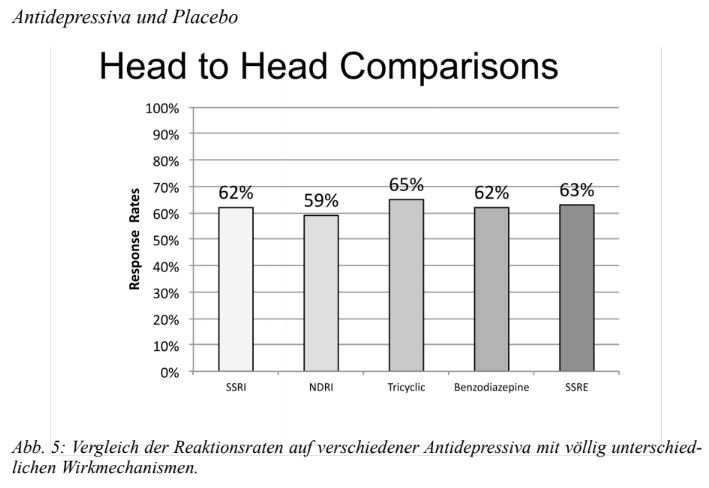
If the theory holds that depression is caused by a serotonin deficiency, then depression could get worse. That, however, is not what happens — one of the myths. In clinical trials comparing the effect of tianeptine with the effect of SSRis and tricyclic antidepressants, 63% of patients showed significant improvement (arbitrarily defined as a 50% reduction in symptoms), that is, the same response rate that is found in this type of trial with SSRis, NDRis and tricyclics (see Fig. 5). It simply makes no difference what the drug contains — whether it increases serotonin, lowers it, or has no effect on serotonin at all. The effect on depression stays the same.
Antidepressants as active placebos
All antidepressants appear to be equally effective, and although the difference between drug and placebo is not clinically meaningful, it is statistically significant. That raises the question: what do all these active drugs have in common, that their effect on depression is small yet statistically significantly better than placebo?
What all antidepressants have in common is that they produce side effects. Why does that matter? Imagine that you are taking part in a clinical trial. You are told that it is a double-blind study and that you might be given a placebo. You are also told what the side effects of the drug are. The therapeutic effect of the drug can only be felt after several weeks, whereas the side effects may show up sooner. Will you wonder which group you have been put in, the drug group or the placebo group, and if you feel any of the side effects you were told about, will you not conclude that you have been given the real drug? In one study, 89% of depressed patients in the antidepressant group correctly “guessed” that they had been given a real antidepressant (Rabkin et al., 1986); in another study, in which antidepressants and benzodiazepines were used to treat panic disorder, 95% of the patients in the active-drug group likewise correctly “guessed” which group they belonged to (Margraf et al., 1991).
It is not only patients who work out which group they have been put in, but also the practitioners who rate them on the HAM-D scale (Margraf et al., 1991; Rabkin et al., 1986). Patients on the real drug “guess” fairly well that they are in the drug group, but those in the placebo group are far more accurate. Clinicians, for their part, identify the assignment very accurately, both for the drug group and for the placebo group. Clinicians' reports were used in every antidepressant trial as the primary outcome for submission to the FDA. Scales on which patients rate their own depressive symptoms could give more accurate estimates of the difference between drug and placebo. In other words, clinical trials are not blind on both sides. Many patients realise it when they are given the real drug, and so do the clinicians who rate the severity of the depression, most probably because of the side effects of the drugs. What consequences can antidepressants have?
We do not have to guess for long. Bret Rutherford and his colleagues at Columbia University have given the answer. They tested the response to antidepressants in studies without a placebo group against studies with a placebo group (Rutherford, Sneed & Roose, 2009). The main difference was that in the first case patients and raters were certain that an active antidepressant was being given, whereas in the placebo-controlled trials they knew that it might be a placebo. Knowing that all patients were receiving an active drug increased its effectiveness considerably. This supports the hypothesis that the relatively small difference between drug and placebo in antidepressant trials is due, at least in part, to “guessing” which group one belongs to and therefore knowing that the patient is in the drug group. Because of the side effects the drug produces.
What to do?
So there is a strong therapeutic effect of antidepressants. The placebo response, however, is almost as strong. This creates a therapeutic dilemma. The drug effect of antidepressants is not clinically meaningful, whereas the placebo effect is. Given these findings, what should be done clinically?
One option would be to prescribe a placebo, but that would be deception. Besides being ethically questionable, there is also the risk of damaging trust, and trust is one of the most important clinical tools that clinicians have. Another suggestion has been to use antidepressants as an active placebo. But this alternative is problematic because of the risks that come with antidepressants.
The side effects of antidepressants include
The side effects of antidepressants include: sexual dysfunction (which may affect between 70% and 96% of patients taking SSRIs; Clayton et al., 2006; Serretti et al., 2009), substantial weight gain, insomnia, nausea and diarrhoea.
Many people who want to stop taking antidepressants develop withdrawal symptoms (Rosenbaum et al., 1998).
Antidepressants have also been linked to increased rates of suicide, violence and crime in children, adolescents and young adults (Molero et al., 2015; Stone, 2014; Stone et al., 2009).
Older people have an increased risk of stroke, as well as an increased risk of all kinds of health problems with a fatal outcome (Andrews et al., 2012).
Pregnant women who take antidepressants are at greater risk of miscarriage, and their children are more often born with autism, congenital defects and chronic pulmonary hypertension (Dolmar et al., 2013). Moreover, some of these risks are associated with taking antidepressants in early pregnancy, when women do not yet know that they are pregnant.
One of the most surprising health consequences of taking antidepressants, however, affects every age group: antidepressants increase the risk of relapse. After treatment with antidepressants the likelihood of depression returning is far higher than after treatment with other agents, including treatment with placebo (Andrews et al., 2012; Babyak et al., 2000; Dobson et al., 2008). The risk of relapse depends on how strongly the antidepressant in question alters the neurotransmitters in the brain.
Given these health risks, antidepressants should not be the first choice in the treatment of depression. The better alternative is to use non-drug treatments. My colleagues and I carried out a meta-analysis of various treatments for depression, including antidepressants, psychotherapy, the combination of psychotherapy and antidepressants, and also “alternative” forms of treatment such as acupuncture and physical exercise (Khan et al., 2012; see Fig. 6).
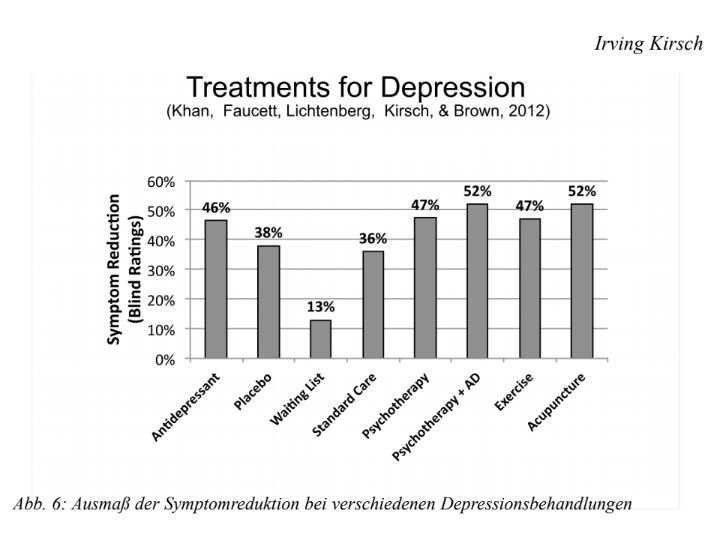
We found no substantial differences between these treatments, nor between the various approaches within psychotherapy. When different treatments are equally effective, the choice should be made in terms of risk and harm, and antidepressants are the riskiest and most damaging of all these treatments (this is no myth, and serotonin has nothing to do with it). If anything, they should be used as a last resort, when the depression is extremely severe and every other treatment option has been tried and has failed.
The best-researched alternative to antidepressants is cognitive behavioural therapy. In the short term it is just as effective, although more expensive, than drug treatment. In the long term, however, it is more effective and less expensive than pharmacotherapy (Dobson et al., 2008). People with depression also prefer cognitive behavioural therapy to pharmacotherapy by a ratio of 3:1 (McHugh et al., 2013). Finally, there is evidence that hypnosis added to behavioural therapy can increase its effectiveness (Alladin, 2013; Kirsch et al., 1995) and that treatment with hypnosis is clearly preferable to treatment with antidepressants (Dobbin et al., 2009).
Irving Kirsch
At the Freud's Legacy club, in response to your requests, we are setting up a group working with the method of cognitive behavioural therapy (life and social counsellor Dimitri Korenev) in tandem with other methods of psychology (the club's specialists) and body-oriented practices (Mikhail Grishchenko).