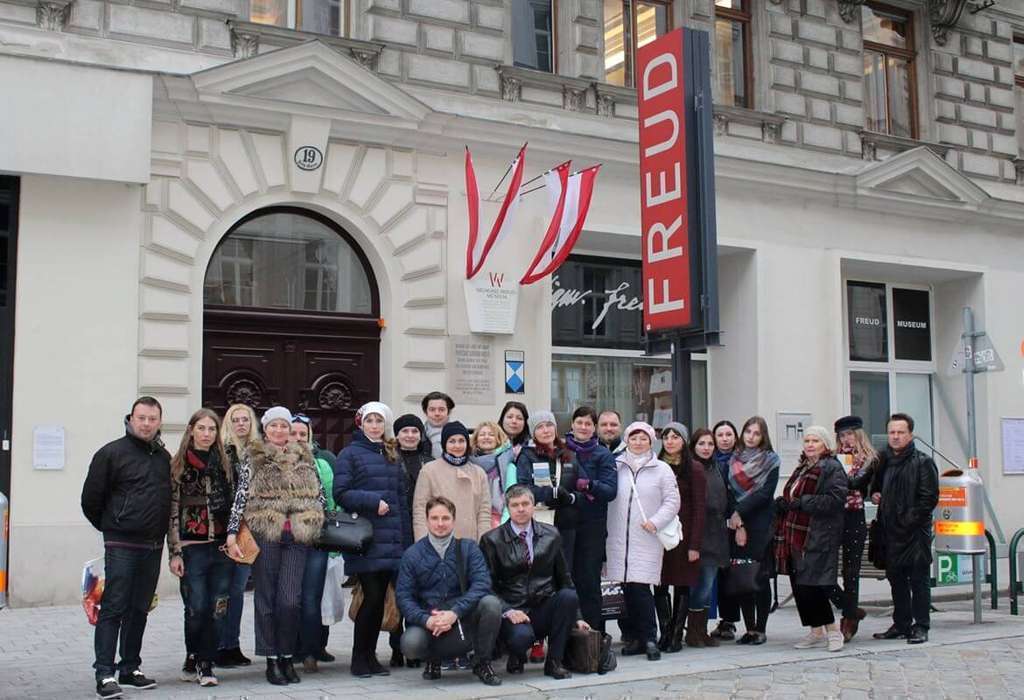
Van Gogh is famous for more than cutting off his own ear. It was Freud in Austria who raised psychiatry to the rank of a science, but what I am writing is an ode to art therapy, which was brought into the world by the famous Dutchman Van Gogh thanks to the Christian mercy of one of the most creative French psychiatric asylums in Provence.
In the 21st century 900 thousand French people a year consult 13 thousand psychiatrists. That is an average of 70 patients per specialist. 40% of psychiatrists work in the private sector, and there are not enough of them. Every day 72 thousand patients are treated as inpatients, 10 thousand of them in private clinics. In 1880, France had 120 psychiatrists for a population of 37 million. That is one specialist per 300 thousand inhabitants. Today the ratio is one per 5 thousand. How did it all begin?
The origins of psychiatry in France
Before the Great French Revolution there were no mentally ill people. There were “excessively free-thinking and dangerous people”, who were sent straight to one of five hundred prisons. That tradition could not be changed in the 19th century either, right up to the appearance of Freud in Austria. In 1801, two years after the Revolution, Pinel's “medical and philosophical treatise on feeble-mindedness” acknowledged the existence of mentally ill people who had the rights of man and of the citizen. In 1810 the Napoleonic Code, in Article 64, freed the insane from criminal responsibility. And in 1838 a law on the insane was introduced which regulated their confinement and the conditions of their treatment and guaranteed their freedoms and the safety of their property.
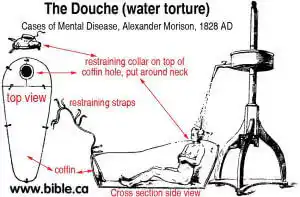
At the end of the 19th century the madhouses became “a hell with the best of intentions”, and turned more and more into a refuge for the poor and the elderly. Families, communes and hospitals sent there everyone they found unseemly and wanted to be rid of financially. For lack of funding, life in these refuges turned into a ritual flowing through a permanently regulated daily timetable. The staff were “all too often recruited from the worst”. Straitjackets, solitary cells and methods of intimidation came back into the practice of treatment. For most of these refuges the main priority, whatever the method of therapy, was maintaining discipline, as the only way to survive.
What did a day in the madhouse look like?
At 5:30 in summer and at 6:00 in winter, the warders (in the men's wing) and the sisters (in the women's wing) unlock the bedroom doors and woke the patients. Having checked the damage done in the night (dirty or torn linen, damaged objects or furniture), they decide who is to be sent to the isolation room. After the inspection comes washing. The “idiots” and the “impotents” (those unfit to act for themselves) have to be washed... Then dressing. While the patients have breakfast (30 minutes), it is time for cleaning and disinfection. Hygiene above all else...
At 7:00 the warders gather into groups those whom the doctors have released. Men and women are strictly separated. The groups were sent off to work. Ten hours of regular daily labour prepare the patient for a return to a normal state of mind. Through work the patient gets the chance to be part of society and builds the capacity to live independently after leaving the asylum. By the rules it is the head physician who determines who is fit for work and who allocates the duties. In reality he has no time for it, and the allocation is done by the overseers. It is often laid down that a mentally ill person has to do both heavy and simple work. Cleaning, laundry and cooking are considered a very important task. But there is also farming, bread baking, shoe repair. Paid staff often supervise and instruct the patients. Even so, some of the mentally ill are trusted with running the laundry.
At 13:30, after a short break, the patients go on working. Some may take a walk, play and relax. At 17:00 it is time for supper. The food is the same as at lunch, and so it goes in an unchanging sequence...
After supper there is a long break. Some play cards or dominoes, smoke, and the most cultivated read books. The women knit or embroider.
At 20:00 in summer and 19:00 in winter everyone must be in bed after a short prayer. The warders put the patients to bed, cover them with a blanket and make sure that all dangerous objects have been taken away from them. The shutters are closed, the rooms locked. At night the warders do their rounds in pairs.
There is not only a daily but also a weekly order. On Fridays beards, hair and nails are trimmed. On Saturdays and before a feast day clean linen is handed out. On Sundays there are entertainments. On 15 October winter blankets and clothing are issued. On 15 May, summer clothing and blankets.
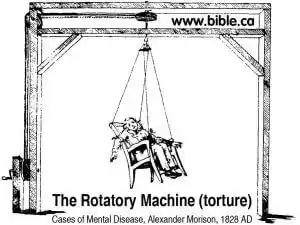
Patients are obliged to remain within sight of the warders. Disobedience is punished by withdrawal of walks or tobacco or, in special cases, by the solitary cell. In the last resort, the straitjacket. How were the insane treated? Intimidation, the straitjacket, the rotating chair and electric shock.
Patients may write letters once a week. In the name of protecting not only the patient but also the family, all incoming and outgoing correspondence is censored. The doctor decides whether a letter goes through or not. The patients' communication is limited; some are isolated for several months.
Van Gogh and the origins of art therapy
It was in this dispiriting era for psychiatry that Van Gogh became a psychiatric patient. Fortunately, a few treatment centres in Europe were guided more by principles of mercy, trying to find new ways of distracting patients from their illness by allowing them to pursue what interested them.
The monastery of Saint-Paul-de-Mausole in French Provence, in the town of Saint-Rémy-de-Provence, was converted into a charitable house for “the unfortunates who have fallen into madness” at the beginning of the 19th century. The institution pursued two aims: to carry on the cultural heritage of the monastery and to develop additional therapeutic methods based on art workshops. By May 1888, when Van Gogh arrived there for a year of treatment, the monastery had become well known and took in on average up to 80 patients.
At the monastery Van Gogh was given a separate room to paint in and a storage room for keeping his pictures, and was allowed to paint within an hour's walk beyond the grounds of the institution. This was entirely untypical of 19th-century psychiatric asylums. That is how the history of art therapy began.
The Dutchman was a truly hyperactive painter. In 10 years he produced 879 paintings and as many sketches again. During the 53 weeks of his treatment in the madhouse he painted 189 pictures and about a hundred sketches. That is a picture a day. From the age of 20 he wrote around 800 letters in four languages. And he took his own life at the age of 37.