Online course: 3 months, 12 classes, 90+ meetings
In-depth profiling. Personality typology
Drawing on the methods of Jung, Freud, Berne and Lowen, brought together in the S-Theory
Want to join the next intake? Come into our Telegram group
for practice, materials, news and conversation
The recognition and appreciation of the subjective determination of knowledge in general, and of psychological knowledge in particular, is the first condition for a scientific and fair assessment of a psyche different from that of the observing subject.
This condition, however, can be met only if the observer knows precisely the range and the nature of his own personality.
And he can know that only once he has largely freed himself from the levelling influence of collective judgements and collective feelings, and has thereby arrived at a clear understanding of his own individuality.
— Carl Gustav Jung
What will learning profiling give you?
See right through other people
Predict how the people around you will behave, find the ‘key’ to each of them and use it
Influence in society
Knowing about unconscious fears, drives, sore points and pleasures — that is all it takes!
Who is right for me?
In private life and in business, the harmonious partner for you is the one with whom everything is simple, easy and full of joy
A map of psychology
You will learn what most people who study psychology never find out: how the different schools are connected to one another.
Self-acceptance
You will go through your own personality type in detail: the reasons behind your behaviour, your strengths and your weak spots.
Tolerance
You will see how personality types shape worldview, religions, beliefs and behaviour. That is the basis of acceptance!
Is personality typology difficult?
The art of reading people is not some secret spy technology. It is simply millions of accumulated psychiatric observations, put to use in real life.
This knowledge is so effective that it can be used to find a harmonious partner in your private life, to build a team and to influence the people around you.
Profiling methods are no secret — you can even find them in the law books. But taking a test is like being handed a fish. On the course we learn to fish: we look at how personality typologies came about and which psychological theories they rest on, and through that understanding we apply them to ourselves, to the people around us and to society.
What is it built on?
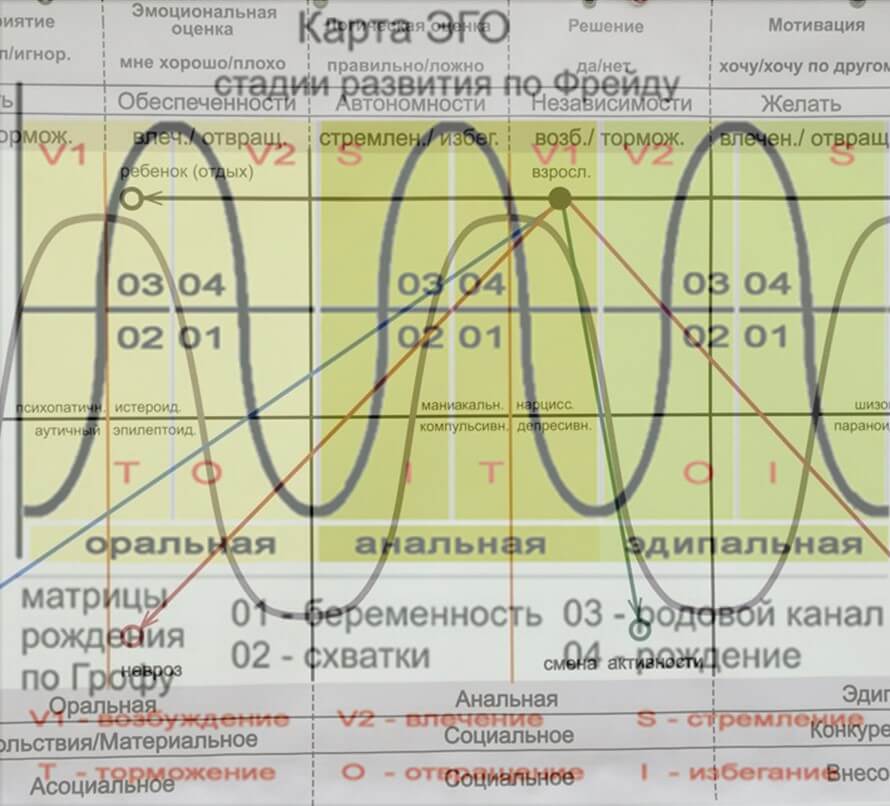
The course is built on the S-Theory — an author's school of thought developed at the Research Institute of Social Psychology and the Psychology of Personality Development under the guidance of Sergey Shishkov. It brings together key psychoanalytic approaches and typologies, including the Myers-Briggs Type Indicator (MBTI), the Minnesota Multiphasic Personality Inventory (MMPI), Freud's concept of fixation, Lowen's rights of the personality, the model of sub-personalities from transactional analysis and other schools.
What the first intake say

Dima, thank you so much for the ‘Profiling’ course and for this precious knowledge. Once I found out my personality type, life became so clear and so simple. I have accepted myself even more, I have learned about my own particularities, about my weak and my strong sides. The course was really interesting and useful for me. I also met some very interesting people, which I am very grateful for as well. It was the right decision. Thank you!

I would like to thank Dimitri once again for the excellent profiling course that has just finished. And to tell you about a practical use I found for the profiling skills I picked up.
The situation: a compulsory visit to the doctor with my baby girl, which the insurance is supposed to cover. But the insurer loses the papers twice, the newborn ends up uninsured and we have to pay ourselves, at the private rate. We send in the documents for reimbursement and get only half of it back. The insurer suggests we claim the rest from the doctor — with luck it will work. The solution:
How does typing work? Try it on yourself
A few questions — and you will see your temperament according to the S-Theory. This is the very ‘first step’ that the course takes apart down to its foundations.
Course content
Three modules of 4 classes each, every class 3 academic hours
Module 1. Theory. Temperaments
4 classes of 3 academic hours
Class 1. An overview of personality theories. Their history, their differences, what they have in common. The structure and the main elements of the personality. What can be changed in a personality.
Class 2. Introversion and extraversion. The active and the passive life position: the dynamics of a person's behaviour towards society.
Class 3. Individuality types: melancholic — phlegmatic — choleric — sanguine. The structure of the nervous system and the basic emotions belonging to each Individuality type.
Class 4. Exercises in identifying Individuality types using social media, films and comments. Reactions in typical life situations.
Module 2. The Ego. The Rights of the Personality
4 classes of 3 academic hours
Class 1. The instruments of the Ego. Cognition, experiencing and contact with reality as the basic ways of interacting with the world. How psychological types come to be formed.
Class 2. The natural rights of the personality. The right to be, the right to security, to autonomy, to independence, to want and to achieve. Violations of these rights. How they show up in the body.
Class 3. The Perception Ring as a universal scheme of information processing. The exercise ‘Walking the Perception Ring’
Class 4. Oral, anal and oedipal fixation in Freud. Individual, social and ideal orientation of the personality. A short profile of the 12 personality types based on introversion/extraversion, the passive/active life position and the instruments of the Ego.
Module 3. Practice. Personality types
4 classes of 3 academic hours
Class 1. The autistic, psychopathic, hysteroid and epileptoid personality types. What is particular about each type. Conflicting and Harmonious Traits. Fears and displeasure. Sources of Pleasure. Comfortable careers and Careers for Self-Actualization. Games – Roles – Manipulations. Appearance. Motor Activity. Paths of Personality Development.
Class 2. The compulsive, manic, narcissistic and depressive personality types. Exercises in identifying personality types from examples on social media.
Class 3. The paranoid, schizoid, frustrating and frustration personality types. Exercises in identifying personality types from examples in films and TV series.
Class 4. Basic and Neurotic Needs of the personality types. Satiable and insatiable needs in a person's life, and ways of steadying one's psychological state.
Course format
Online on the portal + in the app
- Video lectures
- Tests and progress checks
- Extracts from books
- Research papers
- A forum
In person, at group meetings on Zoom
- Practice once a week
- Online on Zoom
- In a group
- Questions and cases
- plus 90 meetings at the Club!
Which way of learning profiling is yours?
The first module
€95/ module
The first module on its own
60% of the practical skills are gained here
12 academic hours, 4 classes over 1 month
All the material on the online platform
A live meeting once a week on Zoom
Online format, from anywhere in the world
Bonus — 1 month at the Freud's Legacy Club (group meetings with different counsellors)The whole course, 3 modules
€165/ course
The whole course: 3 months, 36 academic hours, 12 classes
Online format, from anywhere in the world
Bonus — 3 months at the Freud's Legacy Club (group meetings every week with different counsellors)+ knowing yourself
€190/ course
THE WHOLE COURSE +
2 hours of personal profiling, working out YOUR personality type with professional counsellors, and a consultationAny questions?
Pick the messenger that suits you and just ask
Stage two
You can only take part once you have completed stage one. Advanced and applied topics in typing.
Module 1. Mental processes across the personality types
Topics of the module
Shifting dynamics: Parent, Child, Adult
Basic (stabilising) and neurotic needs
Inner fears and sore points
Defense mechanisms
Module 2. The ‘markers’ of the personality types
Topics of the module
Core values and beliefs
Speech patterns and favourite turns of phrase
Preferences in music and art. Writing style
What their jewellery, hairstyles and appearance give away
Module 3. Putting it to use in life
Topics of the module
Compatibility of personality types in love
The careers that fit
How religions map onto the personality types
Building organisational structures around personality types
Want more theory?
Articles tagged ‘S-Theory’: the fundamentals, the theoretical base and the origins of profiling