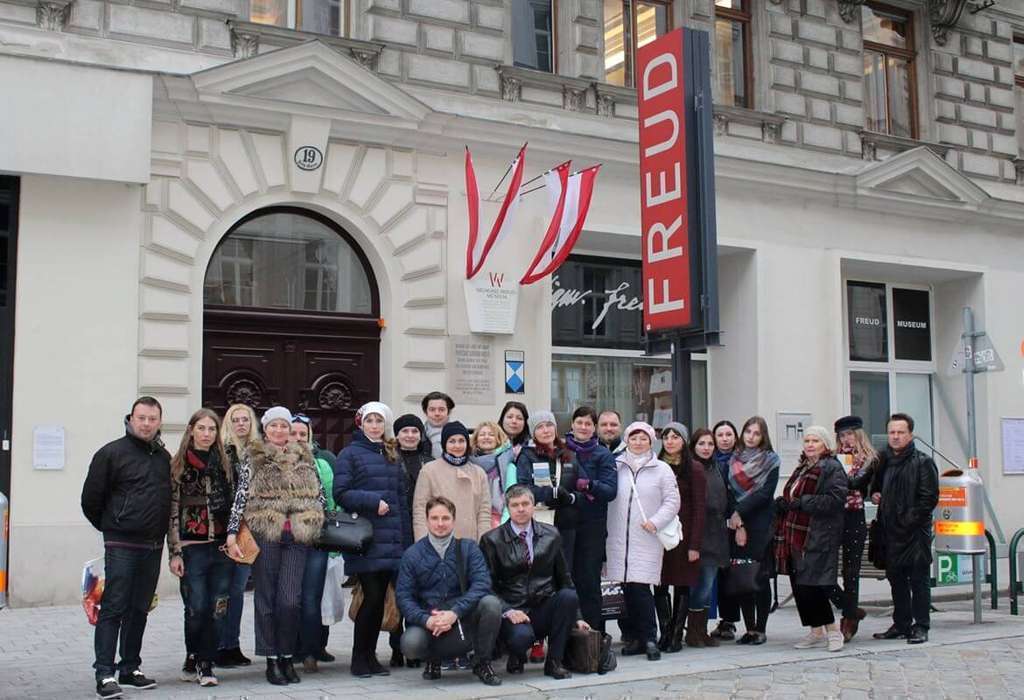
The Romantic is the most thoroughly studied personality type in psychology. These are feminine women and very sweet men. These are the Turgenev maidens of the 19th century, the heroines of classical literature. These were Freud's first patients, mostly women suffering from hysteria. They are also called Theatrical personalities. In the language of the S-Theory this is the epileptoid personality type.
It was thanks to the Romantic that psychoanalysis was born, and out of psychoanalysis, directly or indirectly, grew most of the schools of modern psychology. We even know the date of its “conception”: 18 November 1882, when Freud heard from a colleague the story of the treatment of Anna O. The real name of this Romantic woman who suffered from hysteria was Bertha Pappenheim.
Everyone knows Norma Jeane Baker Mortensen and Leonardo DiCaprio... For those who do not: the first of them is Marilyn Monroe. And everyone knows the Ukrainian politician Yulia Tymoshenko and the French president Emmanuel Macron. Yes, we all know plenty of representatives of the epileptoid personality type.
At their core lies a hidden, indirect and unspoken bid for the attention of others, and that is where one of their other names comes from: the Theatrical type. The level of inner conflict here is high: an enormous wish to be given attention sits side by side with the fear of getting it and the refusal to want it. Two opposite desires, present inside one person at the same time. Hence the fainting fits and the swoons of the heroines of Russian classical literature of the late nineteenth and early twentieth century. The central female figures there are the “Turgenev” young ladies, the Romantics.
Appearance of the epileptoid personality type
But theatrical “swooning” belongs to strongly expressed Romantics. Take the more harmonious, balanced epileptoid women and they are, as a rule, beautiful, graceful, feminine. Of them one can say: a woman with a capital W. The image of female beauty celebrated in our culture was shaped through epileptoids.
For men this image is too heavy a load, the feminine principle dominates it too strongly. So epileptoid men become deliberately harsh, just to set themselves apart somehow. They pull themselves together, take control, and on the whole come to resemble a “grand inquisitor” who keeps himself in hand, and everyone else with him. What shows is a constant restraint, including in the way they move. These people often stammer, mispronounce their letters and fall ill a great deal, which is an indirect way of drawing attention.
Where hysteroids are slender in build, epileptoids are a little soft-edged, slightly pear-shaped. The most pronounced epileptoids, the ones already closer to imbalance, begin to lose their femininity, to turn into a barrel and to swell up because of illness.
The intrigues of the epileptoid personality type
Inside, the person carries a ban on drawing attention to themselves, and at the same time wants that attention badly. The whole thing is built on this conflict. They are, meanwhile, quite aware of everything around them, they keep it under control, and on the whole they are rather cunning people. Behind an outward artlessness their mind is finely tuned for intrigue. Where the intrigues of the hysteroid type are guileless, played the fool and out in the open, epileptoids can run very long, multi-move, carefully thought-out games. It is another matter that they are sometimes too lazy for it, because what counts most for them, as melancholics, is their own inner experience of the whole business. So they may think it all through, but whether they will carry it out remains unpredictable.
Psychosomatics in the epileptoid personality type
These are people for whom psychosomatics is practically a god. They fall ill at the slightest excuse, because it is a chance to get attention from a doctor and from other people. Blowing your nose, rustling plastic bags, going to the clinic: these are processes where there is attention.
“Oh, I think I have a headache!”
- and she did fall ill, very fast at that, literally within a few seconds.
“I think something is twinging in there, I should go and get it checked”
- and it starts twinging.
They are great believers in anything that rustles. It is their style to come into the hall after the performance has begun, to be a little late, to apologise profusely, “not to draw attention”, “I will just slip quietly into this corner”. After that first bid for attention everyone looks, turns away and goes back to watching the play. And then part two begins: the programme has to be taken out of the bag, to see who is in tonight's cast. And the bag is the noisiest one there is, so that everyone looks again. And once more: “oh, sorry, do not mind me, I do apologise!” After the programme comes the coughing — a continuous process of drawing attention.
Chekhov has a wonderful story, “Spectacles”, about a man who sneezed messily onto the glasses of a superior, and about everything he then went through. Dovlatov has a splendid piece, “The Blue Diaries”, which tells the story of an epileptoid woman living in her own, always more elevated world. The monologues of Ostrovsky's heroine, “Why do people not fly like birds?”, are filled with an inner spirituality. That is how epileptoids express themselves.
They value art in the highest sense of the word. Come to an opera or a classical concert, to the Tchaikovsky Hall for a piano concerto with orchestra, and most of the audience will be epileptoid (in other cultures the prestige of the moment may lie elsewhere). They go there because at that moment a harmony finally arises between their inner, “incredibly rich” world and the sound of the world outside. Among believers, quite a few of them sing in church choirs.
There are autistic grandmothers who will make the atmosphere: they create, they tidy, they clear away, and even if you have done something wrong they will not tell you off, they will simply put it right after you, quickly. And then there are epileptoid grandmothers, the famous door-keepers who can make the very air ring with “all sorts wandering in here!” They allow themselves to receive attention when they are protected by some kind of status. It is not they who are drawing your attention now when they say: “Do not walk past, where is your pass? What are you shoving some bit of paper at me for!” It is their post doing it; they themselves are all sweetness and light.
An opera singer does exactly the same, as a rule a woman of the epileptoid type, when she comes out on stage, starts to sing, goes into that state and receives the attention of the hall. It is not she, it is the music that receives the attention, it is art. She is merely “a modest vehicle for all of this, a channel of divine revelation”. That is, there is always something to hide behind, although in fact it is they who get the attention.
As with any melancholic, the smallest thing becomes the occasion for a great inner story and a great deal of feeling. They lean on physical reality and on comfort, and at the same time they draw the maximum of inner experience out of it. So any outward action provokes an enormous amount of inner work and inner feeling, most of which is kept inside.
“Will he call, or will he not? And if he does not call, what am I going to do?”
This can go on inside a person for a very long time. If they are told “come with us”, the churning starts: “And why did they take me along? What am I going to do there? How will I manage? What if I do not like it? Are they all nice people there?” Every question comes with its own worry: “And what if they had not invited me? They have left me out again! Traitors! Nobody needs me! Now if they had invited me, then... But here I am saying yes, because they say no...”
Harmonious Traits of the epileptoid personality type
Their Harmonious Traits are the ability to secure their own advantage and to stand up for what is theirs, persistence, purposefulness, refinement. They are hospitable, because hospitality is attention paid not to me but to my home: “here I am not I-the-person but a good hostess. And over there I am a good door-keeper, and the enemy shall not pass, he will fall at Smolensk”.
In their harmonious expression these are feminine women. Accordingly, they are people of feeling, romantic in the very highest sense.