The Immortal Regiment is a grassroots movement for preserving the memory of the strength, the courage and the deeds of our forebears. Every year participants march in a column through the streets of towns and cities carrying photographs of their dead relatives, and enter their family stories in a chronicle. This initiative is criticised by people who do not see the enormous psychological component the event carries, one that is chronically lacking in the modern world. It is the personal psychological value of the Immortal Regiment that this article is about.
For those with no time to spare, here is the gist:
- Every human psyche has a deep-seated need for belonging — to a family, a group, a society and, in the end, to a family line.
- The need for belonging is satisfied not only physically, through knowing your parents, but also culturally, through the “search for the father”, or for one's forebears.
- In the modern world, against the background of the disappearance of the institution of “fatherhood”, people look for “belonging” in other substitutes for the parental figure: in the state, and often in dictators. And from there it is not far to nationalism, to repressions ordered from above and to wars...
- What is more, "Switching off historical memory" is a training manual item in the special services that run special operations
- The Immortal Regiment makes it possible to restore, honour and maintain the connection with your family line, and thereby to satisfy the need for belonging. Because of this a person becomes more independent, more balanced and less dependent on authoritarian structures.
- A person with a developed sense of belonging has access to additional resources — the source of the strength of the family line, which he can draw on in important and critical situations.
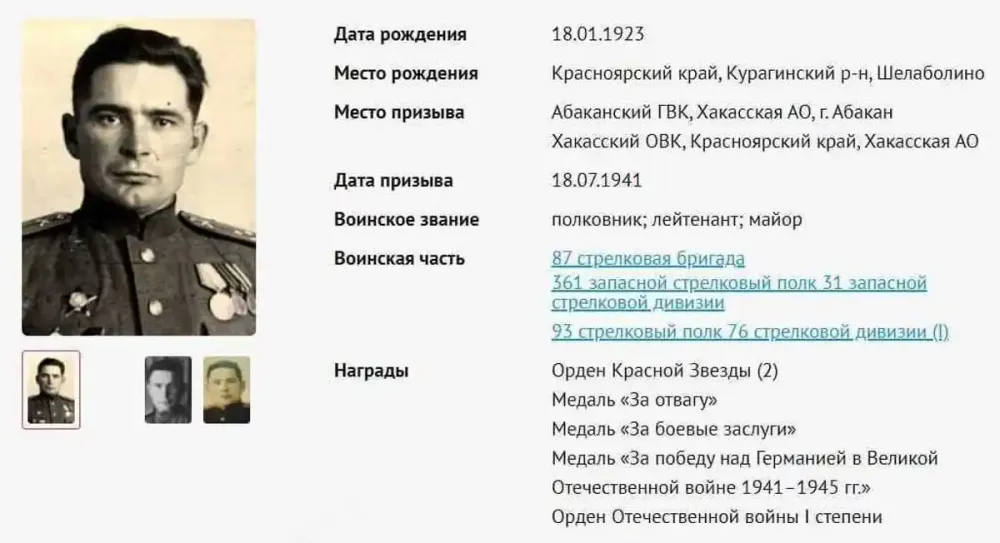
Along the way I will tell you about my grandfather, Ivan Ivanovich Peskov. Between ourselves: in Soviet times he commanded one of five anti-missile defence installations. This is his record card in the chronicle "Pamyat Naroda" ("Memory of the People"): https://pamyat-naroda.ru/heroes/person-hero85192440/
Now let us take it in order:
A little theory about basic needs
Whichever way you look at it, a human being is a biological species, and every one of us has exactly the same basic needs, deeply “hard-wired” into the psyche: existential needs. This means that without their satisfaction a person feels incomplete, becomes insecure and depressive, and constantly looks for satisfaction in external “substitutes”.
Academic psychology has various theoretical constructs describing basic needs: from A. Maslow, C. Alderfer, E. Fromm and others. And all of them, using different synonyms, describe the same structure:
- Consciously or unconsciously, a person's life revolves around satisfying a small number of needs
- Needs may be physiological (food, sleep, safety, being strong), social and group-related (career, hierarchy, recognition, being clever) and spiritual (for instance self-realisation, being important).
- Needs are arranged in a hierarchy: without satisfying the basic needs it is impossible to satisfy the “loftier” ones
So then, the need for belonging is a basic, fundamental, deep-lying human need. It is already activated in early childhood and, if it goes unsatisfied, can have a negative effect on a person all their life. And the other way round,
How do we satisfy one of the most powerful drivers of our life?
How do we look for Belonging?
Outwardly you can belong to a family, a group, a society.
- For children, belonging to a mother, a father, a family means not only love but above all care and safety in life.
- Teenagers looking for belonging join musical, academic, religious and sporting groups.
- As adults we want to be part of a corporation, a political party, a society of like-minded people, and even to have followers of our own.
But inwardly, at the level of the psyche, all these belongings are nothing other than a manifestation of the “search for the father”, or for one's forebears.
The search for the father is not only a real necessity but also a universal psychological need.
Luigi Zoja, Italian psychotherapist
Every person wants to know whose descendant they are. Adopted children, however much their adoptive parents loved them, will want to find out who their real parents were. Any child who has lost a father in the course of the parents' divorce will start looking for him in adolescence. Any adult will wonder what "dynasty" they came from.
Dictators as substitutes
The theme of the search for the father has been played out in any number of films and series. In the series “Mediator”, for instance, criminals built a whole teenage terrorist group out of children who were looking for their lost physical fathers

A person without belonging is a very insecure person, prone to suggestion from outside. That is understandable: not knowing his father or his grandfather, a person looks for him in outside “substitutes”. It may be a firm that tells its staff “we are a family”. It may be a religious sect with a wise and accepting “enlightened one”. But more often, in our time, such substitutes are dictatorial structures or the state.
We arrived at the birth of dictatorships not only for political reasons but out of personal needs as well: the growing absence of fathers and the decline of their authority encouraged the search for safety in public structures. Behind the political need stood the need for a strong father. ... The need for the father — a fire onto which the century kept pouring petrol — was satisfied for millions of young people by dictators, suddenly and in a perverted way, which led to a still greater loss of family roots. This psychological wound was deeper than the political one, and it is still waiting to be thought through.
Luigi Zoja in the book “The Father”
Having found belonging in the state, in the government or in a single dictator, a person becomes “obedient”. In the “Milgram Experiments” it was proved scientifically, reliably and many times over that in absolutely any western society (the USA, Germany, Great Britain, Russia or Ukraine) between 60 and 90% of the population are prepared to commit violence, up to and including the creation of concentration camps, on the orders of an authoritative ruler. I repeat: in any state, not only in the Germany of the 1940s but also in the USA, and in Ukraine or Russia in the 2020s. All that is needed for this is simply for members of the government to start calling for violence.
You can find out more about the “Milgram Experiments” and about obedience produced by the Search for belonging in the artic:? The collective guilt of not knowing the “Milgram Experiment”
Exactly how this mechanism works, the one that reduces a person to a mere executor executor of violence, is described by the Russian sociologist and political scientist Sergei Kara-Murza in the book "Manipulation of Consciousness. The 21st century"
How do you destroy a society from outside?
The special training course "Information Operations" of the Special Operations Forces of the Armed Forces of Ukraine (edited by D. A. Bogush, SSO ZSU, Kyiv 2018) quotes Kara-Murza's book, in particular the section "Switching off historical memory". That is the best proof of the quality of this book. Let us take a look at what interested the Special Operations Forces.
Sergei Kara-Murza writes that the core of any society is its "cultural core", which contains a set of notions
- about the world and about people,
- about good and evil,
- about beauty and ugliness,
- numerous symbols and images,
- traditions and prejudices,
- centuries of knowledge and experience.
Culture stabilises a society and increases its vulnerability to manipulation. As long as the "cultural core" is stable, a "stable collective will" exists in society. Culture sets the frame of what is right and what is wrong and affects the psyche at an unconscious level.
The “cultural core” chimes with “traditions”, “symbols”, “culture” and “historical memory”: these notions are part of a single whole that forms a society.
"Historical memory" is a more structured, "rational" knowledge, embedded in the information and symbols that link people to society and provide a common language and stable channels of communication.
"Symbols" are the images (the ghosts) of things, phenomena, relationships, social institutions and so on, which have settled in the mind and taken on a metaphysical, almost religious meaning. Each of us defines his own personal history through symbols, and only through symbols can we fit ourselves into the time and space in which we live. Symbols carry knowledge of good and evil, guide our actions, advise us to remember some things and forget others, and day by day shape our personal history.
A special place among symbols is held by the image of the dead. The image of the dead takes part in the biography of a person and of a people, guiding his family and his nation.
In a certain sense human culture is the symbolic organisation of the experiences of a dead past preserved by memory, felt and understood anew by the living members of the collective. Man's own personal mortality and the relative immortality of our biological species turn the overwhelming part of our communication and our collective activity, in the broadest sense, into a grand exchange between the living and the dead William Warner, American anthropologist, sociologist and social psychologist
Why do "islands of tradition" — that is, knowledge stored in the depths of historical memory and not subject to doubt or logical analysis — strengthen rational thinking? Why do they work as effective "signalling devices"? Because they work automatically, and it is hard for those who manipulate our consciousness to separate them from the outside world.
And the other way round, in order to increase vulnerability to manipulation and destroy a society from outside, you have to do the opposite of all this:
- remove the stabilising block of traditions from people's consciousness
- switch off historical memory through “rewriting history”
- manipulate the symbol of the dead, precisely because of its enormous symbolic value, for instance by pulling down monuments or by banning the Immortal Regiment march
People lose the ability to place events within a frame that is "anchored" to some rigid and absolute standard. Everything becomes relative and weighed on indeterminate scales. And that is precisely the deliberate programme of the political forces involved, a great working propaganda machine.
A radical rejection of the culture of the fathers — even if it is entirely justified — may bring a ruinous consequence, making the young man who has scorned that counsel the victim of the most unscrupulous charlatans. I need hardly add that young men who have freed themselves from tradition are usually all too willing to listen to demagogues and to take on trust their cosmetically embellished doctrinaire formulas Konrad Lorenz, Nobel laureate in physiology or medicine
This is why any tradition or ritual that supports the “search for the father” (which is what the “search for the father” is) will make a person more confident, calmer, inwardly stronger, more independent, and in that way prevents violence in society. But is the “search for the father” a purely private matter for each of us?
The Immortal Regiment as a “search for the father”
It may seem that for a sense of belonging to your family line it is enough to know your physiological origin, the names and the history of your parents and grandparents together with their heraldry. But no: the need lies deeper still.
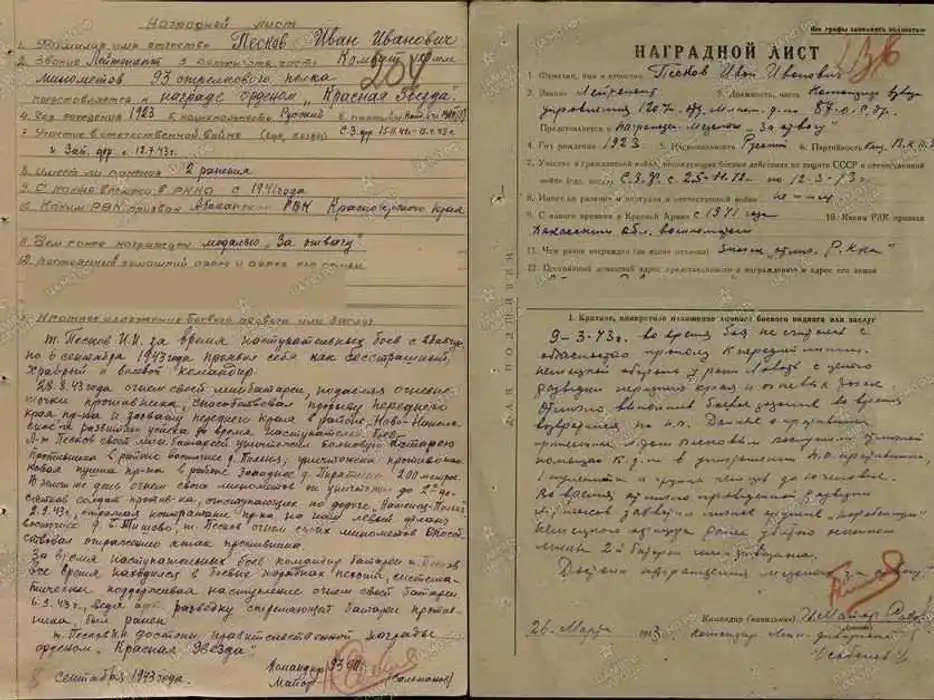
Comrade Peskov I. I., during the offensive fighting from 28 August to 6 September 1943, showed himself to be a fearless, brave and strong-willed commander. On 28.8.43, with the fire of his mortar battery, suppressing the enemy's firing points, he contributed to the breakthrough of the enemy's forward line and to the seizure of the forward edge in the area of "Novo-Nikolskoye" and to the development of the success during the offensive fighting. Lieutenant Peskov, with his mortar battery, destroyed an enemy regimental battery in the area east of the village of Pilnya; an enemy anti-tank gun was destroyed in the area 200 metres west of the village of Piryatino. On 2.9.43, repelling enemy counterattacks on our left flank east of the village of V. Tishovo, Comrade Peskov, with the fire of his mortars, contributed to the repulse of the enemy's attacks. Throughout the offensive fighting the battery commander, Comrade Peskov, was constantly in the battle formations of the infantry, systematically supporting the advance with the fire of his battery. On 6.9.43, while conducting artillery reconnaissance of a firing enemy battery, he was wounded."Comrade Peskov is worthy of the government award of the Order of the "Red Star". 8 September 1943.
We are not talking about finding a father in the literal sense and getting something out of him, maintenance payments for example. We are talking about the father being a symbol of strength, of protection, of might. It is an archetype whose roots go back into deep antiquity. And through it we sense the strength and the might of our whole family line. You will agree that with support like that it is easier to walk through life.
A child endowed with sensitivity understands that the father is the one who chose him: the father is always a cultural product, since a natural father is not enough. The child must in any case “search” for a parent and, even if in doing so he finds his biological father again, choose him in his turn. In terms of symbols, the need that led to the search remains the same.
Luigi Zoja in the book “The Father”
So, the “search for the father” and for belonging is also an enormous archetype of humanity, one that calls for rituals, symbols, mythological expressions and traditions which find no expression in modern society.
Against this background the newly minted tradition of the Immortal Regiment is a unique ritual that helps to maintain a symbolic connection with dead parents and grandparents and satisfies precisely that need to belong to a family line.
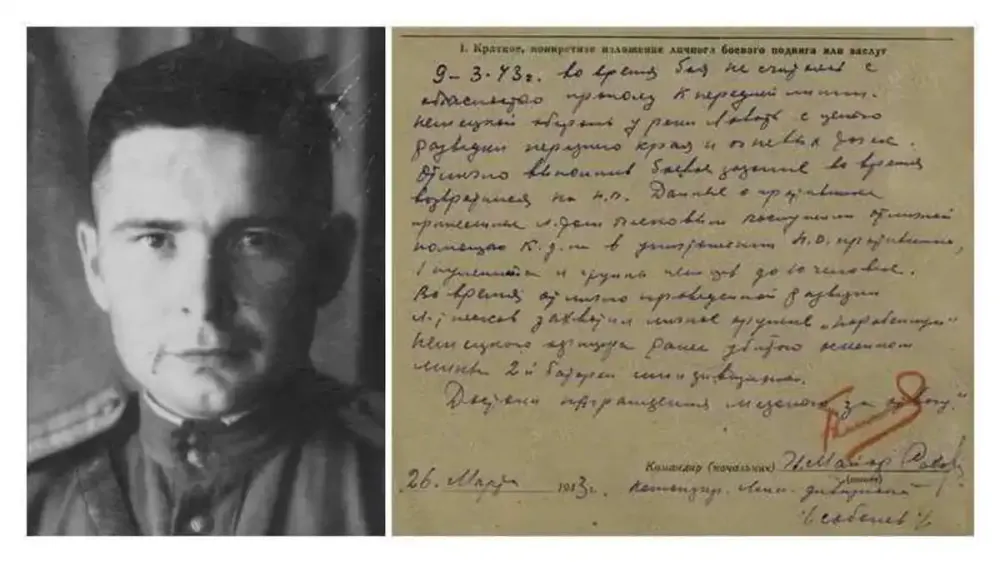
On 9 March 1943, during the fighting, disregarding the danger, he crawled up to the forward line of the German defence at the river Lovat in order to reconnoitre the forward edge. He carried out the combat task excellently... The information about the enemy brought back by Comrade Peskov was of excellent help in the destruction of an enemy observation post, one machine gun and an infantry group of up to 10 men. During this excellently conducted reconnaissance, Lieutenant Peskov captured the personal weapon, a "Parabellum", of a German officer who had earlier been killed by a mortar splinter from the 2nd battery of the mortar detachment. Awarded the model "For Courage" on 26 March 1943
For me, someone born in the USSR, 9 May was always associated not only with the military parade but above all with my grandfather in his best clothes, with laying wreaths together and with his meetings with other veterans. Then my grandfather, like most veterans, passed away, and the military parades became merely external events. Yes, they were holidays, but there was nothing personal in them.
So when, from 2012 on, the chance appeared to remember my grandfather together with others and with pride, to tell about him at least by his name and a photograph on a placard, and to do this together with other people, there appeared exactly the mass cultural ritual that modern civilisation lacks so badly. “The Immortal Regiment” makes it possible to cultivate in yourself a sense of belonging to your family line. Because the sense of the family line and of one's forebears gives unimaginable energy and support to us ourselves.
The power of the family line in everyday life
When you take part in the "Immortal Regiment", you are taking care of yourself. And you can now use this in everyday life
Having found her soul family, a person finds vital strength and a sense of belonging.
Clarissa Pinkola Estés in the book "Women Who Run With the Wolves. The female archetype in myths and tales"
When you are nervous — before an interview, say, or a conversation with your boss, or speaking in public — you can picture your father, your grandfathers and your whole male line standing behind you. They stand behind you in a “triangle”: one grandfather has put his hand on your left shoulder, another on the right. Behind them stand their own grandfathers, and so on. Your back is, metaphorically, your rear, your supply line, your support. And then a feeling of might will come, and the nerves will go.
That is a technique of that kind, if you honour your family line.