Most people think they are unique. And at the same time they cannot say what exactly sets them apart from millions of others. Yet being aware both of what we share with other people and of our own distinctiveness is the foundation of understanding yourself, of reading people well and of the skill of influencing those around you. In this article I will tell you whether a human being is unique from the point of view of psychology as a science. And I will answer the question: a person's uniqueness — what is it, exactly? I will even hint at how uniqueness can be measured.
A person's uniqueness — what is it, exactly?
When we discussed the question of whether a human being is unique, 31 readers out of 42 answered that they considered themselves unique. Yes, holding that belief is fashionable today. And not one of them could — or wanted to — say what exactly made them so.

Their hairstyle? Hairdressers have a catalogue of those. Their clothes? A fashion show will “tell” you exactly what is worn this season. Their beliefs? Those are catalogued too, and social surveys bring them to light.

The list could go on forever:
- The horoscope has just 12 signs of the Zodiac.
- There are 2 sexes, or 54 according to Facebook. Plenty — but rather too much imagination at work.
- The fashionable esoteric Human Design system has 70 thousand variants of people, yet only four basic types — and 70% of the planet's population is supposedly a single type.

Are people really so individual, so unique, so randomly distributed? Talking about uniqueness, one cannot get past a more realistic question: where is our non-randomness.
What is non-randomness in the human psyche?
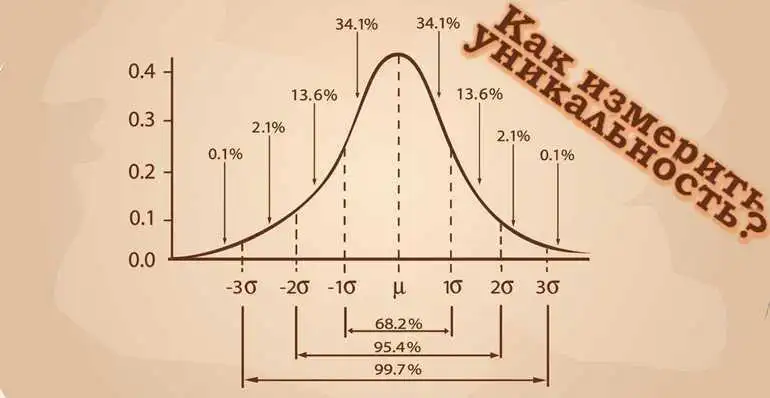
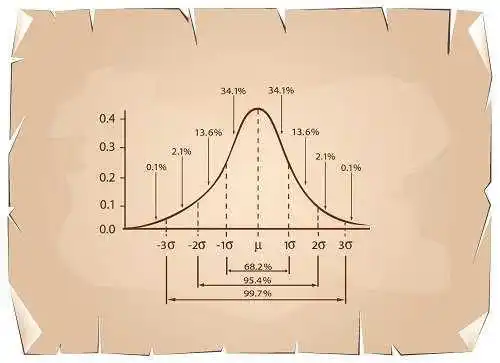
Non-randomness is that unloved word "norm", "normality". How do the non-humanities look at it? The point is that “individual” human behaviour is modelled rather well by the statistical NORMAL distribution (also known as the Gauss–Laplace distribution). If the behaviour of a sapiens is the sum of the behaviour of many random, weakly interdependent people, each of whom contributes only a little to the overall conclusion, then as the population grows (residents, clients of therapists) the result tends towards that hateful word, the NORM. It is used just as often to predict deviations in marksmanship, to measure instrument error, in physics, in economics and… well, in most of what we know.
Being amenable to normal modelling, human behaviour obeys the law of TWO SIGMAS. Put simply, this means that
- the statements of professional psychologists and psychotherapists hold true for 95.4% of the population (the standard spread lies within two standard deviations, two sigmas), and the rest are one-offs.
- all pop psychology and all coaches hit the mark in 68.2% of cases.
A great deal depends, of course, on sampling the population of “one-offs” correctly. Get it right and the standard deviation will be small.
What else MATTERS when defining the NORM? Whom we compare. If we study, say, a population of neurotics, they will have their own norm — the norm of a neurotic society. It is described in textbooks and in the work of therapists, and it is often published under the heading “British scientists have discovered”. If we take the self-actualising personality as the norm, the way Maslow described it, we get a different norm.
Normality according to Maslow
Abraham Harold Maslow is the acknowledged founder of humanistic psychology. He argued that the very essence of a human being pushes them towards personal growth, creativity and self-sufficiency. He came up with the pyramid of needs, which is the foundation of coaching today. And in 1970 Maslow suggested that the average person satisfies their needs roughly in the following proportions:
- physiological needs are met by 85%,
- the need for safety and protection — by 70% — safety and protection,
- for love and belonging — by 50%
- for self-esteem — by 40%
- for self-actualisation — by 10%
As for that last category, the self-actualising personalities — among whom Maslow counted Thomas Jefferson, Abraham Lincoln in his final years, Albert Einstein, Eleanor Roosevelt and Benjamin Franklin — there are not even 1% of the world's population. From observing 48 of humanity's finest, Maslow derived 15 markers of success. In short, the “SELF-ACTUALISING PERSONALITY” possesses:
- realism and acceptance of themselves and of others
- creativity in small things and the ability to get high on life without chemistry
- a social attitude towards society, and
- depth in their close relationships
Maslow himself regarded his observations as a “pilot” study that his followers would one day confirm. Which is exactly what those followers did, by developing the POI test.
How do you measure uniqueness?
Oh yes, uniqueness can easily be measured! Precisely through the Personal Orientation Inventory (Shostrom, 1964, 1974). That is between 15 and 250 questions assessing the various markers of self-actualisation that Maslow derived from observing 48 outstanding people. For instance, which is true of you:
- I must always keep my anger in check
- I should freely express justified indignation
How reliably will this test check your uniqueness? It was first tried on 30 high-flying lawyers, who were assessed by 3 experts over 9 months. It turned out that with a confidence of 99% (p) and a correlation of 44% (r) they matched the markers of the normal (McClain, 1970). It was later found that POI scores improve in the course of therapy. The higher the POI, the less alcoholism, depression, hypochondria and neuroticism, and the more autonomy, creative ability and emotional adjustment. And above all, the better students perform academically (LeMay, Damm, 1968; Stewart, 1968).
A psychologist is the little goat that counted
So, we have worked out whether a human being is unique. Unique enough to be measured. Which means that psychologists are rather like the little goat in the cartoon who counted everyone up.

If you are an ordinary unique person, like 95.4% of the population, you will be measured by the statistical normal distribution by university psychologists and statisticians. And if you belong to the top 1% of the population, you will be measured by the Personal Orientation Inventory. In short, we have all been counted. There is nothing to take offence at — it is the first step towards knowing your true uniqueness.
Recognition and respect for the subjective conditioning of knowledge in general, and of psychological knowledge in particular, is the first condition for a scientific and fair appraisal of a psyche different from that of the observing subject. But this condition is possible only if the observer knows precisely the range and the nature of his own personality. Yet he can know this only when he has largely freed himself from the levelling influence of collective opinions and collective feelings, and has thereby arrived at a clear conception of his own individuality.
Carl Gustav Jung, "Psychological Types"
Do you want to arrive at a clear conception of your own individuality? If so, do you know the range and the nature of your own personality? You can find out here: https://freud.online/dating. But more on that in the articles to come)