Dementia is a chronic or progressive disease of the brain in which memory, orientation, perception, learning, speech and judgement are impaired. The disease usually appears in old age, but it is not a normal sign of ageing. In Russia more than 1.5 million people suffer from dementia. Worldwide at least 44 million people live with dementia, which makes it a global problem that has to be addressed. There are different forms of dementia, such as Alzheimer's disease, and the symptoms are similar, but the treatment options differ. The diagnosis of dementia consists of various testing procedures (the clock-drawing test, for example).
Dementia..
There are different forms of dementia, such as Alzheimer's disease, and the symptoms are similar, but the treatment options differ. The diagnosis of dementia consists of various testing procedures (the clock-drawing test, for example).
Article overview:
- How common dementia is
- Causes / symptoms / course of dementia
- Diagnosing dementia
- Therapy for dementia
- Dementia: what family and friends can do
- Validation
How common dementia is
In more than 40% of cases dementia is today the most common reason for admission to a care home. As life expectancy rises, the number of cases of dementia will keep growing. In the group aged 60 to 70 roughly 1 person in 100 has dementia. In the group aged 80 to 85, 1.5 people in 10 are affected, and in the group over 90 it is 3 people in 10.
Causes, symptoms and course of dementia
Dementia is an umbrella term for the pathological decline of mental abilities, which can have many causes. In the course of the illness mental abilities are lost. Around 50 illnesses are known today that can lead to dementia. They include, for example, Alzheimer's disease, Parkinson's disease, Creutzfeldt-Jakob disease, epilepsy, multiple sclerosis, vascular diseases of the brain or brain tumours.
Risk factors:
Old age
Women are affected more often than men.
People with a lower level of education are at greater risk.
At the beginning of the illness there is often depression.
People who live alone and people with limited social contact are more likely to fall ill.
The risk is higher with conditions such as obesity, hypertension, diabetes mellitus, kidney failure or stroke.
A distinction is made between primary and secondary forms of dementia.
Primary forms arise from damage to brain tissue, secondary forms are caused by events and disorders that are not primarily located in the brain. Primary dementias account for the majority of cases. Alzheimer's disease is the most common form, with 6 to 8 cases in 10. Between 1 and 3 cases are vascular dementia or dementia with Lewy bodies. Frontotemporal dementia is diagnosed in fewer than 1 case in 10.
Alzheimer's disease
Often, namely in 60 to 80% of cases, Alzheimer's disease is the cause of dementia. In most cases Alzheimer's disease begins after the age of 65. The causes of the disease have not yet been established.
Vascular dementia
Vascular dementia is often marked by a sudden onset and a gradual worsening of the condition. The cause is usually a disturbance of the blood flow in the brain, for example a cerebral infarction, a stroke or atherosclerosis. Because this interrupts the blood flow in the brain, individual areas of the brain are damaged. Unlike Alzheimer's disease, this form of dementia affects men more often than women.
Dementia with Lewy bodies
The term “Lewy bodies” means deposits of protein in the brain. They too can cause dementia and usually arise as a result of Parkinson's disease. In some cases Lewy bodies can also appear without Parkinson's disease. About 20% of people with dementia have this form.
Frontotemporal dementia
One speaks of frontotemporal dementia when the nerve cells in the area of the forehead and the temples, the frontotemporal lobe, break down. Emotions and social behaviour are controlled in this area of the brain, which is why personality changes occur at the very beginning of the illness. Aggressiveness, tactlessness, overeating and indifference are the first signs of frontotemporal dementia. It begins earlier than the other forms, usually in the fifth or sixth decade of life.
Secondary dementia
Dementia can also be a consequence of another illness. In this case one speaks of secondary dementia. It is not caused by changes in the brain and is the only form that has a chance of being cured, if the underlying illness is cured. If, however, the diagnosis comes too late, this is no longer possible.
- Medicines such as antidepressants, sedatives and relaxants, antihypertensive drugs or remedies for cardiac arrhythmia can cause secondary dementia.
- Tumour diseases can also be the cause, such as brain tumours, cancer of the lymph nodes or cancer of the blood. If the tumour is treated, the symptoms of dementia usually go away as well.
- Metabolic diseases such as an overactive or underactive thyroid gland, kidney or liver failure, and also a low blood sugar level (hypoglycaemia), can cause secondary dementia.
- Infections caused by bacteria, viruses or fungi that spread to the brain and bring on dementia.
- Head injuries, for example after an accident or a fall, can later lead to dementia.
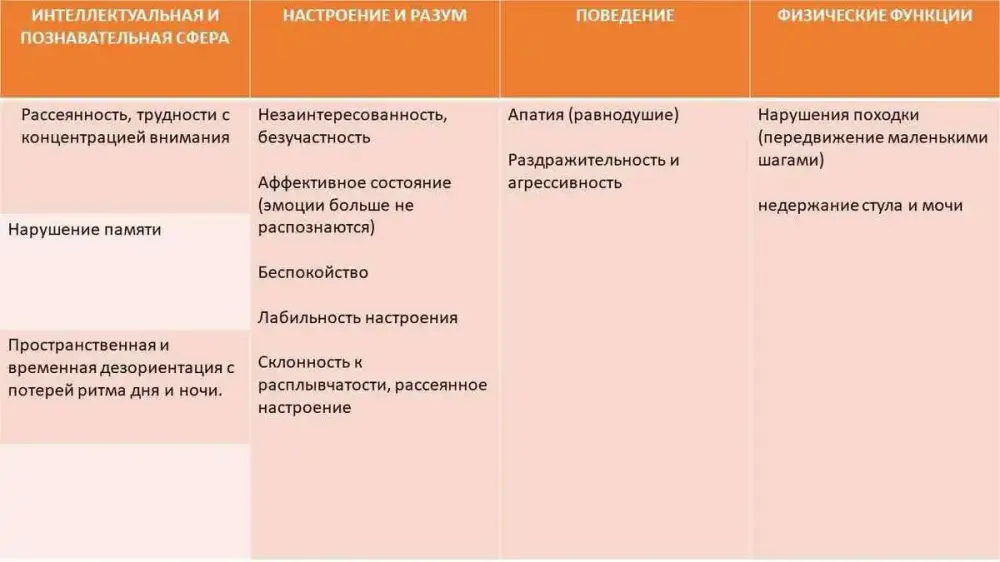
The course of dementia is divided into 3 stages:
1 Mild dementia:
The person affected is slightly impaired in everyday life, but can still manage on their own and largely lead an independent life. At times they find it hard to follow a conversation. Difficulties in finding words and repetitions also occur. The person remembers things that happened long ago better. With complex tasks, the first mistakes appear.
2 Moderate dementia:
Leading an independent life becomes ever harder. Help and supervision are needed to a certain extent. Those affected also have difficulty with simpler tasks, such as choosing clothes or buying goods. Personal hygiene is often neglected. Psychological symptoms appear, such as fear, delusion, agitation and other behavioural disturbances; patients become disoriented, wander aimlessly and show restlessness. If one tries to correct the patient, they often react irritably and aggressively. Other possible symptoms are a disturbed day-and-night rhythm and cognitive incontinence (going to the toilet at the wrong time, using chairs or waste bins).
3 Severe dementia:
At this stage an independent life is no longer possible. The person affected can no longer carry out even simple actions on their own; motor disturbances also occur at this stage, for example in walking. Patients are confined to bed and often forget to eat; urinary and faecal incontinence also occurs. Progressive language disorders make communication with the patient more and more difficult.
Diagnosing dementia
Dementia is difficult to diagnose, especially in the early stages. The first signs often go unnoticed or are played down by those affected themselves and by their relatives. For this reason the diagnosis is often made only once something has shown itself in everyday life.
Diagnosis begins with a detailed conversation with the doctor. This involves talking not only to the patient but also to relatives or other close people. The key points:
- Previous illnesses.
- Illnesses in the family.
- Events that have affected the patient's body or mind.
- Changes that have been noticed, signs of impairment.
- How the symptoms have developed.
- Mood swings.
- Personality changes.
- Medication.
For diagnosing dementia it is very important to establish a decline in cognitive function, for example with the Mini-Mental State Examination or the clock-drawing test (I shall write about the latter in future articles). In the early stages detailed neuropsychological testing is needed. If the results are clear, imaging methods such as computed tomography (CT) or magnetic resonance imaging (MRI) are used to clarify things further.
Therapy for dementia
Early detection is an important factor. The earlier dementia is detected, the better it can be treated. Depending on the form and the symptoms, different medicines are used. Their aim is to preserve mental abilities and to delay the course of the illness. Neuroleptics, antidepressants, neuroleptics and sleeping pills can also be prescribed to treat accompanying symptoms.
Treatment of dementia is individual for every patient. Besides drug therapy there are a number of other options available which are suitable as therapy depending on the symptoms and the severity. Psychological and psychotherapeutic methods, memory training and occupational therapy are suitable for improving cognitive function and the quality of life of the person affected, and for slowing the course of the illness. The therapy must, however, be based on the stage.
Psychotherapy is suitable for treating affective disorders such as anxiety, depressive states, helplessness or aggressiveness, disorders of behaviour and of the drives, social isolation and regression, trauma from perceived losses and deficits, and also functional disorders such as urinary incontinence. Psychotherapeutic methods are varied.
Dance therapy is suitable for patients with limited mental and cognitive abilities, since the main focus is on working with the body. Dance therapy encourages body awareness, social contact, a positive mood and self-esteem, and helps to maintain mobility.
Music therapy works with sounds, rhythms, harmony, melody and noises. Familiar songs are played to the patient, for example. This jogs the memory; sometimes the patient spontaneously thinks of a situation connected with the song. In active music therapy those affected are also asked to make music or to sing. Music therapy is usually done in groups, which creates a sense of group and encourages communication skills. Patients seem more mobile and better oriented.
Memory training. The aim of memory training with people who have dementia is to maintain and train mental performance. It is important to bear in mind that in the advanced stages short-term memory often stops working. Questions about the events of the current day can put pressure on the person. It makes sense to choose exercises aimed at long-term memory, that is, exercises that bring memories to life. The exercises should give the person pleasure and a sense of success. Tasks such as talking about the past while looking through a photo album, or repeating proverbs, are examples of what memory training can look like.
Art therapy helps people to express themselves and their emotions, slows down problems with fine motor skills, engages visual activity and memory, and gives positive emotions.
Occupational therapy. The aim of occupational therapy is to strengthen people in independent activity, in productivity and in the use of leisure, and to improve the patient's quality of life and emotional state. Training functions and skills is an important component. Thanks to occupational therapy, mental decline and behavioural problems are reduced, while social behaviour and everyday activity increase.
Dementia: what family and friends can do
If dementia is suspected, a doctor should be seen as soon as possible. Early diagnosis and treatment can slow the course of the illness.
Preventing dementia.
Studies have shown that dementia is less common in people who take regular exercise and lead an active intellectual and social life. Cardiovascular disease or diabetes mellitus increase the risk of falling ill. Other risk factors are smoking or obesity. So if you pay attention to a healthy way of life, the risk of dementia can also be reduced. But there are also risk factors that cannot be influenced. These include age, sex and dementia in the family. Staying mentally active can not only slow the course of dementia but also lower the risk of falling ill. Reading, studying, learning foreign languages, writing, making music and singing, taking part in community life (in a club or in the family, for example), as well as regular physical exercise and helping out in sport.
Dealing with people who have dementia - advice for relatives.
If a member of the family has dementia, it tells on their relatives too. They feel pain, compassion, helplessness, anger, anger, sadness and despair. A great many difficulties have to be overcome. Caring for someone with dementia takes a lot of time, strength and persistence, so it is important to get support in good time. Relatives should remember that the changes in the person's behaviour are not deliberate. They are the result of an organic impairment in the brain. The patient does not consciously want to annoy or provoke anyone.
Validation
Validation is a useful concept in working with people who have dementia.
It is not about criticising or correcting the behaviour of the ill person, but about declaring it true and accepting it, that is, validating it.
A set routine is good for people with dementia: processes that happen the same way every day help those who have dementia. When it comes to care, patience, composure, respect and understanding matter in dealing with the ill person. Patients should not be overloaded, but at the same time should be able to do as many things themselves as possible. This slows mental decline.