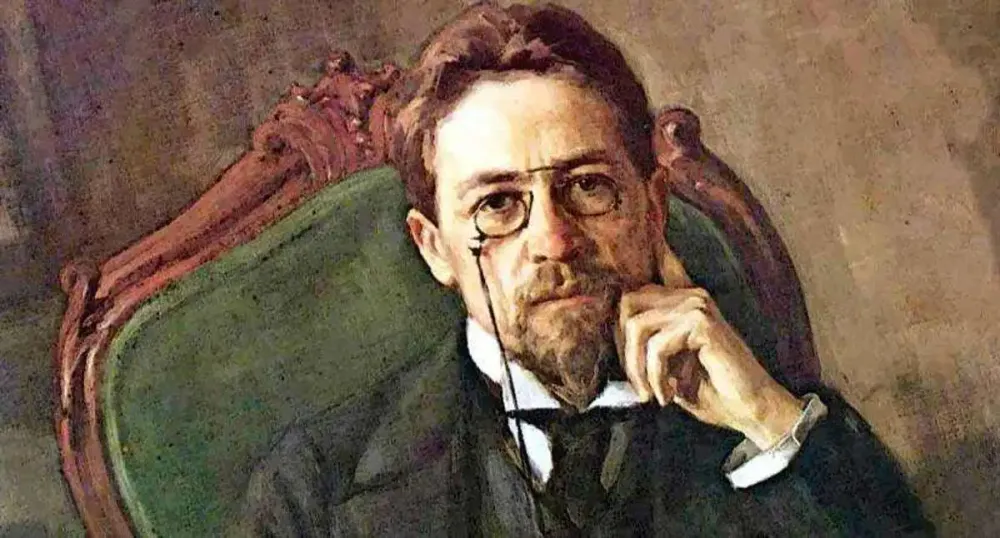
Let us look at Chekhov’s story through a counsellor’s eyes and do a little analysis! Chekhov did not invent his stories, he took his ideas from life. With no training in psychology, but with a natural gift for observation and empathy, he understood people’s souls deeply — and you can feel it in his work.
A little about Chekhov
Anton Pavlovich Chekhov finished his course at the medical faculty in 1884 and began working as a district doctor at the Chikino hospital. From the recollections of P. A. Arkhangelsky (a physician):
"He worked unhurriedly; at times there was something like uncertainty in what he did, yet he did everything attentively and with a visible love for the work, and above all with love for the patient who passed through his hands. <…> The patient’s state of mind always drew Anton Pavlovich’s particular attention, and alongside the usual medicines he attached enormous importance to the effect that the doctor and the surroundings had on the patient’s psyche."
And so, on to the story "The Black Monk"!
"Without you, the servants of the highest principle, who live consciously and freely, humanity would be nothing; developing in the natural order of things, it would have to wait a long while yet for the end of its earthly history. You will lead it into the kingdom of eternal truth several thousand years sooner — and that is your high merit. You embody the blessing of God that has come to rest upon people."
A healthy person (not a neurotic) is not afraid of the truth; more than that, they are not afraid to speak it, not afraid to be frank and open. And this is not the neurotic sort of truth, where someone shouts with foam at the mouth, blaming everything and everyone around them — shouting about their own truth, and it is not the adult doing the shouting but their small, frightened, wounded Inner Child.
"And what is the aim of eternal life?" asked Kovrin.
"The same as that of any life — enjoyment. True enjoyment lies in knowledge, and eternal life will provide countless and inexhaustible sources of knowledge; it is in this sense that it was said: in my Father’s house are many mansions.
"If only you knew how pleasant it is to listen to you!" said Kovrin, rubbing his hands with pleasure.
"I am very glad."
"But I know that when you go away, the question of your nature will trouble me. You are a phantom, a hallucination. So am I mentally ill, abnormal?"
"And what if you are? Why be embarrassed? You are ill because you have worked beyond your strength and worn yourself out, which means that you have sacrificed your health to an idea, and the time is near when you will give it your life as well. What could be better? That is what all gifted and noble natures strive for."
"If I know that I am mentally ill, can I trust myself?"
"And how do you know that the men of genius whom the whole world believes did not see phantoms too? Scientists say nowadays that genius is akin to madness. My friend, only the ordinary people of the herd are healthy and normal (here "healthy and normal" is meant in the sense that ordinary people — neurotics — give it. There are so many of them that a truly healthy person will naturally be taken for a sick one in that crowd). Reflections about the nervous age, exhaustion, degeneration and so on can seriously trouble only those who see the aim of life in the present — that is, the people of the herd.
"The Romans used to say: mens sana in corpore sano (a healthy mind in a healthy body).
"Not everything the Romans or the Greeks said is true. Elation, excitement, ecstasy — everything that distinguishes prophets, poets and martyrs for an idea from ordinary people — runs counter to the animal side of a human being, that is, to physical health. I repeat: if you want to be healthy and normal, join the herd. (here "healthy and normal" is what we would now call neurotic)
"Strange, you are repeating what often comes into my own head," said Kovrin. "It is as if you had spied out and overheard my innermost thoughts. But let us not talk about me. What do you mean by eternal truth?"
The monk did not answer. Kovrin glanced at him and could not make out his face: its features grew misty and blurred. Then the monk’s head and arms began to disappear; his body merged with the bench and with the evening dusk, and he vanished altogether.
An elevated, normal, healthy man spends a whole summer among neurotics and is not particularly bothered or strained by it. They, meanwhile, have nothing beyond the garden and the daily round; they think about nothing, they simply work because that is how it should be, because that is what they are used to, and the thought "But what for? Might there be something else out there?" never visits them. You could call it a learned script.
The master of the estate is clearly a neurotic with paranoid leanings; his daughter Tanya is a depressive personality type, so typical of Russia. New conditions arrive — Tatyana has fallen in love and is marrying Kovrin, while her father, used to the settled flow of life and to caring for the garden, finds himself under stress — and neither character can cope with the situation: it works as a trigger, it presses on all their traumas, and their neuroses grow stronger accordingly. (Read my article What is neurosis?)
The book describes how their state swings from one extreme to the other and how they behave "as if in a dream". What does this tell us? That, in principle, this is how all neurotics behave: in stressful situations their behaviour does not match the reality around them, and what is more, they are not aware of it. They live in a kind of half-oblivion; ask them what they ate or did half an hour ago and they will not remember — all they can do is repeat, on autopilot, the actions they learned years ago.
Kovrin, meanwhile, worked with his former zeal and did not notice the bustle. Love only added fuel to the fire. After every meeting with Tanya he went to his room, happy and exalted, and with the same passion with which he had just been kissing Tanya and declaring his love, he took up a book or his manuscript. What the black monk had said about the chosen of God, about eternal truth and the brilliant future of mankind, gave his work a special, extraordinary meaning and filled his soul with pride, with a sense of his own loftiness. Once or twice a week, in the park or in the house, he met the black monk and talked with him at length, and this did not frighten him — on the contrary, it delighted him, for he was by now firmly convinced that such visions come only to the chosen, to outstanding people who have devoted themselves to the service of an idea.
What we see here is rather a representative of the manic personality type — not in its extreme, that is, pathological form, but in its normal, constructive one. Kovrin works at what he loves; at the same time he can walk, rest, be aware of himself in the world, fall in love consciously and look at his own hallucinations quite consciously, as if from the outside, reflecting on his mental illness.
Anyone who reads this story will agree that Kovrin is mentally ill. Well, I do not agree!
To my mind, Kovrin is a splendid example of a mentally healthy person, one who has freed himself of neuroses. Note that he lost his parents early, yet this did not leave him with a psychological trauma, because there was compensation (he was brought up by Yegor Semyonych, who took his father’s place); all he feels is love and an enormous sense of gratitude towards Yegor Semyonych, who raised him. And he shows that love consciously, and understands that these two are the closest people he has in the world.
A healthy, sincere feeling of gratitude is something only a healthy person can experience! A neurotic will always find that they were given too little, or too much, or the wrong thing, or at the wrong time, or by the wrong people, and so on — that is, they never truly experience that wonderful feeling of gratitude, and as for love, there is nothing to be said.
The Dormition fast came round unnoticed, and soon after it the wedding day, which, at Yegor Semyonych’s insistence, was celebrated "with a bang" — that is, with a senseless spree that went on for two days and nights. They ate and drank some three thousand roubles’ worth, but between the bad hired music, the shouted toasts and the scurrying of footmen, the noise and the crush, nobody could taste either the expensive wines or the remarkable delicacies ordered in from Moscow.
Another typical display of neuroticism is easy to spot at weddings! With the most beautiful and expensive dress, the expensive rings, the best cars, the fancy restaurant, the musicians, the photographers and so on — what are neurotics doing? Defending themselves! All that tinsel is merely a defence mechanism against stress + dependence on other people’s opinion + their own reality instead of the one around them + parental rather than adult behaviour + a great deal else that can come crawling out of a neurotic under stress.
"Good evening," said the monk, and after a short silence he asked: "What are you thinking about now?"
- About fame," answered Kovrin. "In the French novel I have just been reading there is a young scholar who does foolish things and pines away with a longing for fame. That longing is beyond me.
"Because you are intelligent. You are indifferent to fame, as to a toy that does not interest you."
"Yes, that is true."
"Renown does not tempt you. What is there flattering, or amusing, or instructive in having your name carved on a gravestone, only for time to rub the inscription away together with the gilding? And happily there are too many of you for the weak human memory to keep hold of your names."
As we can see, a healthy person takes even fame — which brings money and power — calmly, consciously, in an adult way.
Let us read on for more signs of a healthy person.
"I see," Kovrin agreed. "And why should they be remembered? But let us talk about something else. About happiness, for instance. What is happiness? When the clock struck five, he was sitting on the bed with his feet dangling onto the rug, saying to the monk:
"In ancient times one happy man ended by growing frightened of his own happiness — so great was it! — and, to appease the gods, he sacrificed his favourite ring to them. You know the story? Like Polycrates, I am beginning to be a little uneasy about my happiness. It seems strange to me that from morning till night I feel nothing but joy, it fills the whole of me and drowns out every other feeling. I do not know what sadness, sorrow or boredom is. Here I am, not sleeping, I have insomnia, and yet I am not bored. I mean it seriously: I am beginning to wonder.
"But why?" the monk was astonished. "Is joy a supernatural feeling? Should it not be a person’s normal state? The higher a person stands in intellectual and moral development, the freer he is, the greater the pleasure life gives him. Socrates, Diogenes and Marcus Aurelius felt joy, not sorrow. And the apostle says: rejoice evermore. Rejoice, then, and be happy.
Many psychologists — V. Frankl, A. Janov, M. Litvak and others — touch in one way or another on boredom and joy in their work. If we sum it all up, it comes down again to this: a healthy person (not a neurotic) spends very little time in boredom or other negative emotions. A healthy person cannot be offended or insulted, always knows what to do with themselves, and in moments of rest feels no unease, anxiety or guilt. They are filled with the energy of creating, of contemplating this world, of existing in it consciously; they understand what they are capable of and what they are not, they do not try to jump above their own heads, they do not suffer solitude but enjoy it, and so on. For the cause of boredom is anxiety, an inner conflict.
My clients often say that they cannot simply take a rest. The best example is a holiday! On holiday every neurosis flares up, because the conditions have changed, which means the person does not know how to behave; there is a lot of free time for themselves and for their own thoughts, and that is exactly what provokes the flare-up. And as always it ends in quarrels with the family, or in psychosomatic trouble, or the person starts doing silly things and "letting rip", and people drink, eat and sleep around a great deal — which is, again, a defence mechanism. But we shall talk about "The Holiday" in another article.
"Don’t be afraid, Andryusha," Tanya was saying, trembling as if in a fever, "don’t be afraid... Papa, it will all pass... it will all pass..."
Kovrin was too agitated to speak. He wanted to say to his father-in-law in a joking tone:
"Congratulate me, it seems I have gone mad," but he only moved his lips and smiled bitterly. At nine in the morning they put a coat and a fur coat on him, wrapped him in a shawl and drove him to the doctor in a carriage. He began his treatment.
The neurotics around such people do not understand them, they impose their own fears on them and in the end declare them mad and force them into treatment. I will say more, from my own experience: when I was working through my neuroses every week individually and twice a week in a group (during my training), I began to change. I liked this new, real Natallia; I came to love my Inner Child, which means I came to love myself.
My nearest and dearest repeatedly tried to "bring me back" into my neurosis; they were ill at ease with the new me, they could no longer take from me what they were used to taking, they could no longer manipulate me or meet their needs through me. The worst of it was that not one of them was glad for me when I said that I felt good, that I was happy, that this is who I am, the real me! I will be honest: some of my friends stopped appealing to me at all; I simply could not see what we had in common or why I needed them, I begrudged the time spent on those empty conversations, and I had no fear of losing them.
In time my family accepted the renewed me, but it was hard: it was a fight for my boundaries, for my right to autonomy, for my right to be myself!
Summer came round again, and the doctor ordered him to the country. Kovrin had recovered by then, had stopped seeing the black monk, and all that remained was to build up his physical strength. Living at his father-in-law’s in the country, he drank a great deal of milk, worked only two hours a day, drank no wine and did not smoke.
On the eve of St Elijah’s day an all-night service was held in the house. When the sexton handed the priest the censer, the huge old hall smelled like a graveyard, and Kovrin felt bored. He went out into the garden. Without noticing the magnificent flowers, he walked about the garden, sat for a while on a bench, then went through the park; reaching the river, he went down to it and stood there thinking, looking at the water. The gloomy pines with their shaggy roots, which last year had seen him here so young, joyful and full of vigour, no longer whispered but stood motionless and mute, as if they did not recognise him. And indeed his head was cropped, the long handsome hair was gone, his walk was listless, his face, compared with last summer, had grown fuller and paler.
He crossed to the other bank over the plank bridge. Where last year there had been rye, cut oats now lay in rows. The sun had already set, and a broad red glow blazed on the horizon, promising windy weather for the next day. It was quiet. Peering in the direction where the black monk had first appeared last year, Kovrin stood for some twenty minutes, until the evening glow began to fade...
When he returned home, listless and dissatisfied, the service was already over. Yegor Semyonych and Tanya were sitting on the steps of the terrace, drinking tea. They were talking about something, but when they saw Kovrin they suddenly fell silent, and he gathered from their faces that they had been talking about him.
"I think it is time for your milk," Tanya said to her husband.(this is not care for a loved one — this is a violation of an adult person’s boundaries)
"No, it is not time..." he answered, sitting down on the lowest step. "Drink it yourself. I don’t want it."(naturally Kovrin answers from the position of a Child, because Tanya addressed him from the position of a Parent. His answer can equally be read as a defence of his own boundaries).
Tanya exchanged an anxious glance with her father and said in a guilty voice:
"You notice yourself that milk does you good."
What do we see here? The cured madman feels BOREDOM; he no longer notices, as he once did, the beauty of the world around him — it has become different and alien to him.
And the depressive personality type, his wife Tatyana, has become a mother to her husband! At first she cared like a mother for her father (which is why they quarrelled so often: unconsciously he resisted his daughter’s "parental" figure) and for the garden.
"Congratulations: since Friday I have put on another pound." He clutched his head hard in his hands and said with anguish: "Why, why did you treat me? Bromide preparations, idleness, warm baths, supervision, a faint-hearted fear over every mouthful, over every step — all this will reduce me to idiocy in the end. I was going out of my mind, I had delusions of grandeur, but at least I was cheerful, vigorous, even happy; I was interesting and original. Now I have grown more reasonable and more solid, but I am like everybody else: I am a mediocrity, life bores me... Oh, how cruelly you have dealt with me! I saw hallucinations, but whom did that harm? I ask you: whom did that harm?
The presence of people, and of Yegor Semyonych in particular, now irritated Kovrin; he answered him drily, coldly, even rudely and looked at him only with mockery and hatred, while Yegor Semyonych grew embarrassed and coughed guiltily, though he felt no guilt at all. Unable to understand why their sweet, good-natured relations had changed so sharply, Tanya pressed close to her father and looked anxiously into his eyes; she wanted to understand and could not, and all that was clear to her was that things were getting worse every day, that her father had aged badly of late and that her husband had become irritable, capricious, faultfinding and dull. She could no longer laugh or sing, ate nothing at dinner, lay awake whole nights waiting for something dreadful, and wore herself out so completely that one day she lay in a faint from dinner until evening. During the service she thought her father had been crying, and now, as the three of them sat on the terrace, she was making an effort not to think about it.
- How lucky Buddha and Mohammed and Shakespeare were that their kind relatives and their doctors did not cure them of their ecstasy and inspiration!" said Kovrin. "If Mohammed had taken potassium bromide for his nerves, worked only two hours a day and drunk milk, that remarkable man would have left as little behind him as his dog. Doctors and kind relatives will end by making mankind stupid: mediocrity will be taken for genius and civilisation will perish. If you only knew," said Kovrin with vexation, "how grateful I am to you!"
Notice which words now describe the feelings and behaviour of the "healthy, cured" man. How like us and the people around us!
Even though the healthy man has been "cured", some crumbs of awareness are left in him and he perceives his position consciously. Let me note in passing, on the man-woman side of things, that their relationship went wrong because the beloved woman turned into a mother!
He was living now not with Tanya but with another woman, who was two years older than he was and looked after him as she would after a child. His mood was peaceable and submissive: he obeyed willingly, and when Varvara Nikolaevna — that was his companion’s name — decided to take him to the Crimea, he agreed, though he had a feeling that no good would come of the journey.
As we can see, it came to a divorce, and he, by now an ordinary neurotic, chose himself another "mother".
The handwriting on the envelope reminded him how, some two years earlier, he had been unjust and cruel, how he had taken out on entirely innocent people his own emptiness of soul, his boredom, his loneliness and his dissatisfaction with life. He also remembered how he had once torn his dissertation and every article written during his illness into small scraps and thrown them out of the window, and how the scraps had flown on the wind and caught on the trees and flowers; in every line he saw strange, groundless pretensions, a frivolous bravado, insolence, delusions of grandeur, and it made the impression on him of reading a description of his own vices; but when the last notebook had been torn up and had flown out of the window, he suddenly felt vexed and bitter for some reason, went to his wife and said a great many unpleasant things to her. My God, how he tormented her! Once, wanting to hurt her, he told her that her father had played an unattractive part in their romance, since he had asked him to marry her; Yegor Semyonych happened to overhear this, ran into the room and in his despair could not utter a single word, only shifting from foot to foot and lowing strangely, as if his tongue had failed him, while Tanya, looking at her father, cried out in a heartrending voice and fainted. It was hideous.
How neurotics suffer! So many inner conflicts, and with them negative emotions and self-doubt!
What happened next you will find out by reading the story to the end. But after this article you will read it differently, with more awareness.
Yes, Chekhov was a brilliant writer and a brilliant man; I do not know where he observed this story, but it is written to be utterly believable. And stories like it happen all the time.
My friends, to everyone who has set out on the road to being a healthy person (not a neurotic), let me give warning! It will be hard, very hard, to live in a society of neurotics; it will be harder still to find a partner; and your greatest test will be not to become a neurotic again — because living that way in a neurotic world is easier, but it is not better.
Do not give up, be bold, keep growing: being healthy is a wonderful, full, productive, rich, interesting life, full of love, understanding and belonging to the world!
Join us at the club — our hosts are ready to support you on your difficult road to a life without neuroses.
© Natallia Nechai