
We all go through stressful states from time to time. They can be set off by ordinary everyday events tied to family or work, and by grave life situations too - a bleak diagnosis, the illness or death of someone close, disasters, fires, floods. Yes, stress is vital for quick, short-lived responses - "Freeze - fight or flight".
The hormones released in such a situation raise the heart rate, quicken the breathing and prepare our body to respond to a potential threat.
Stress is a natural physiological and psychological response of the body. Whatever the problem, the hypothalamus, the tiny Sentinel in our brain, sends out the order: release the stress hormones into the blood! This response was formed to protect us in emergencies and to mobilise our body for a lightning-fast reaction. But when stress reactions do not stop, stay elevated and go on day after day (even if all of it happens only in our thoughts), they will not only build the muscular armour but will also put physical and psychological health at serious risk.
Chronic stress affects general well-being and brings on the following symptoms and states:
- irritability;
- restlessness;
- anxiety;
- depressive states;
- headache and muscle pain;
- insomnia...
Chronic stress is also a factor linked to social adaptation; to overeating, anorexia and the abuse of alcohol or drugs.
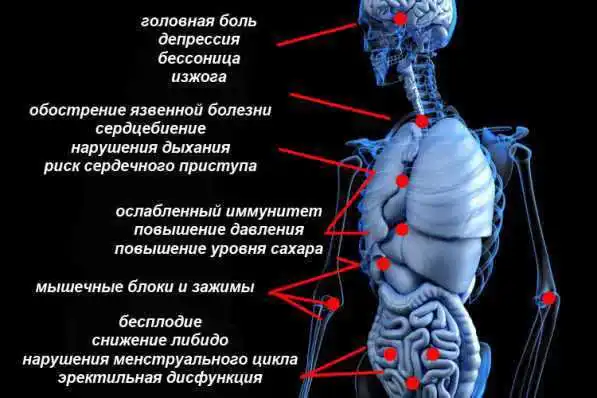
Under stress, many different reactions and changes take place in our body, across various systems and organs:
- Cardiovascular;
- Respiratory;
- Endocrine;
- Central nervous;
- Immune;
- Digestive;
- Musculoskeletal;
- Genitourinary.
The central nervous and endocrine systems
When the hypothalamus triggers the "fight or flight" response, the adrenal glands release cortisol and adrenaline into the blood. These hormones speed up the heartbeat and the breathing, sending more blood to the areas that need it most for defence or attack. Mostly that means the muscles.
Once the threat is gone, the hypothalamus tells all organs and systems to return to their normal state. But if the CNS (central nervous system) keeps responding (inhibition does not set in), or the stressful situation has not been resolved, the release of hormones continues, with the corresponding reactions of the body.
The respiratory and cardiovascular systems
When the hypothalamus triggers the "fight or flight" response, the adrenal glands release cortisol and adrenaline into the blood. These hormones speed up the heartbeat and the breathing, sending more blood to the areas that need it most for defence or attack. Mostly that means the muscles.
Once the threat is gone, the hypothalamus tells all organs and systems to return to their normal state. But if the CNS (central nervous system) keeps responding (inhibition does not set in), or the stressful situation has not been resolved, the release of hormones continues, with the corresponding reactions of the body.
The respiratory and cardiovascular systems
We remember that the stress response shows itself in our starting to breathe far faster than usual. This is needed to move oxygen-rich blood quickly to all the muscles. So if you already have lung problems such as emphysema or bronchial asthma, this kind of breathing can trigger a worsening of the condition tied to those diseases.
Under stress our heart starts beating at a faster pace. Our blood vessels contract to supply the muscles with oxygen and give us more strength for a quick reaction, and blood pressure rises accordingly.
As a result of chronic or frequently repeated stress your heart works hard and at full stretch, which over time wears out the heart muscle. Together with raised blood pressure, this increases the risk of strokes and myocardial infarctions (heart attacks).
The immune system
In short-lived situations, the boost that stress gives the immune system is a great plus. This response helps us heal wounds faster and avoid possible infection. But because chronic stress wears the immune system out quickly, the body's defensive reactions to foreign bodies will later decline. Colds, flu, acute respiratory viral infections and other infections get more easily into the body of a person exposed to chronic stress. It will also increase the time you need to recover and get back on your feet after illness or injury.
The digestive system
The rapid breathing and heartbeat that come with stress can also disturb the normal working of the digestive system, and of the stomach in particular. Stress on its own does not cause a stomach ulcer, but it markedly raises the risk of one flaring up or appearing. And one of the reasons will be increased secretion of stomach acid, accompanied by heartburn or acid reflux.
Constant stress will also affect the absorption of food, which leads to heartburn, acid reflux, diarrhoea or constipation. Possible reactions from the gastrointestinal tract may be vomiting, nausea and abdominal pain.
To raise our energy during the stress response, our liver produces an extra supply of glucose. Accordingly, if stressful situations have become chronic, the pancreas simply cannot cope with processing the extra sugars, and the outcome is a risk of developing type 2 diabetes.
The musculoskeletal system
Your muscles are meant to relax once the stressful situation is over. In chronic stress mode the muscles stay permanently tense, though that was only ever needed for a short spell. In a state of constant micro-injury, trigger points and "tensions" form; they cause pain and stiffness in the back and the neck, and are behind headaches, dizziness and constant fatigue.

The genitourinary system
There is nothing surprising in the fact that stress wears out not only the mind and the body, but is also a reason for lowered libido (loss of desire). Short-term stress, of course, is not a reason for testosterone levels to fall, but chronic stress is.
With constant stressful situations, testosterone in the blood begins to fall sharply. This comes with reduced sperm production, causes erectile dysfunction and can lead to impotence. On top of that, chronic stress raises the risk of infections of the genitals, the testicles or the prostate, which, as you will remember, is linked to a weakened immune system.
In women, chronic stress states may come with an irregular, painful or longer menstrual cycle. The physical signs of the menopause, "hot flushes" for example, can also grow stronger under stress.
Take care and stay healthy!