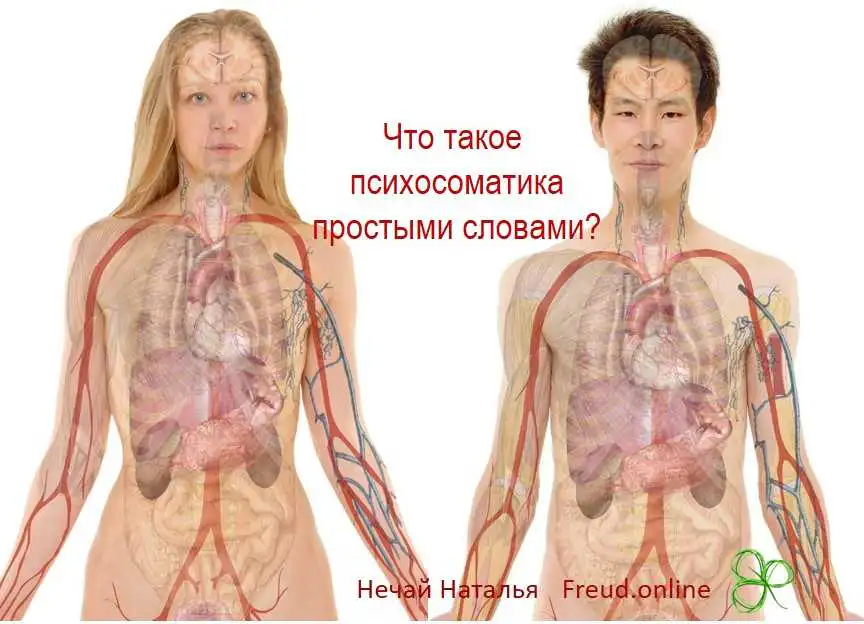
Many people live a healthy life, eat properly, do sport, are emotionally stable — and still cannot call themselves healthy. And questions arise: why? how come? Many times I have seen situations in which all the tests, all the possible examinations and check-ups have been done and all the doctors say with one voice that everything is fine, while the person is ill, complains, suffers. Seventy years ago no one spoke or thought about psychosomatics, although it was known back in antiquity — “psycho”, the soul, and “soma”, the body — but somehow, at some point, traditional medicine began to treat only the body and to forget the psyche (the soul). Today we are gradually coming back to the idea that a human being is a single, many-sided system in which everything is interconnected, and that the disturbed balance of this perfect nature is the cause of illnesses. Today doctors no longer deny that psychosomatics exists, and they refer patients on for psychological help.
In this article I will tell you a little about the history of psychosomatics and about how to work when there are several illnesses at once.
The history of psychosomatics
Every person can live a happy life if they live in accordance with their nature, keep a sense of proportion with the help of wisdom, strive for justice and take responsibility for their own actions. Democritus
The ancient philosophers already tried to make sense of the notion of health. They came to the conclusion that a person's health rests on three pillars — the body (its aesthetic beauty and stamina), morality (the psyche, the soul) and activity (the mind). Philosophers of different schools, for all their disagreements, agreed on one thing: that health depends on a person's way of life and behaviour. The forefathers of medicine — Hippocrates, Avicenna — never separated the human body from the mind and the soul. Psychosomatics was born in deep antiquity. Today no one doubts any longer that illness is nothing other than the body's reaction to disturbed processes in a person — psychological, spiritual and emotional processes that have departed from nature.
Today the best-known specialist in psychosomatics is Louise Hay. Her contribution in this field is undeniable: she brought illnesses and their emotional causes into a system and also pointed out a direction (affirmations) towards recovery. She is convinced that if a person finds and becomes aware of their emotional problem, they will be able to forget their illness.
Like the philosophers of antiquity, she too says that the norm, that is, health, means living the way nature created us.
Avicenna
best-known
psychosomatics
Hay
-
Let us add a little to this statement. Yes, we fall ill because the balance in our nature, between our “systems”, is disturbed; we have plunged so deep into the fast current of modern life that we do not feel our body, do not feel the signals it sends us. In reality an illness never comes suddenly — there were always small signals before it that we did not hear. Our organism is magnificent, it can tune itself, adapt and heal itself as well, but time and again we do not let it do that, because we are running and rushing about, because it is easier to throw pills into our mouth and run on; and then, when it becomes utterly unbearable, we go to the doctor and “hand over” to them the responsibility for our own organism. We forget that our emotions affect our body.
Nowadays anyone can find information about psychosomatics and thereby help themselves, find a “clue” and understand what the cause of their illness is. But the sheer variety of information can also confuse and, so to speak, hold attention on the surface; add to this the fact that few of us have only one health problem. And what should you do if the emotional causes of one illness differ from the emotional causes of another? We will talk about that below.
Louise Hay brought us back to the attitude to health that existed in antiquity. She reminded us of the connection between all three systems, she created a “new” (well-forgotten old) direction in psychology. Over the last 50 years this direction has been developing and “growing” new knowledge: practical observations by specialists, collected studies and records of counselling sessions.
To be healthy you have to learn to hear these small signals of the body, to analyse them, to connect them and to become aware of which emotional state a signal is linked to, and then to look for a way to “balance yourself”, to “get rid of this negative emotion”, to “take it under control” .....
Yes, yes — this is possible for everyone, you just have to walk towards yourself in small steps every day
Natallia Nechai
Let us also not forget Wilhelm Reich, one of S. Freud's pupils, whose name is linked with a direction in psychology known as body-oriented psychotherapy. Reich knew psychoanalysis and noticed that a patient's neuroses gather in the body and form the so-called “muscular armour”, better known under the names “tensions”, “blocks”. In his works and studies Reich confirmed the influence of a person's psycho-emotional state on the emergence of illnesses.
If we drive a problem out through the door, it then comes back in through the window as a symptom of illness.
Sigmund Freud
Human health has always drawn my attention. In 20 years of medical practice, even before I moved into counselling, I gathered a mass of interesting observations. Caring for a sick person is not only drips, injections and dressings; it is first and foremost a kind word and human contact. It is not the medicines that treat a patient, but attention to their problem: to listen, to comfort, to encourage. The conversations with patients behind me are past counting — their life stories, their own analysis of the causes that led to their illness, their road to recovery.
Fate had it that I moved into counselling with a huge amount of medical experience and knowledge behind me, and the subject of psychosomatics found me by itself and decided to become my friend and partner.

A short explanatory dictionary
Psychosomatic medicine and psychotherapy — a medical specialty for identifying and for treating and preventing, medically as well as psychotherapeutically, illnesses in which social and psychological factors play a role in bodily and mental health.
How do you decode illnesses and complaints properly?
To understand the whole depth of psychosomatics you need at least a minimum of knowledge of human anatomy, physiology, the working of the autonomic and the central nervous system, pathological physiology, psychology, neuropsychology, perinatal psychology, acupuncture and personality typology.
When I talk with clients, they look at me with surprise or suspicion, wondering whether I am clairvoyant or an alien, because I can say something about their personal life before they have told me anything about themselves. The answer is in fact simple. If you know which emotions illnesses are linked to, then you easily know what a person has been through in life.
The experience and knowledge gathered in the field of psychosomatics to date can assure you that a person cannot fall ill with diabetes without experiencing deep sadness or disgust towards a situation they went through in the past.
You may object and say:
— Now look here, there is such a thing as congenital type 1 diabetes, an autoimmune disease of the endocrine system: what sadness or disgust could a newborn child possibly have had?!
And this is the answer that follows:
— At first glance I understand your surprise; but if you know perinatal psychology, the answer can be put like this. There is a high probability that the mother's emotional state during pregnancy is directly linked to the physical and mental health of the child.
As I have already written above, very often a person has not one illness but several, and often ones that at first glance are unconnected. You have read what one illness is linked to, and the second, and the third, and then you can come to a dead end and not know where to begin, which “stuck” emotion to work with?
The first thing we look at -is: which illnesses were there already in childhood?
Second — are there chronic illnesses, “sleeping” ones, so to speak, that do not remind you of themselves?
Third — how often and under what visible conditions do the health problems listed above appear.
Fourth — we decode every illness and every small complaint and look for a feature they share, that “common thread”, so to speak!!!
Fifth — at the beginning we work only with what resonates with the client, even if we understand that this is merely the “tip of the iceberg.
Understanding the client's personality type helps to divide the “symptoms” into those linked to an emotional imbalance and those that are natural for that personality type.
In the articles to come I will decode frequently occurring illnesses and also give affirmations for self-help.
Deep profiling. Training. Personality typology
The art of reading people is not a secret technology used by agents. Training in profiling is simply 100 years of observation, applied in life