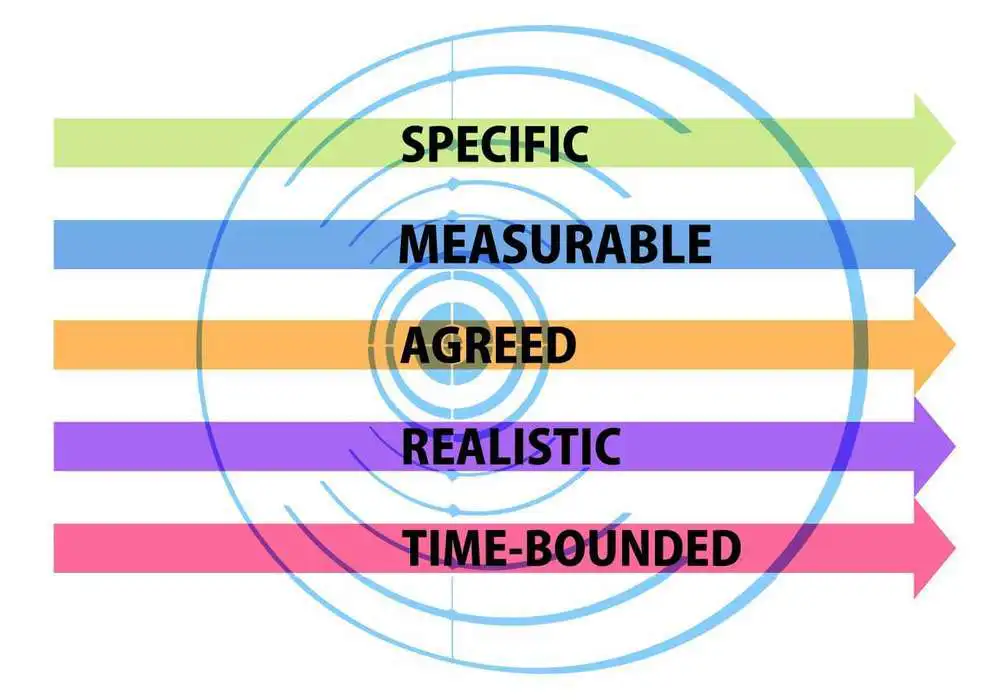
So, let's talk about goals. Or rather about SMART, the system for setting them properly. Do you think these are simply clever goals, from the word smart, or is there something hidden behind it?
It is not just a word, it is an acronym.
S-pecific
M-easurable
A-ttainable
R-ealistic
T-imely
How SMART works
Type a query about SMART goals into the internet and Google will give you 260 million results. Why? It is simple: because it works.
By breaking our goals down into definite components we make them specific and, in a way, help ourselves to reach them. We set our brain to work on finding ways of getting there. There is one more condition for SMART goals: these are goals with a horizon of at most 3 years, otherwise the motivation to achieve them drops and we simply slip into the ranks of daydreamers.
So, from words to practice. What should a goal look like?
Specific: a specific goal has a far better chance of being reached than a general one.
To set a specific goal you have to answer six questions:
- Who: who is involved in the process?
- What: what do I want to achieve?
- Where: name the place.
- When: set the time frame.
- What: define the requirements and the constraints.
- Why: the specific reasons, the purpose or the benefits of reaching the goal.
An example
A general goal would sound like this: «I want to be rich».
But a specific goal would sound like this: «I want to earn a lot of money».
Measurable — set definite criteria for measuring progress towards each goal you set. When you measure your progress you stay on track, you meet the deadlines you set and you feel the thrill of achievement that spurs you on to keep making the effort your goal requires.
To work out whether your goal is measurable, ask questions such as:
- How much, exactly?
- And how many were there?
- How will I know when it has happened?
- Let's sharpen our goal: «I want to earn 5,000 euros a month»
Attainable — once you identify the goals that matter most to you, you begin to see how you can make them real. You develop the attitudes, the abilities, the skills and the financial means to reach them. You start to notice opportunities you had previously missed for coming closer to your goals. You can reach almost any goal you set if you plan your steps sensibly and set time frames that let you carry those steps out.
Goals that may once have seemed distant and out of reach eventually come closer and become attainable — not because your goals shrink, but because you grow and expand to match them. When you list your goals, you build your self-image.
You see yourself as worthy of those goals and you develop the traits of character that let you have them.
And so
«I want to earn 5,000 euros a month or more by changing my job».
Realistic — to be realistic, a goal has to be one you are willing to move towards and able to work on. A goal can be both ambitious and realistic; you are the only one who can decide how high your goal should be. But make sure that every goal represents substantial progress.
A high goal is often easier to reach than a low one, because a low goal has little motivating force. Some of the hardest tasks you have ever done actually feel easy simply because they were a labour of love.
Our goal: «I want to earn 5,000 euros a month or more by changing my job and putting to use the knowledge I gained at art college».
Time-bound — a goal has to be reached within a set period. With no time frame attached to it there is no sense of urgency either.
If you want to lose 10 kilograms, you need to know when you want to lose them. "Some day" will not work. But if you pin the goal to a definite period, "by 1 May", you set your subconscious in motion to start working on it. Your goal is probably realistic if you genuinely believe it can be reached.
Further ways of telling whether your goal is realistic are to ask whether you have achieved something similar in the past, or to ask yourself what conditions would have to be in place for this goal to be reached.
Our goal: «I want to earn 5,000 euros a month or more by changing my job and putting to use the knowledge I gained at art college, starting from January 2022». Our goal is entirely realistic, and one of my clients has reached it: she changed her profession, took up the work she loved and became a first-class professional in it. She now earns 10,000 euros a month and more.
It is important to remember that a goal has to be realistic for you. Take a look, weigh up the situation around you and go for it! And yes, do not forget that you also have to write out the steps that will take you towards that goal. The word DO matters enormously in reaching a goal! Setting it matters, but moving towards it matters even more!)