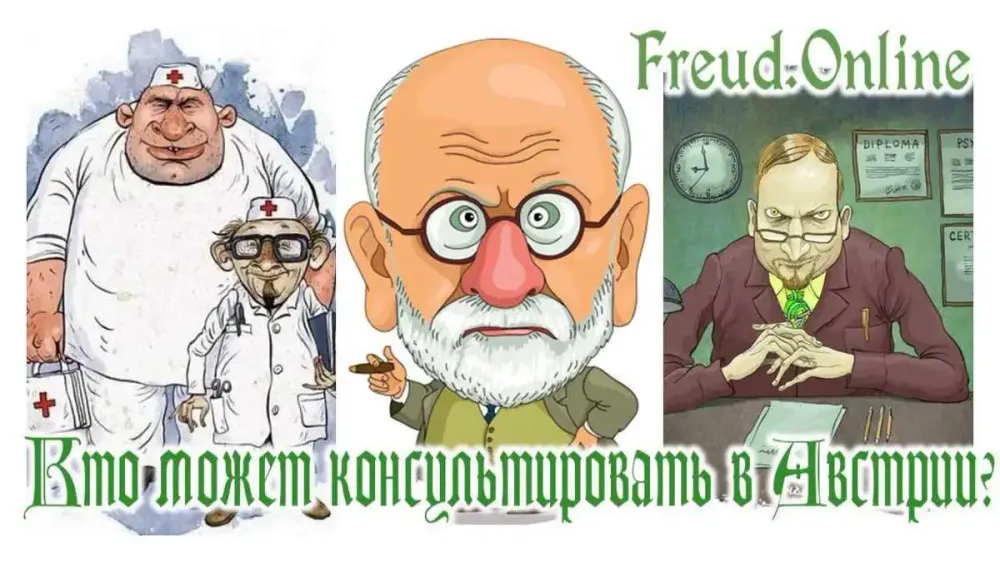
Who is allowed to offer psychological counselling in the homeland of psychology, in Austria? Are there any requirements for a psychologist? Do you need a psychologist's licence? In this article we
- look at what a counselling specialist in Austria does and how the profession is regulated,
- take apart the most popular myths and misconceptions about it, and
- see how the law tells a real Psychologist from an armchair psychologist (luckily, that is easy).
If you are looking for a psychologist or a psychotherapist in Austria, use the button below:
In Russia and Ukraine no licence is needed, and that leads to a familiar situation
From there it is a short step to the predictable jokes about the psychologist as "the cobbler with no shoes". From there — to armchair psychology, to contempt for an entire scientific field and to... the impossibility of getting professional psychological help. But the situation is not that far gone everywhere.
In Austria, the homeland of psychology, they saw through this problem back in 1989 and introduced very restrictive requirements for the profession. There are no coaches and no trainers here as professions. What there is, is the life and social counsellor (Lebens- und Sozialberater, LSB) — a profession that requires a trade authorisation and a licence, formal training with a final thesis, 150 hours of personal therapy and 100 documented counselling sessions under a supervisor. Put more broadly and briefly, Austria has:
- Psychologists, who work with tests and statistics and may not counsel people
- Life and social counsellors (LSB, the closest thing to what Russian speakers mean by a counselling psychologist), who help people get rid of neuroses
- Psychotherapists, who work with people who have a clinical diagnosis made by a psychiatrist, and
- Psychiatrists, who prescribe pills and a course of psychotherapy... that is clinical territory already.
But let us start with a simple question
What is psychological counselling?
In Austria the list of trades is officially regulated. In every case they have to be "registered" (gemeldet), that is, the authorities have to be told that a person is practising them. There are free trades (freies Gewerbe) that require no certification (see the official list on the website of the Ministry for Digitalisation). And there are regulated trades (reglementiertes Gewerbe) that require experience and proof of that experience (see the list of regulated trades).
In Austria, psychological counselling is a trade that requires a state licence. It is governed by §119 of the Austrian Trade Act (Gewerbeordnung 1994). It is defined as follows:
A trade authorisation is required for the counselling and care of people, in particular in connection with personal, marital and family problems, problems of upbringing and problems in the professional sphere, as well as sexual problems. This also covers psychological counselling, with the exception of psychotherapy.
Einer Gewerbeberechtigung für das Gewerbe der Lebens- und Sozialberatung bedarf es für die Beratung und Betreuung von Menschen, insbesondere im Zusammenhang mit Persönlichkeitsproblemen, Ehe- und Familienproblemen, Erziehungsproblemen, Berufsproblemen und sexuellen Problemen. Dazu gehört auch die psychologische Beratung mit Ausnahme der Psychotherapie.
The details of what the regulated scope of psychological counselling contains are set out in an information leaflet for the authorities dated 20 March 2006
This is counselling, coaching, mediation and support for people and organisations in the fields of personal development, finding oneself, solving problems, improving personal relationships and socialisation
Informationsblatt für Gewerbebehörden №2 vom 20. März 2006. Tätigkeitskatalog des Gewerbes der Lebens- und Sozialberatung.
And, importantly, in Austria psychological counselling is governed by a separate piece of secondary legislation,
The personal sphere
In the personal sphere, counselling covers topics such as:
Personal development:
- Building self-esteem, discovering your own values, achieving goals and planning the future,
- Decision-making, weighing up the options, working out life strategies,
- Personal development and learning: what to do in your free time to strengthen your personal resources,
- The emotional attitude towards money, support in dealing with financial problems,
- Psychosocial issues — loneliness,
- Support in social and personal crises.
Career
- Choosing a profession. Career strategy. Preparing for job interviews.
- Time management and dealing with stress. Motivation, capacity for work and job satisfaction
- Support with mobbing and burnout. Work-life balance, reconciling private and working life
- Mental hygiene at the workplace, workaholism.
Life crises
- Accompanying people through the stages of life.
- Support in illness and death. Mourning. Living through the loss of someone close.
- Support for older people, counselling for their relatives and for nursing staff.
The interpersonal sphere
In the interpersonal sphere it is help in the following areas:
Relationships, family and children
- Partnership and marriage. Resolving conflicts and crises, stabilising a relationship,
- The family climate, the dynamics of family relationships,
- Support during a divorce, the ending of a relationship,
- Upbringing, pedagogy, children's behaviour at school, in learning and in exams,
- Sexuality. Questions of sex education, of identity and of sexual behaviour.
Group interaction
- Conflict resolution. Analysis of values. Communication that prevents conflict. Mediation and going between the parties,
- Group dynamics. Working in a team. Analysis of interaction in society,
- Supervision. Supporting a person in carrying out tasks in the professional and social sphere.
Communication skills
- Conversation technique. Training in verbal and bodily communication,
- Social behaviour. Learning social habits and logic, developing "emotional intelligence" in dealing with other people,
- The variety of forms of communication and of behaviour in relationships. Negotiation techniques,
- Cooperation and interaction in groups. Overcoming resistance in the person you are talking to.
Fables about psychology
So we have established that the Austrian LSB corresponds, in terms of what it does, to what Russian speakers call a counselling psychologist. Given that Russia has no such thing as statutory requirements for psychologists at all, let us take apart the most ignorant "transfers" and fables. Sadly, these fables get in the way of finding a specialist who can help in critical life situations just as much as they allow people with mental disorders to put on a white coat and introduce themselves as "psychologists".

Fable #1: after university a psychologist may counsel clients
In fact a psychologist is a statistician with no right to counsel anyone on personal matters. Anyone who has graduated from university in psychology (plus two years of a master's degree) may use the title. But there is no such profession. These are the people who test children for career aptitude, run scientific studies and produce the work behind headlines like "British scientists have found". The biggest revelation is that psychologists may not counsel people on personal matters. For that they first have to gain some practice working with living human beings.
A Master of Psychology can earn the right to counsel by taking further training after university as:
- an LSB, that is, a counselling psychologist (the curious part being that the latter does not need a university degree at all)
- a clinical psychologist (klinischer Psychologe) or a health psychologist (Gesundheitspsychologe)
Fable #2: a life and social counsellor deals with social welfare matters
Lebens- und Sozialberater in Austria have nothing in common with the profession of a psychologist or a psychotherapist. That is more the level of a social worker!
A comment on Facebook
In fact, among Austria's social workers you will as a rule not find a single Lebens- und Sozialberater. Those posts are taken by psychotherapists)))) The curious thing is that the specialists who ought to be helping people with a CLINICAL diagnosis often work with HEALTHY people and, most interestingly of all, deal with matters such as settling a conflict between warring parents at a school. In other words, a PSYCHOANALYST (one of the branches of psychotherapy) will be doing the mediation, while the people trained precisely for settling conflicts (the LSB) are kept out for political reasons. Which, by the way, is well known within the profession and regularly spills over into rows between the Austrian health ministry and the economic chamber. It comes out in reproaches like this:
Healthy people are of no interest to anybody here
The head of the counselling branch in Austria (no names)))
Fable #3: to become a psychotherapist you need a university degree
In fact, to become a psychotherapist you do not have to study psychology at university. It is enough to complete the preparatory training (Propädeutikum) and then the specialist training (Fachspezifikum) at a psychotherapy school recognised in Austria.
Psychotherapists are the people who treat psychoses, or severe, persistent and maladaptive disturbances in a person's behaviour and perception — people with a clinical diagnosis, referred by a psychiatrist.
Fable #4: a psychiatrist cures psychoses
Psychiatry is a branch of medicine. It is the only one of the fields discussed in this article that requires a completed medical degree. And it takes years of additional practical training.
But here the curious part is a different one: a person who ends up in a psychiatric ward is not cured. They are stabilised, pumped full of pills so that in the rare moments of "lucidity" they can at least temporarily work with a psychotherapist.
The mark of quality, or why Austria has no armchair psychologists
And now, attention! In Austria the right to counsel people personally is held by:
- Life and social counsellors (LSB)
- Psychotherapists
- Clinical and health psychologists
What is required of the professions that are allowed to counsel? Or: "why not everyone who wants to be called a psychologist can work as a counselling psychologist". These requirements are set out in the relevant ordinances Lebens- und Sozialberatungs-Verordnung and the Psychotherapy Act (Psychotherapiegesetz).
Requirement — Life and Social Counsellor — Psychotherapist
Theoretical training — 584 hours — 1065 hours
Therapy (individual and group) — 150 hours — 250 hours
Practice — 750 hours — 2150 hours
Counselling sessions conducted independently — 100 sessions — 600 sessions
Supervision (review by a teacher) — 100 supervisions — 120 supervisions
That is exactly why a person holding an official licence as a psychotherapist or a life and social counsellor can be trusted. Otherwise, how are you to tell a psychologist from a psycho?
How can you check whether a "psychologist" holds a licence?
It is simple. There is an official register of life and social counsellors kept by the economic chamber. And every psychotherapist in Austria is listed on the page of the Austrian Ministry of Health.
There is one more way of working legally without holding a licence yourself: people who have trained as a life and social counsellor or as a psychotherapist may work under someone who does hold a licence and who therefore bears responsibility for the person they employ. In that case, check who this person works for and whether that employer appears in the list below. Press the buttons below, look for the name, check!
Since any counselling on personal matters — on relationships, family and children, group interaction and negotiation skills — requires a state licence in Austria, check the person's surname on the page of the Austrian trade information system GISA (Gewerbeinformationssystem Austria)
Official sources have one drawback: there is no way to find a psychologist who speaks your native language (Russian, Ukrainian, Belarusian, ...). The state registers of some professions — of clinical psychologists, for example — do record the languages spoken.
For the other specialities there is a semi-commercial portal where you can also search by the languages spoken, and which asks for proof of a licence at registration. Some of the specialists there will no longer hold one (there are continuing-education requirements too))), but it is better than nothing...