I live in Europe and have moved between big employers. In this article I share the particulars of the job hunt itself and answer the question of how to get through a job interview in Austria successfully.
What is special about Austrian recruiters?
How do Austrian interviews differ from what people are used to back home? The answer is simple: across twenty firms and corporations I met only two experienced recruiters over 40. The trouble is the usual one — most firms are a perfect match for the Austrian norm, that is, they hire young graduates straight out of university for low pay. When I am being interviewed by a young woman of about 25 whose LinkedIn profile says she left university two years ago and has three years of experience, what "stress interview" are we talking about? Who exactly is she going to put under stress?
Against that background one headhunting company stood out, one that actively promotes its candidates. I do not know whether they want to appear in an advert, so for the details write to me, Dimitri Korenev. What struck me was this:
- I was looked after by a young woman "hunter" (as in headhunter), who got in touch once a week and checked what I was up to among the competition.
- Before each interview the "huntress" checked who was going to interview me and gave me hints on how to behave.
- After the interview she rang round both me and the employers herself and collected their impressions of me. I had informal feedback within two days.
- After the successful third interview, but before the offer arrived, she agreed the possible salary with me, the minimum and the maximum.
- Once the employer's offer had come in she rang me and checked whether I was planning to jump ship at the last moment instead of signing the contract.
In other words, she ran the whole thing in proper Hollywood style, like in the film "Headhunter calling"

Bringing "huntresses" like that into your job search gives you at least two advantages:
- It seems to me that her mere presence noticeably tipped the decision my way. If only through the sense of "owing" her for the work she had put in.
- From the "huntress" you get the feedback you will NEVER get directly from the HR department. If you are turned down, for example (see below), you will as a rule never find out the reason from the company itself: are you underqualified, too expensive, or did the boss simply not take to you?
You will agree, that is very useful. But not with every agency in Austria. Many of them simply work sloppily.
When is the fastest time to look for a job?
Austrian corporations, like corporations everywhere in Europe, live in yearly cycles, and that shows in the number of open positions and, more importantly, in how badly the company needs staff.
- January — the hangover and the slack time. The year's targets were closed in December. The clients are still celebrating. Too early to start anything.
- February — slowly waking up from the winter and Christmas hibernation, which lasts until March. The first deals, talking clients into new contracts that will be signed in the second half of the year.
- April is reporting time, the balance sheet is published. More importantly, everyone is waiting for the accountants to finally count the profit that the BONUS will be based on!
- Hiring just before the summer does not pay off — employees who start in the middle of the year are legally entitled to a bonus in that same year. Whereas if someone starts later, they may well see no bonus for that year at all.
- Then come the first summer months and everybody goes on holiday. At the same time there is budgeting, fitting growth curves in Excel and deriving the staffing needs from them. By the end of the summer the budget for the next year is approved, and with it the plans for growing the headcount. That is the good moment to be looking for a job.
- From July the pressure on the labour market grows. Staff are needed, all the more so because you simply must grow your own department (that makes it harder to sack the head of it).
- In August they start hiring in a hurry.
The conclusion: for the employee it pays to join a corporation in May. The bonuses have been paid out, the pressure has eased, the bosses' "new year" has begun. At the same time the employee can still get a bonus for the whole year. As for the company, it needs people from September. Plan accordingly).
How long does the process take?
The whole process takes an average of 2 months from the moment you send in your CV. As a rule, HR will forward your CV straight to your future boss. First two weeks will pass before he finds the time to read it.
In about 3 weeks the first interview takes place (there are two altogether). At the first one you will meet your boss and someone from HR. Then a pause of two weeks, possibly the holiday season as well.
At the second interview you will meet the BOSS (the head of the division), the head of the department, and the same recruiter again. So do not be in a hurry)
What is the philosophy of an interview?
The soundest inner setting is this: they are taking a good look at me, and I am taking a good look at them. The firm is looking for an employee, I am looking for and choosing a firm. It is entirely possible that working at this firm will not interest me. It is entirely possible that the boss will not take to me.
No matter how much we practise, with mentally rehearsed calm, ready-made answers and attention to how the conversation is going, you can control 80% at most. The other 20% lie in the dimension of chemistry and do not depend on us. So if a rejection comes, it means one of three things:
- You are underqualified. They will tell you that straight away.
- You did everything right, answered well and adapted, but you are overqualified. That is visible from your CV and from your self-assurance. Here a rejection is a great thing! You have been saved from a boring job.
- You did everything right and your qualifications fit. But you do not control the mindset of the boss. Maybe you are too ambitious and the boss is an insecure creature. Maybe you simply do not match his values. This is where the "chemistry" comes in: you do not "smell" right. And that is exactly the 20% in life that is beyond our control.
So you can happily fire off your CV left and right, everywhere something is cooking. Which does not free you from the duty of writing the cover letter "properly" and tailoring your standard CV to the job description.
How do you tailor a CV to a position?
I do not know how it went for you, but after my first five interviews I had the following templates ready:
- A long CV describing my work experience, education and all sorts of skills, about two pages.
- A cover letter with a stack of prepared paragraphs explaining why I want to work for this particular firm.
- A list of projects, about four pages.
Now, the only document you will not change for different employers is the list of projects. The rest — the CV and the cover letter — will have to be assembled from templates and made "individual".
How do you tailor them? Take the job ad and copy it into Word. Put every sentence, or every requirement of the position, on a separate line. Then read it carefully and highlight (in bold, in colour) the key words and phrases that you are going to transfer, plainly and simply, into your own CV)))).
The CV
This is ONE page. Not two, not three, and so on! The aim is that both the boss and the HR person can hold it in one hand and see in it the key words for the tasks and the speciality.
To do that, take our long CV template and DELETE EVERYTHING SUPERFLUOUS! What is left is one page of text containing the skills from the job description. Why? Because Austrian companies are not looking for geniuses who can do everything. They are looking for cogs in a machine, able above all to carry out one narrowly defined task. The danger is too great that a person with many skills will be seen as a potentially dangerous free spirit under the pretty label "OVERQUALIFIED".
So as not to look too clever and to hit the job description precisely, tailor the names of your skills to the ad as well. Instead of OLAP write, say, Business Intelligence.
The cover letter
This is the second ONE-page sheet. Its aim is to get through the HR filter. It answers the question of why I want this particular firm and this particular job, and why I fit the position. Recruitment agencies attach little importance to this piece of writing. At best they see it as the link between the CV and the list of projects. For applying to companies directly, though, the motivation does matter.
Writing it is even more fun. Take the ad and carry the key phrases from it over into the letter. If the ad speaks of "innovative thinking and quick wits", for example, you write exactly that: "I am an innovative and quick-witted specialist".
Hardly anyone read my cover letter. You can tell from the standard question "why do you want to work for us?" To improve the chances that your text copied from the ad will actually be read, you can insert a PowerPoint picture with a "spider chart" of your skills. And then, if the question "what makes you good for us" is asked after all, you can answer with a straight face and a sly look: "as I wrote in my letter, ..."
Which questions "caught me off guard"?
At special training sessions you can run through the typical recruiter questions in a role play and get a feel for them, along with the answers that close the topic and leave no room for follow-up questions. In the post-Soviet countries the experience of "stress interviews" is rich and colourful, but in Austria "stress" is in short supply. Austrians are peaceable people, inclined to compromise. So out of, say, thirty prepared answers for a "stress interview", at most a third came in useful. Which gives you extra confidence in the conversation.
- "Why did you leave your previous job?" Asked at almost every meeting. Why did you leave a well-paid, secure, interesting job?
- "Why did your career go up and then stop?"
- "What makes you good for our firm? Why do you think we are a good match?"
- "What mistakes have you made in a management position?"
- "Let us do a role play." That was the biggest hit, and the one I was not ready for. The interview was one to one with the boss, for a management position. He played an employee who hid behind the rulebook and did not want to do the work. My task was to "motivate" such an employee.
Where can you learn to handle interviews?
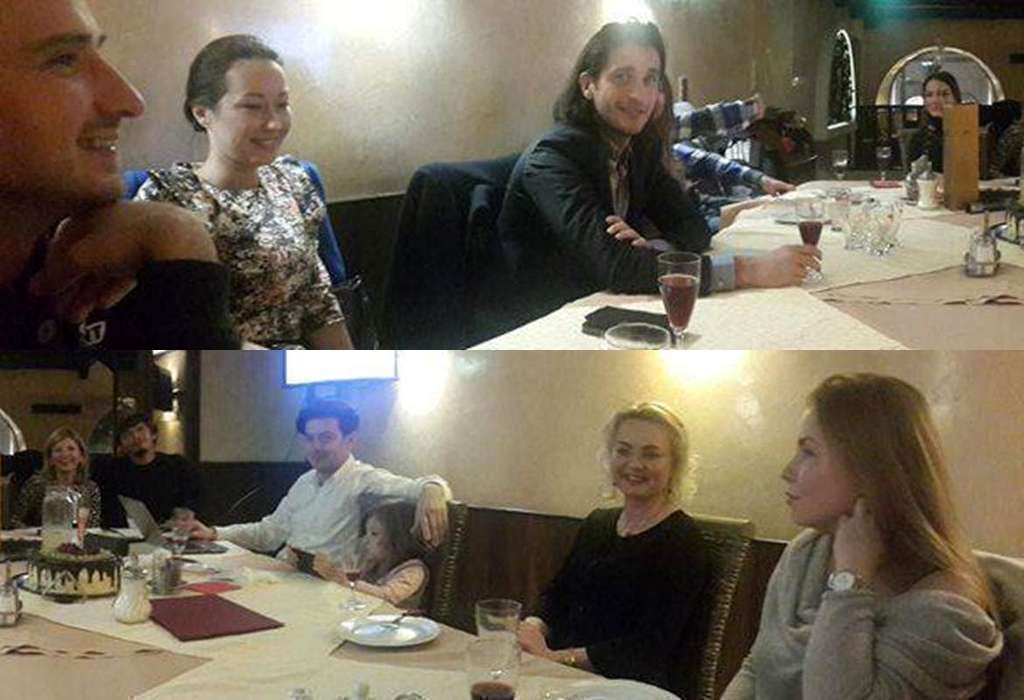
At our club meetings. One of our favourite tools for practising negotiation skills is acting out interview scenes on camera. The host's barbed questions, the veiled hints, an audience and the watchful eye of the camera will throw anyone off balance. Afterwards the recording is analysed second by second: where you sat awkwardly, where you froze, where your gestures gave away confusion and panic. And of course it starts with preparation: which questions recruiters ask at interviews, what they expect to hear, how to answer "properly".
Watch this video. The "recruiter" is needling me, the "job applicant". It is the typical format of our practice sessions. By that point I had six months of preparation behind me and about five interviews.

Watch how the recruiter tests the applicant, which questions he asks (taken from real interviews), and how exactly he tries to get under my skin. And at which minute did the recruiter manage to knock me off balance? By changing my body position I brought my inner state back into balance.
If you would like to learn how to handle a job interview — send us a query and come to our meetings)