Dear people! For months many of you have felt that you are being steered and manipulated from a distance. Some of you are certain of it, others find it hard to trust their instincts. I advise you to do so, because your instinct is your best friend. Read the translation of an article from https://www.wochenblick.at/, and also the translation of an article about the research carried out by Manuel Schabus, professor at the University of Salzburg; the original is at https://salzburg.orf.at/stories/3088768/
"I am an economic and social psychologist, I see the mechanisms by which this is happening, and I can call them by name. That is why I consider it my duty to inform people about how manipulation and mass control work" - a comment by Katy Pracher-Hilander
The biggest experiment in history
I want to protect myself and those people who have become victims of manipulation (especially children, adolescents and older people, who cannot help themselves), but also to stand up for my own field of knowledge, because I will not stay on the sidelines and I want to tell you how the knowledge of psychology is being used (once again!) for the dark side of power. And from me they will get a clear and definite NO.
Since the beginning of 2020 I have been a witness to the largest modern socio-psychological experiment in the history of humankind. It is plain, however, that psychologists are offering their knowledge so that this global experiment leads to the desired result. Psychology is like a huge chessboard with an endless number of pieces and moves. Each piece stands for a particular insight.
Controlling the masses requires having no principles
In a game of chess it is not the one who knows the most pieces who commands the situation, but the one who also knows the possible moves and can think many moves forward and back. In the case of pandemic policy, however, it is enough to see one step ahead. And once again in history, controlling a crowd takes a little more than basic psychological knowledge. Psychologists have to meet only two conditions: 1. take a job as a consultant «on the other side»: and 2. have no character.
Even clever people turn into headless chickens
In March 2020 my father - a retired anaesthetist and intensive care physician - and I talked about the phenomenon of the corona pandemic. It was clear to us that here «something stinks to high heaven» ( a literal translation) and that the familiar world would become history. As a child I witnessed the overthrow of the Persian Shah, and ever since then I have known how easy it is to turn outwardly clever people into headless chickens. And what a danger they pose.
On my ninth birthday, also known as Revolution Day, I was hit by a bullet, and it was clear that we had to leave the country. Today, four decades later, I am living through it again - the manipulation of the masses. My goal is to give you - the tools to protect yourself from manipulation and to regain control over your own mind. At the very least, I have to try.
Group pressure makes people deny reality
Conformity and adaptation: good behaviour in the time of corona
Conformity - it means adapting to the attitudes or the behaviour of others - and note, regardless of the question of the meaning or the correctness of that behaviour. Conformity is the key to peace within a social group.
Anyone who dares to disturb this peace becomes an enemy of the group. Such «hostile behaviour» is punished by the group with expulsion or by other means. In the context of Corona, critics are seen as traitors who break the peace of the group. Anyone who dares to speak out against the group norm will be excluded from the in-group and from then on will be part of the out-group.
The deliberately controlled division of society is a central instrument of power in politics, because the in-group community takes on the role of a social police force. Denouncing people thus suddenly becomes practically a civic duty, and the debate about introducing labels for unvaccinated people turns into choral singing - "Let the enemy atone for his guilt".
How hard it is for many to stand up to group pressure (in which, for instance, I do not wear a mask - that is, a cheap prop from the staging of the pandemic) is shown by the following socio-psychological experiment, known as the Asch lines. This classic shows how incredibly weak people are when it comes to the opinion of the majority. The psychologist Asch asked test subjects to compare three lines of different lengths with a reference line and to say which of the three lines matched the reference line (see the illustration).
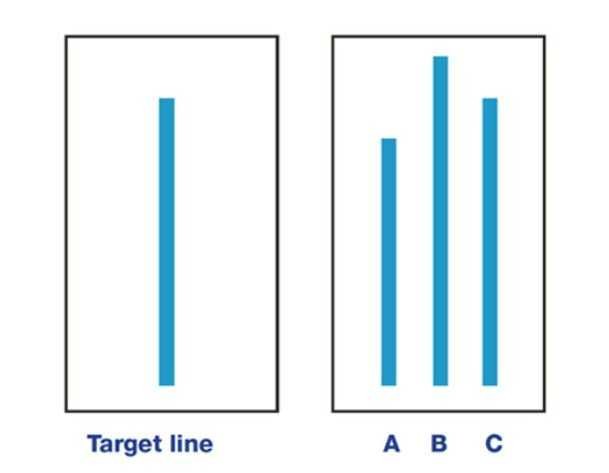
No matter how the experiment was set up, it made no difference to the result: many found it easier to side with the obviously wrong opinion of the group than to muster a little courage, give the right answer and thereby go against the opinion of the group. (The briefed participants deliberately gave wrong answers, and only one or two people were real test subjects, i.e. not briefed).
With Corona too, society walked into a trap
If you transfer these findings to the corona situation, it becomes clear how far society has fallen into psychological traps. This one example alone is enough to understand why an incredible number of doctors are betraying their moral and medical duties instead of protecting their patients.
And now it becomes clear how unbearable it must be for police officers to treat demonstrators as criminals, since they know that these are people with the moral courage to dare to say the truth: «This is wrong»!
Survey: more than 80% are critical of the coronavirus measures.
Below I give a translation of the study conducted (published 2 March 2021) by Manuel Schabus, professor at the University of Salzburg.
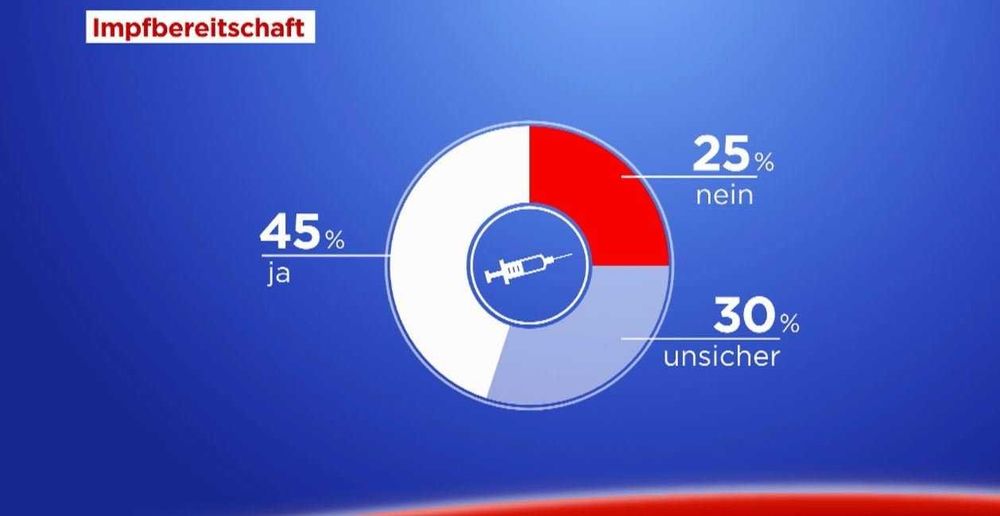
Forty-five per cent of the respondents in an online survey want to be vaccinated against CoV of their own accord or for professional reasons. 3,606 people from all over Austria took part in the study by the University of Salzburg. A great many of them are critical of the measures taken by politicians in respect of CoV.
The study ran for three weeks. Its initiator is the psychologist Manuel Schabus. About 42 per cent of those surveyed do not expect a return to normal everyday life before 2022. The researcher from the Centre for Cognitive Neuroscience at the University of Salzburg assesses this as «an expression of a certain hopelessness in the population».
After all, according to the researcher, almost the same percentage of respondents do believe in a return to normality by this summer. The aim of the study is a representative «overview of how the Austrian population as a whole assesses the current situation with the corona pandemic». The online survey is intended for people over 18 currently living in Austria.
A quarter of the population surveyed do not want to be vaccinated
As for vaccination, which has become a hot topic for many, according to the survey 30 per cent are still undecided and waiting, and slightly more than a quarter rule vaccination out for themselves altogether. Approval is somewhat higher in the group of people over 60 and over 70. Here more than half of them will certainly get vaccinated.
More than 80% are critical of the CoV measures
After all, more than 60 per cent feel «very restricted» by the measures, and almost 29 per cent «somewhat restricted». According to the survey, the general scepticism about these measures should not be underestimated: more than 80 per cent have already spoken critically about them several times or regularly in their private circle. At demonstrations or public forums, for example, almost 27 per cent of respondents speak out against these measures repeatedly or even regularly. Almost 40 per cent have felt «moments of anger or unease» in the last few weeks, because they had the feeling that the topic of «Corona» was not being covered objectively in public.
Who feels threatened?
At the same time, the study participants' concern about the threat looked like this: 14% feel themselves to be «in great danger», just under 30% consider themselves "to be in some degree of danger".
Schabus stressed that even among the older generation, those aged 60 and over who belong to the extended Covid risk group, 61 per cent feel «safe» or «in very little danger».
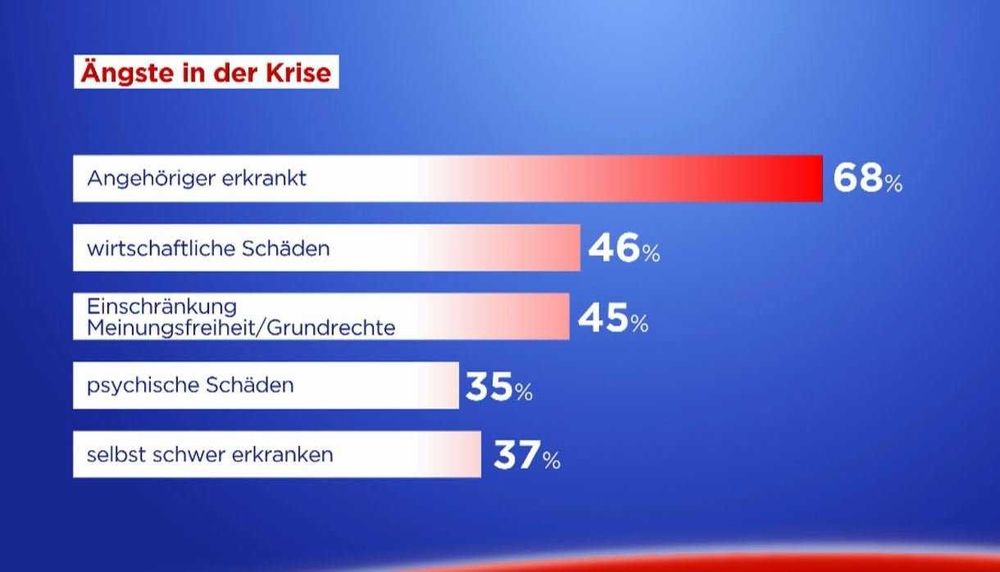
The illustration shows a chart of FEARS, from top to bottom:
- For those close to them and their families,
- Economic problems
- Violation of human rights (restrictions, the right to express an opinion),
- The impact on their psychological state (the harm being caused),
- Falling ill themselves.
An extremely heavy burden on families
What the survey participants fear most is the illness of a close relative, economic damage to themselves, restrictions on freedom of expression and on fundamental rights, long-term physical damage, even with severe symptoms of the disease, and psychological damage as a result of the Covid-19 pandemic. The last fear is even more pronounced among younger respondents. Among the stresses, social restrictions matter especially, that is, not being able to meet friends and relatives.
Parents also consider «homeschooling» to be stressful. The burden of the negative economic consequences was also one of the options that respondents often perceived as «very burdensome».
The researcher Manuel Schabus warns of the psychological consequences of distance learning. Children and young people have no clear daily routine.
«I think people slightly underestimate how important these structures are for children and young people at school and in regular meetings with friends. And that it is not only about «schooling», but rather about an all-round social approach, and that is not so easy to compensate for, because it is forbidden ».
Fear makes a person ill
If people feel constantly under stress and under threat, the likelihood that they will become mentally and physically ill increases, Schabus warns.
«Fear for a short time, of course, helps the measures to be observed, but that can last two or three months. We have been in this "package" of measures for a year already. I believe that such a prolonged effect of fear will lead to pathologies, and people will fall ill and become exhausted».
This bleak situation is especially dangerous for young people aged 18 to 29. The youngest group surveyed said that what they fear most is the long-term psychological consequences. «It is very unusual for the youngest group to have the greatest fears. And I think it is important to offer a perspective. When things will get better », Schabus stresses.
The CoV measures divide society
At the start of the pandemic people had a sense of unity, but Covid-19 and the measures taken tend to accelerate the process of social division in society. This can also be seen in media consumption, Manuel Schabus explains. «In our survey data we see a clear division of people into 2 groups. Those who watch a lot of public television, and those who watch private television more. And the groups react in completely different ways. Those who watch state television and read the state newspapers approve of the measures against the pandemic, while those who mainly get their information from the internet tend to be critical of the state measures», the researcher says.