Mikhail Labkovsky is a heavily promoted psychologist on social media. To me he is a charismatic figure — you can love him or hate him, but you cannot be indifferent. People like Mikhail teach others how to live. But how do they speak about themselves?
I came across an interview by Olga Novgorodova. Olga, being a young and beautiful woman, is interested in the eternal subject of love. But something else caught my attention. Listen to it, read it, with this question in mind: are you able to talk about yourself so openly and so publicly? So then — Mikhail Labkovsky on himself, and on how he recovered.
When I got well, I realised that love …
“When I got well, I realised that love does not exist, because I, like most neurotics, measured love by the level of distress. Most people think exactly that: it means sobbing, ‘I couldn't pull myself together for five years', falling into depression… I suffered in a different way, but I was not happy. It was a hard relationship, and, as a person of a neurotic bent, I believed that the more distress and suffering there is, the stronger the feeling. When I got well, I realised that this has nothing in common with healthy love.

As I like to joke, my first love was a cat I picked up on the street. We have a healthy relationship. When you are mentally healthy, your whole attitude to life is different. You don't divide the world into cats and dogs, pedigree and mongrel. I was simply walking home, met a two-month-old flea-ridden cat, and for four years now we have been living heart to heart.
My relationship with my child has changed enormously. I was not the best of fathers. The hardest part is that I did not accept my child the way she is. I was forever dissatisfied with her, while believing that I adored her. And the child evidently did not see it that way, because all people take love to mean being accepted the way they are, with nobody trying to remake them. And when it let go of me, I began to treat my child as a person who is simply the way she is, and I accept that, and I love my child the way she is. Leftovers remain. It gets to me when my daughter dyes her hair different colours; it winds me up.
As for women, I can't say anything at all, because what there was I do not count as normal healthy relationships, and I simply haven't had any others yet. But we shall see. But I don't think I am the only strange one, having spent so many years in such abnormal relationships. There are a great many like that.
When I fixed my head, I realised that my parents …
When I fixed my head, I realised that my parents did love me. It is just that they were hard people, and they loved hard. Even when a mother gives her child up to a children's home, she loved him in some way. But I was not sure that I was loved, because I was not accepted the way I was. And I was no picnic, because I had ADHD (attention deficit hyperactivity disorder), which means I couldn't sit still. I kept running off, I didn't study at school, I caused my parents a great deal of trouble. My parents didn't understand this either; back then there was no such thing as an EEG machine, and no decent neurologists either. By my second year at school I was already having the odd smoke and was generally a wild one. When I turned 16, on my birthday, I was lying on a bench with empty bottles scattered underneath me. My father found me, made no attempt to punish me and said: “let's go home, it's your birthday today”. Clearly, my parents were much the same as their son.
What is left of it in me? I never saw that I was loved. I always invented all sorts of reasons to prove that I was not loved. And the girls who did love me held no interest for me, because I had no experience of that. To be loved I had to do something. Study well, wash up, so that mum would praise me. To get mum to say I was a good boy, you had to make an effort. She wouldn't open her mouth for nothing. And when a girl tells you “I love you”, she robs you of any chance to get your backside off the chair; that's not interesting.
The second problem, which two-thirds of the population — and not only in Russia — go through, is when you like the people who don't like you. That's a classic. The classic neurosis of neurotic relationships. A neurotic does not need a person, he needs to make another person love him. He deliberately picks those he doesn't like, in order to carry out that task — to make himself liked. I recovered from that one too, by the way.
It is like in the film “The Irony of Fate”, the character played by Barbara Brylska. She has a fiancé, and she has absolutely no use for him. What she needs is a drinker from Moscow who has no intention of marrying anybody. His mother was pushing him into marriage. It is a comedy, but when you watch it today you don't feel like laughing at all. There is Ippolit, he loves you, he wants to marry you, and he is of absolutely no use to you.
Don't go bothering people who don't like you, because nothing will come of it, and nothing healthy will ever come of it either.
Normal healthy love is …
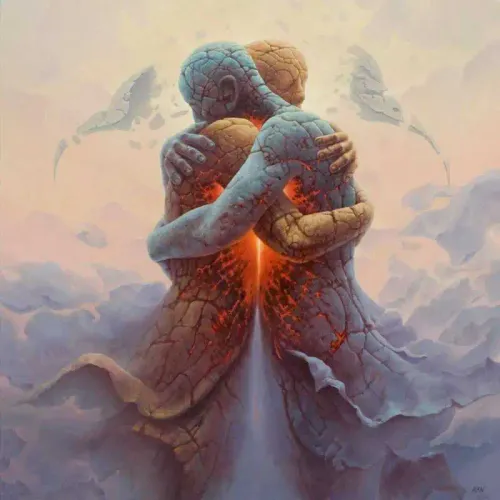
Normal healthy love is not only the acceptance of another person. It brings joy, happiness, pleasure. It is positive and creative; people pick something up from each other and become better themselves.
“Love is the experiencing of childhood emotions, and nothing more.” Giving something is the rational part. But love as an emotion is an absolute reproduction of childhood experiences.
The understanding of adult relationships is laid down in childhood by the relationship with one's parents. A child of 3 to 5 reaches out to mum, and mum, as always, is out of sorts. She might smack your bottom, she might shout, and when you come up to her you don't quite know what to expect. That is the situation: you love your mum, and she behaves in an emotionally unpredictable way, even though she loves me in her own fashion. When I grew up, I realised that she had had a childhood of her own too, a hungry wartime one. A never-ending story.
But when I got older, the first thing I ran into was that if I liked a girl, what other people call love left an unpleasant aftertaste in me. For the same reason as in childhood: I don't know what to expect next. And the second thing was that these very complicated, difficult relationships are exactly what love is. I had never seen any other kind; I had no other experience in the family in childhood.
Love is a natural emotional need of a human being, one that appears when he is born into the world. When a child is born, he has an absolute animal attachment to his mother. It is biological in nature.
A couple of words about fathers. If you want your husband to be involved with the child, then hand him the child the moment you leave the maternity hospital and go off to get on with your own business. The more energy and time fathers put into a child, the more attached to him they become. A father's feelings for the child arise out of what they do with him. He spends his energy on the child, and he develops the same kind of love as he has for a woman. The more he invests, the more precious she is to him.
Can one learn to love?
Yes, and that is exactly what psychologists do with patients whose emotional sphere is completely suppressed or undeveloped. If the emotional sphere is undeveloped, people don't come for help with such a problem, because they don't have one. There is no love, but I am comfortable and at ease with the person. Yet love is not a rational business, to be measured by comfort or convenience. First there is an explosion of emotions, called being in love, and it lasts for a while. Then, naturally, it fades. And after that people have a need, just as with their parents, to be with the person. You need that person to be with you. You miss them, you want to talk to them, you want to be close to them. Even children feel jealousy, over their parents' attention.
Take attraction, for instance. The decision whether you want a person or not takes 15 seconds for girls and 7 seconds for boys. What is that? It is an intuitive, unconscious thing, and it arises because the person calls up at least some association from childhood. So if somebody doesn't like you, don't fret — you simply don't look like his dad or his mum.
Can you tell, while you are in love, whether this is your person? You can't, because being in love is a temporary mental disorder. And it does not necessarily grow into love. When being in love passes, after about three months, because the body cannot keep going at that mental pitch for long, it turns out that the person feels calmer, but feels the same as three months ago.
Can love arise out of physical intimacy? No, it cannot. There are asexual relationships, where you love your partner but don't desire him.
Are there many people who live without love? Many, because they were not loved in childhood, and for them this is the usual, familiar state; they don't make a problem out of it. For example, when a child is beaten — for him that is a relationship, for him that is the norm of adult life.
Can marriage and everyday routine kill love? No. What kills it is degradation, when one person grows and the other does not. Or when inner degradation leaves you wanting nothing at all, and people no longer live but solve problems. To raise the children, build the house, buy the car. As long as there are tasks, everything is fine. And when the children grow up, life with each other becomes boring. Or the interests are so far apart — the husband works, the wife doesn't.
Do you want healthy love?
Fortunately, there is a way to find someone for a simple, easy and joyful relationship. That is possible in the Dating Club, where counsellors do the matching. Details — here: