Plenty of people are afraid of change — metathesiophobia, sometimes also called neophobia, the fear of the new. We feel comfortable in familiar surroundings, in our routines and our familiar things; changes to the comfort zone we meet with doubt, suspicion and fear.
Nobody knows exactly what is changing or what you are getting yourself into. Why can't everything just stay as it is? The trouble is that this is how the world works: it changes all the time. There is no stopping it — which is why you have to learn to handle your fear of change and to get past it. Don't make the mistake of shutting down because change frightens you. In this article I will show you where the fear of change comes from and what you can do to cope with change better ...
Causes: where does the fear of change come from?
It should surprise no one that a great many things change over a lifetime. After nursery we go to school, then to university, very often in another town, in a new environment, among new friends. It goes on like that at work and in private life too: there are always turning points where change is inevitable. And yet many people find themselves unprepared, resist it and fear change.
But why? There are in fact several possible reasons for the fear of change:
A bad experience
One possible reason is a bad experience in the past. Anyone who has ever lived through a change that turned into a fiasco has no wish to go through anything like it again. A single negative experience is often enough to produce a lasting fear of change. From then on, every new departure is assumed to be heading for trouble as well.
Self-doubt
The fear of change is often driven by self-doubt. What people fear is failing to adapt to the new situation. It is not the change itself we are afraid of. The fear of change grows out of doubting whether we can handle it.
Loss of control
The fear of change can also come from the worry of losing control. You can never say in advance what exactly will change, or whether it will go to plan. The sense of not being able to control these things leads to a fear of change.
The psychology of change
Change on the horizon offers a glimpse into a person's psychology. How will they react? How do they go about it? Are they afraid of change, or optimistic about it? The circumstances always have to be taken into account, though — changes come in two kinds:
Voluntary change
The first category is always the more pleasant one. Every change here is self-initiated: it happens on your own initiative and therefore with a high level of motivation. We want the change and we do everything in our power to bring it about. Voluntary change is what happens when, say, a job stops giving you any pleasure, so you hand in your notice and set a new course, or when you break off your studies early of your own accord to take up a traineeship. It is your impulse, your decision, your change — a great advantage for the psychology behind it. That does not mean there is no fear of change when the change is made voluntarily. But you will find it easier to accept the change and easier to overcome the fear, because you have already made the decision for yourself.
Involuntary change
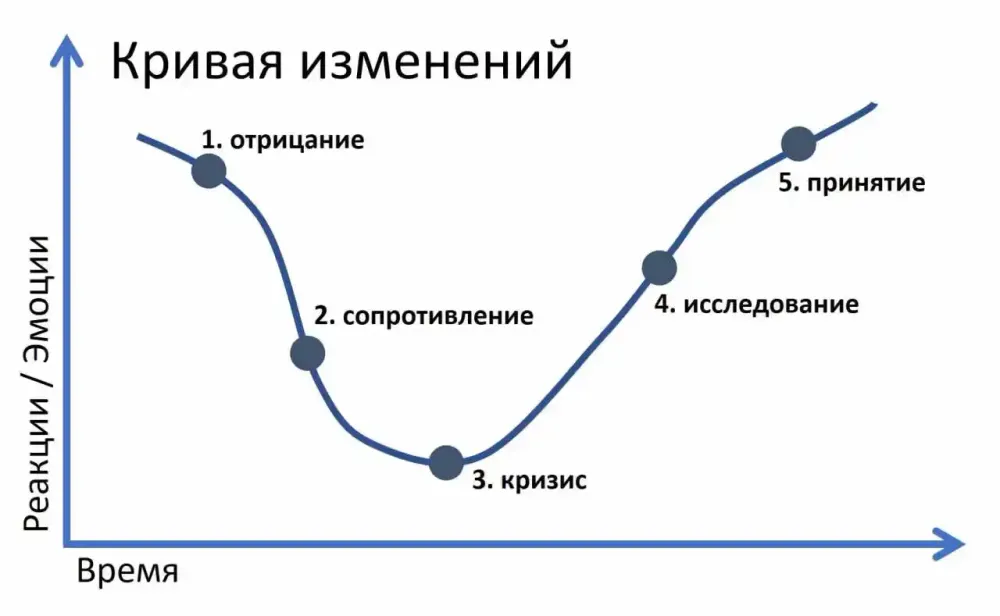
This is far harder. A fixed-term contract runs out and is not renewed even though you want to stay with the company; your employer declares bankruptcy and you have no choice but to change jobs. Unwanted steps like these produce a strong fear of change and, at first, refusal. It is hard to see an opportunity: beyond the fear of change, an imposed new beginning feels more like a burden. A change of this kind usually goes through five consecutive phases:
- At first the change is rejected outright and the need for it is ignored. People act as though everything will stay as it is.
- Then comes resistance, out of fear of the change. Everything possible is done to keep the coming change at bay.
- With the realisation that resistance will not help, the crisis hits rock bottom. Everything is called into question, and the fear of change is at its greatest.
- From this point on things start to improve. Step by step, new possibilities are explored and put into practice.
- In the end we see that, fortunately, things were not as bad as we feared, and we accept the new situation. The fear of change also subsides, or has already gone completely.
This is why you need to master the fear of change.
The key to successful change: it does not always have to be one enormous step that changes everything at once and turns your former life upside down. That is usually necessary and unavoidable only when the moment has genuinely arrived. Out of fear of change, you have waited so long that it has become even harder. Better to tackle the fear of change early on. Then even small adjustments can have the effect you want. There are three good reasons to overcome the fear of change sooner rather than later:
You solve problems before they grow
Of course, waiting is the easier option at first. You hope that everything will sort itself out and that the problems will disappear as quickly as possible. In some cases that may work, but it is not a promising strategy. As a rule, if something is really to get better, you have to do something about it yourself.
If you have acted early, you have an advantage. Despite our hopes to the contrary, problems have an unpleasant habit of growing over time. Put simply: the later you start making the necessary changes, the harder it will be to repair the damage already done.
You keep your options open
Not every window that opens stays open. Most of your opportunities are limited to a certain span of time — and once you have let it pass, there is no way back. Be aware of that finality the next time you face the choice of whether to leave everything just as it is.
It also gives you the time you need to make a wise and considered decision about the change. You are not (yet) obliged to act at once, and you can study the alternatives carefully and pick the path that promises the most success.
You keep getting better
An important but sadly underrated insight is that improvement is not a one-off event but a constant, continuous process. It is not about making changes only once the old ways have stopped working. Success comes to those who act proactively and consider possible changes even when there is no need for them.
You can see this again and again, especially in the corporate world. Successful companies do not wait for their business model to reach a dead end, for sales figures to fall, or for customers to switch to the competition. Instead they are in a constant process of change and improvement.
How to deal with the fear of change
That leaves the question: what can you do to handle your own fear of change? It will clearly not be easy, since overcoming fears takes persistence, discipline and a fair amount of work. The following tips will help you face the fear of change and get it under control:
- Hold on to your fear. There is no point in ignoring your fear of change, playing it down or pretending it isn't there. To overcome a fear, you have to face it head-on. The first step is accepting it and admitting it to yourself.
- Talk about it. Talking can help you handle the fear of change better. Confide in your partner or in a good friend. Explain what frightens you and what you fear about the change ahead. A conversation like this offers a different perspective and helps against the fear of change, because you get support and backing.
- Keep the worst case in mind. The fear of change usually means fearing the worst outcomes and consequences. What if things really do go wrong? Think that thought all the way through, and you will see that even the worst-case scenario is often not that bad. Knowing what could happen at worst gives you far more confidence.
- Look to the future with optimism. The right mindset matters too: anyone who decides from the outset that they cannot cope with change only makes their fear stronger. Believe in yourself instead, encourage yourself and acknowledge your strengths. Optimism is a very good remedy for the fear of change.
- Take small steps. The fear of change is easier to handle if you start with small steps. Where possible, you don't have to change everything at once. Small adjustments are easier to manage and easier to get used to. That way you also learn that there was no reason to fear the change — and next time you will dare to do more.
The fear of change: quotations
People have always been preoccupied with change. Many well-known figures have shared their thoughts on it. Here are a few of those sayings and quotations, to make you think, to inspire you and, hopefully, to be put into practice:
I do not know whether things will get better if they change. But for them to get better, they must change
Georg Christoph Lichtenberg
Pray for miracles, work for change. Thomas Aquinas
If you are unwilling to change anything, you will lose what you want to keep. Gustav Heinemann
Change is as necessary as the renewal of the leaves in spring. Vincent van Gogh
Be the change you wish to see in the world. Mahatma Gandhi
Only the very wisest and the very dullest never change. Confucius
Whoever wants to be happy for a long time must change often. Confucius
Life belongs to the living, and whoever lives must be prepared for change. Johann Wolfgang von Goethe
Whoever goes on doing what he already does will always stay who he already is. Henry Ford
When the wind of change blows, some build walls and others build windmills. Chinese proverb
Only those who change stay true to themselves. Wolf Biermann
The secret of change is to focus all your energy not on fighting the old, but on building the new. Socrates