
Collective guilt, or shame, is when responsibility for the actions of a few is shifted onto everyone in that group, family or nation. The simplest version: "it's all the fault of ...". The more sophisticated one: "it's shameful to be German, light-skinned, an anti-vaxxer, Russian, Ukrainian, neutral, ...". Who invented "collective guilt", what psychologists say about it, and how to avoid violence in society — these are the questions we look at in this article.
For those with little time to spare, here are the conclusions up front:
- Does collectively admitting guilt, or being ashamed of your origins, help to avoid genocide, war or violence? Psychological research since the 1960s has proved many times over, through the "Milgram experiments", that the cause of violence, war and mass murder lies not in nationality, race or even ideology, but in a "universal suggestibility" to authority
- "Collective guilt" as an instrument of influence was first developed by the Psychological Warfare Division of the Supreme Headquarters Allied Expeditionary Force (PWD/SHAEF) in 1945. It is a psychological weapon, and it can be aimed at very different targets.
- The most striking example of imposed "collective shame" over the past 80 years is the shame of being German. Over the past three years, however, the target has shifted three times over: guilt for being white, for being unvaccinated, for being Russian.
- The "suggestibility" of a population towards violence depends on (1) the view of the authority figure heading the state, (2) how close that figure is to the population, and (3) whether an opposing view is present.
- It looks as though today's authority figures endorse violence — even in democratic Austria
That is why the concept of "collective guilt" is today unscientific and, at the same time, an applied and effective psychological weapon. Now, if your interest has been awakened, you can read the details below
Present-day examples of "collective shame"
Until now the only nation to be ashamed of its origins has been the Germans. Public censure after the Second World War, responsibility for the concentration camps and for stoking the war removed pride in their nation from German consciousness for a long time. But if you think this is only about Germans, here is a timeline of how "collective shame" has mutated over the past three years.
In 2020, at the mass protests of the Black Lives Matter movement, white people knelt and apologised to black people for the colour of their skin and for having "white privilege". The example below is a prank — its author was not part of BLM, but it does show how ready people were to apologise for the colour of their skin.

And this one is no longer a prank:

In 2021 the governments of Austria and Germany tried to impose collective guilt for the lockdowns on everyone who was unvaccinated. The narrative of a "pandemic of the unvaccinated" was repeated insistently by both the government and the press, and it led to a "lockdown for the unvaccinated only". Today we know that this was not only unscientific but also a political abuse — yet the aftertaste remains.
The whole country is being held hostage by these people, who want to get their way against the scientific evidence
Karl Lauterbach, German Health Minister, 17 March 2022
This is an example of "collective shame" imposed along ideological lines

In 2022, against the backdrop of events in Ukraine, the Western press began to develop the narrative "it's shameful to be Russian". If you are Russian and have not condemned the President of the Russian Federation for the military action in Ukraine, the disgrace is on you. The band Leningrad put this trend best in their song "Vkhoda net!" ("No Entry!").
To you a Russian is the new Yid. Burn the lot of us in the ovens
lyrics of the song "Vkhoda net!" by the band Leningrad
This is an example of "collective shame" imposed along ethnic lines.

These are vivid examples of how, since 2020, "collective shame" has become a roving trend. Today it is shameful to be white, tomorrow to be unvaccinated, the day after to be Russian, and a week from now it will be shameful to stand for neutrality. Why such "instability"? The answer is easy to find in history.
Who invented "collective guilt"?
Open Wikipedia — the entry "Kollektivschuld", for instance — and you will learn that the idea of "collective guilt" arose not in society but in the highest echelons of power. In 1945 the Psychological Warfare Division (propaganda) of the Supreme Headquarters Allied Expeditionary Force (PWD/SHAEF) drew up directive JCS 1067, setting out the basic principles of US occupation policy after the surrender of Germany.
The first steps of re-education are focused on presenting the Germans with incontrovertible facts, in order to awaken an awareness of Germany's guilt for the war and of collective guilt for the crimes committed in the concentration camps
From Directive No. 1 of Robert McClure, head of the propaganda division
The propaganda division then ran campaigns to instil collective guilt. The concept took hold successfully. Even 80 years later Angela Merkel, the German Chancellor, said on the anniversary of the invasion of the USSR: "For us Germans, this is a cause for shame."
This trend was supported by Carl Gustav Jung as well, one of the founding fathers of psychology as a science. On 11 May 1945 he gave an interview to the newspaper Die Weltwoche in which he said:
The question of collective guilt, which troubles the politicians so much and will go on troubling them, is for the psychologist a fact beyond doubt, and one of the most important tasks of therapy is to bring the Germans to acknowledge their guilt
Carl Gustav Jung in the article "Will the Souls Find Peace?"
Drawing on his patients, Jung suggested that "in sincere repentance they find divine mercy". Paradoxically, though, Jung's ideas differ little from those of the people he criticises. Where the latter extolled the special nature of the Aryan race, Jung extols their special inferiority:
The Germans show a particular weakness in the face of these demons because of their extraordinary suggestibility. It shows itself in their love of obedience, in their supine submission to orders, which is only another form of suggestion. This corresponds to the general psychic inferiority of the Germans, a consequence of their undefined position between East and West
Carl Gustav Jung on the special nature of the Germans
But Jung would not have been the eminent psychotherapist he was if he had not noticed that this was about more than the Germans. He called it "universal suggestibility"
Scientific research into "universal suggestibility"
The artificially invented concept of "collective guilt" gave no answer at all to the question of how an entire nation could take part in the destruction of innocent people in concentration camps. The psychologist Stanley Milgram examined that question in depth. He is also known, incidentally, as the author of the "six degrees of separation" theory, according to which any two people on Earth are linked by five mutual acquaintances.
He described the findings that went down in history as the "Milgram experiment" in "Behavioral Study of Obedience", 1963. The subject is so well known that a film has been made about it, the film "Experimenter"

Milgram had originally wanted to run the study in Germany, but after the very first experiment in Connecticut in the USA he realised that Americans were no different from Germans:
I found so much obedience I hardly saw the need for taking the experiment to Germany
Milgram on how alike Germans and Americans are when it comes to obedience
The results were so shocking that the experiment was repeated in many countries. The design was much the same:
- There is an Experimenter (the authority), a Teacher (the one who obeys) and a Learner (the victim)
- The Experimenter orders the Teacher to set the Learner tasks. For every wrong answer the Teacher "punishes" the Learner by force — with an electric shock, for example
- The strength of the punishment rises from painful to lethal
- The Learner is an actor and only plays out the pain
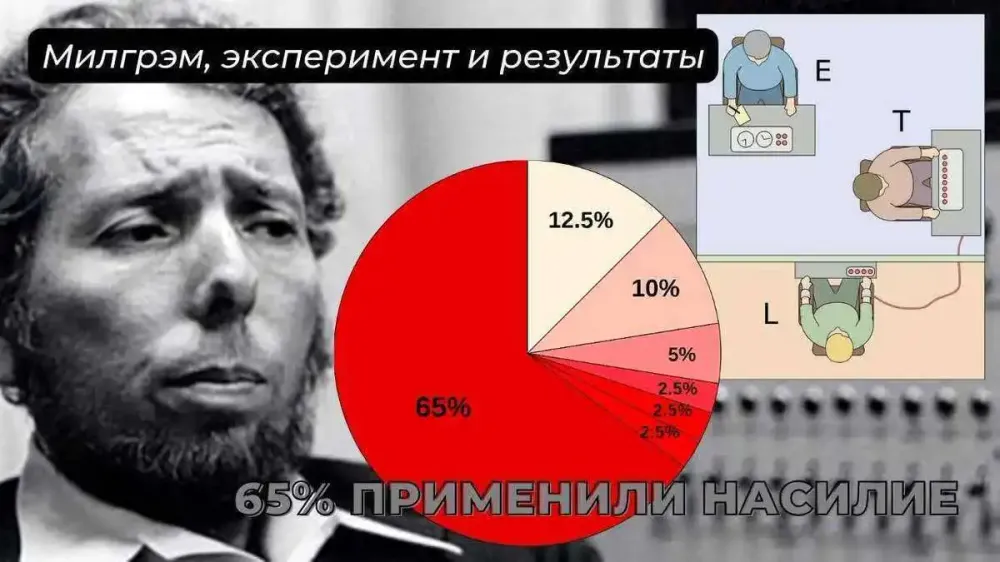
In the event, 65% were prepared to torture the Learner to death. The experiment was repeated in the USA, Germany, Austria, the Netherlands, Spain, Italy, Jordan and Poland. In 2002 Thomas Blass of the University of Maryland repeated Milgram's experiment, with an average result of 61% (that is how many participants were ready to kill on command).
In 2017 Polish social psychologists at the SWPS University of Social Sciences and Humanities tried to repeat Milgram's experiment. Participants were offered a fee to inflict physical pain on stooges by means of electric shocks of varying voltage. 90% of the participants were ready to do it.
The extreme willingness of adults to go to almost any lengths on the command of an authority constitutes the chief finding of the study
Milgram's view of the results of the experiment
To see why the claim of "collective shame" for one's racial, national or ideological distinctiveness is unscientific, it is important to know that the readiness to harm one's neighbour is equally characteristic of any social group, and is the same for the USA, Russia, Ukraine, Germany, Austria and other countries.
What is more, when you are called on either to be ashamed of your origins or to shame others, be aware that a psychological weapon is being used on you, prompting you to do exactly that: to inflict pain and to act violently.
But what is to be done now? If "collective shame" does not help, and the majority is ready for violence, how can violence be stopped or avoided? Milgram himself found a possible way out in the course of his experiments
How can violence be avoided at the level of society?
It is not all hopeless. Milgram himself changed the experiment and found conditions in which subjects refused to inflict pain in 100% of cases.
- If the Experimenter gave the instruction to stop the violence, or if it was only the Learner who demanded to be "punished", the Teacher always refused to inflict pain. That is, if the "orders" come from someone of equal rank, the "readiness to kill" does not work
- When Experimenters are in conflict — when there are several of them and they contradict one another — the Teacher then acts on his own convictions and does not inflict pain on the Learner
In theory such conditions are perfectly embodied in a political structure with several independent parties holding opposing views, with a system of checks and balances, or where the positions of those in charge are temporary. In other words, in a multi-party democracy. But that is in theory — and in practice?
Do those in authority stand for peace?
So: whether violence is ruled out in a society depends on (1) the view of the authority figure heading the state, (2) that figure's high rank, and (3) the presence of a competing party with an opposing view. How do things stand with this in Austria, where the author of this article lives? Let us think it through with two examples.
In November 2021 the governing parties were discussing a bill on the preventive detention (Beugehaft) of unvaccinated people in separate prisons, with the imprisonment to be paid for by the unvaccinated themselves. On 2 December 2021 the constitutional committee found the bill unlawful and in breach of human rights. Even so, on 16 December all the parties in parliament (apart from the opposition FPÖ) went on insisting that preventive detention be introduced.
What astonishes me is (1) that it was acceptable in the 21st century even to discuss the idea of putting a person in a separate camp for his convictions, with partial confiscation of his property, and (2) the unanimity of the parliamentarians on this question. What does that remind you of?
But authority need not be the government alone: it can also be the administration of a social network. In March 2022, for instance, Facebook — through its vice-president Nick Clegg — permitted, against the backdrop of events in Ukraine, aggressive statements and calls to kill the head of state and the soldiers of the Russian army.

Let me repeat the result of the Milgram experiments: if the Experimenter permits violence for a good cause, up to 90% of those in his charge will use it. No comment!
Where does the pull towards authority come from?
Milgram was convinced that the sense that authority must be obeyed is deeply ingrained in us. The question is why, and how it can be changed. The answer was given by the Jungians and by the humanistic psychologists. Here is a hint: it has to do with today's cult of "fatherlessness", which is partly explored in another article
How "fatherlessness" and not knowing your family line turn into a pull towards authoritarian rulers is explored in the article:
? The strength of the family line, or how the "Immortal Regiment" helps the psyche
For my part, I hope that having read this article you will go on being proud of your origins, and that when you hear a call to violence from those in authority, you will make your own choice. Though, as psychologists joke: "there is always a choice, but never freedom of choice".