The generational theory was developed by the economist and demographer N. Howe and the historian W. Strauss in 1991 (the Strauss–Howe generational theory). Independently of each other and at the same time (there it is, the universal mind), they analysed the history of the USA from 1584 onwards and derived a theory of the cyclical succession of generations that share the same values and moods.
What may interest us here is the understanding that every generation lives in its own perception of the world, with different points of reference and different priorities in life:
- our grandmothers and grandfathers of the Second World War generation, geared towards survival
- our parents of the post-war generation, the ones who are now around 60, , with their eternal youth
- me and everyone around 35–40, with rationality and development
- young people under 30, with their apparent sense that anything goes.
How are these generations to talk to one another? And who will hold the top jobs in 5–10 years?
Why know generational theory?
I use this theory myself right now, when developing banking strategy. And to work out how much longer I have as a manager. Should I expect competition from the younger generation? It turns out I can relax — they won't let me retire) But let us start with ourselves:
- Fancy thinking about where your values came from, your taste in music, your attitude to work and family? Watching how much they resemble those of people your own age?
- And now, how about looking at circles 10–15 years apart in age? Both older and younger? What are their values?
- And then, how about starting to speak to those age groups in their own language?
What is a social generation?
We are talking about a community of people born within one twenty-year period. They share three things:
- Historical events lived through at the same age
- The same beliefs and patterns of behaviour
- A sense of belonging to their generation
So, history runs in cycles the length of a human life. My colleagues put that length at 80–90 years, and this is where the first error may creep in. People used to live shorter lives, and how long they will live in future is anyone's guess. There are four generations in one cycle. They have the same values and behaviour patterns — watch and compare for yourself! The external reason why attitudes to culture, family and risk change is the alternation of crises and booms.
- In a crisis the herd closes ranks in the face of danger. Skirts get longer, self-sacrifice grows, a craving for order appears.
- An economic boom comes in its place. Individualism grows, and so does criticism of the state. And rest assured: the boom will be followed by a crisis!
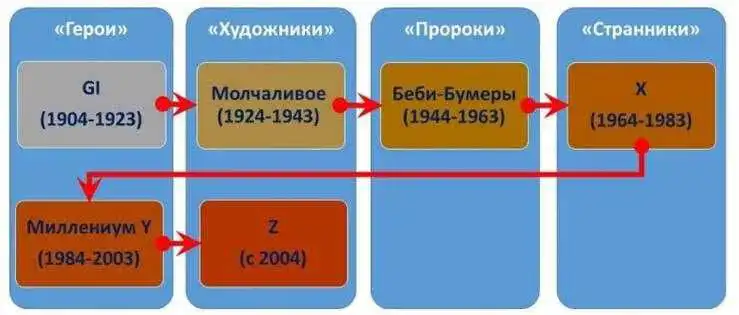
The internal reason values change is teenage rebellion. That very wish to put right what one's elders got "wrong". So one generation passes into the next with the opposite values. A swing, in short. This is especially visible in cinema. Thirty years have passed since the premiere of the first — that is, the fourth — part of "Star Wars" in 1977. A change of generations has taken place. If the first film was aimed at the "Nomad" generation, the latest part of "Star Wars" is aimed at the "Heroes", which is plain to see at the end of the two films.
In the first part, aimed at Generation X, the heroes came through their searching to a group of "good people", accepted their rules, won, survived and were given honours and rewards.
In the latest part the "heroes" from Generation Y, the Millennials, came through their searching to the "good guys", decided the "good guys" were thinking wrongly (did not accept their authority), followed their own "heart", saved civilisation and died. As they say in the film "Wag the Dog", "what could be better than the return of a dead hero home?".
Heroes
They are born at the peak of plenty and self-assurance. Universal prosperity, growth in technology. All the hardships fell on their parents' shoulders; the children were left to beat their chests belligerently and go into politics. That is how it was before the First World War — the age of Titanics, of luxury, of military overproduction. And these are today's 20–30-year-olds, today's "millennium" generation, born between 1983 and 2003. But more about them later. The "G.I." generation saw several revolutions at the start of the 20th century, the First World War and the civil war. The "victors" of Soviet times grew up with the ideal of responsibility and hard work. They were building a bright future, after all, a future order and justice. Money for them was a means of making a living, never a goal.
Artists
They were born in a time of crisis. The First World War is over. Or Stalin's communism is being built. Everyone is united by survival! To hell with social differences, to hell with politics. Everyone off to the war, everyone off to the market to trade in whatever comes to hand! We shall sacrifice ourselves, we shall tighten our belts! This is the "silent generation" of 1923 to 1942, our grandmothers and grandfathers. And it is our children, born in the 2000s. What was going on back then? Stalin, collectivisation, Hitler. This is a person who is silent, diligent and patient. Law-abiding, obedient to those in charge. For the "silent" generation the family is an important place, one where you can open up. Outside the family, God forbid you let anything slip! After the Second World War the generation lived through reconstruction amid hunger and ruin. Hence their thrift, their frugality, their care for children and grandchildren.
- They love physical exertion through work. At the dacha)
- This is the "book generation", raised on books, like all Soviet citizens)
- This is the generation of inventors and makers who built spaceships
- The family is the universe they live in
- Food has to be treated with care: stock up on tinned goods, make jam and put it away for the winter. Bread is the staff of life!
Prophets
They are born after a crisis, when public life is recovering again and new rules appear. These are our parents, vivid in their youth and community activists in middle age. These are the "baby boomers", born after the Second World War during the birth-rate surge from 1943 to 1963. Born in the great power that was the USSR. And born during Europe's rapid recovery after the Second World War. That is why they are optimists who put in the effort to reach their goals. They refine moral and religious values. They are communists and anti-communists, waging ideological wars in Vietnam and Afghanistan, tying the knot of the Cold War, sacrificing their own well-being in the name of communism and the arms race.
- They adore sport and football, the thrill of winning.
- They lead a healthy way of life
- They love life and stay active, in youth and afterwards)
- They learn quickly and apply what they have learnt effectively
- They make excellent mentors
- They want to live long and actively. They plan and take the long view
Nomads. Generation X
They were born in a time of stagnation, of booms and crises. This is today's Generation X, born 1964–1984. Because their "baby boomer" parents were constantly at work, Generation X grew up on its own, grew up fast and turned pragmatic.
- They have lived through several crises, they are ready for change, and they are set on surviving and on gathering life experience. They are rational and pragmatic, and look for meaning in everything.
- They rely mainly on themselves. Individualists who use technology for personal efficiency and reach their goals by their own effort. They practise time management and look for the feeling of being in control of their own life
- They are ready to keep learning for life. When choosing a job they weigh up the chance to use their intellectual and creative abilities.
- Patriotism is less pronounced than in their parents (the "baby boomers"). A drive to gain an advantage.
- They are informal and like exploring their emotions. And they look for equality and respect for the individual.
- They feel uncomfortable in times of stability and look for constant opportunities to grow.
- Money means "security" to them. It flows into self-education and travel
That, in short, is me, the author)))
Generation Y, the "Millennials"
This is the 20–30-year-old generation, born between 1983 and 2000 and now entering its active phase of life. Young people seem unique, not least because in generational theory they are the twins of the G.I. people who belligerently started the First World War. They are the ones who built the Titanic and sailed on her. It was long ago, nobody remembers it, but that is exactly why "millennials" are so called: they form the beginning of centuries. The film that comes to mind is "Sherlock Holmes: A Game of Shadows", which caught the atmosphere of that time superbly.

The end of the Cold War, the collapse of the Soviet Union, the appearance of new countries, the redivision of the world — that is what the "millennials" lived through, and the conclusion they drew is that even the mightiest can lose everything in a single moment. So there are no authorities and no heroes for them at all; there are a couple of people you can respect.
"Millennials" are accompanied by the fear of missing out, so they make decisions very fast. Their resilience to change is even higher than Generation X's, but the speed of their decisions leaves no room for a cool-headed reading of the situation and lowers the quality of those decisions. The most useful thing for an employer to understand is that "millennials" are not inclined to long, sustained labour. They value their time and want to get everything done. And they need the "American dream": rapid "growth", a prestigious, well-paid job straight away. They count on themselves alone, find it hard to ask for help — and at the same time expect their reward here and now!
Remember the wild 90s? Crime, hyperinflation, political score-settling? Parents from Generation X knew hardship, and they raised their "millennial" children shielding them from danger. So "millennials" take everything life has to offer (their parents gave them everything, after all), grow up late and are in no hurry to leave their parents' care. University for them is not a chance to gain a profession but a reason to put it off. An unwillingness to take on responsibility leads to late marriages.
And of course "millennials" grew up during computerisation and became dependent on gadgets. The abundance of information made it possible not to think, not to analyse and not to take in complex information in large volumes. Read less, look at more pictures and films
Online communication, chat especially, smacks of an inability to set out one's thoughts, to speak in public and to build complex sentences. And of a fear of personal contact with real people. Hence the paradox — a need for constant communication "without borders" through short text messages, and an inability to communicate in the real world.
Today's abundance of opportunities for self-expression creates a sense of one's own uniqueness. Nothing is impossible for them (that is, they have not yet come across it). Getting what they have set their mind on (from their parents) is the normal order of things for them. Because of that a "millennial" finds it hard to compromise with the people around him, employers included. He does not want to make do with little, to start at the bottom, and believes he deserves more.
And then there are computer games, with a linear storyline, a simple levelling-up mechanic and the option to save and replay a mistake. What does that schooling look like in real life?
- act only after clear instructions and supervision (where are the rules of the game?)
- every action must bring a concrete gain (where are my bonuses for completing the quest?)
- what matters most is the process, not the result (we're levelling up!)
- If it didn't work out, give up (where is the F5 button for a quick save and reload?)
For employers "millennials" are a special generation, with special means of training and motivation.
- They have to be trained in the form of games
- They need a flexible schedule and the chance to manage their own working time
- You will have to invent rapid career growth for them and at the same time keep checking on them constantly and giving precise instructions.
- And of course the tasks have to be creative
But that is only possible in positions with a low level of responsibility and in junior management. That is why the top posts will go on being held by Generation X. "Millennials" are not ready for long training and painstaking work. This will be especially visible in 5–10 years.
Generation Z
All the children born after 2000. If we follow generational theory, these will be the "Artists", similar to our forebears, the "silent" generation of the Second World War. Perhaps they will shut themselves off from the outside world in virtual reality and become full-fledged free persons only in the shape of a virtual avatar? Other generations simply won't be able to get in there) Perhaps they will have the clip-thinking of instant reaction and perception, like three-minute clips on YouTube, and will never learn the depths of the human psyche? They will surely popularise science, develop robotics and bioengineering, and invent many new engineering and technical professions. Who knows?
Different men and women
And finally, the most trivial and at the same time least obvious thing — the differing attitude to family and to private life.
- The elderly, over 80: man and woman live in a family. The roles are divided. Each has their own business to attend to.
- Those around 50–60: family values are at their strongest. The clearest division of roles. The husband earns. The wife gives birth, raises the children, keeps the home fire burning
- Those around 30–40: family values begin to be questioned. The family still matters, but the woman now decides when to have children and increasingly tries to fulfil herself at work.
- Those under 30: the family as an institution is broken up and fragmented. Socially, men and women are identical at work and in the family. The woman increasingly takes the lead in the relationship.
Do you think these are my own conclusions? No, this is a retelling of two sources). To begin with, Ozhiganova, "The generational theory of N. Howe and W. Strauss. Scope for practical application" (in Russian)
You can also look at the presentation "Generational theory: William Strauss and Neil Howe" (in Russian) at https://infourok.ru/prezentaciya-teoriya-pokoleniy-illiam-strauss-i-neil-oe-1138924.html. Or read a further article, "Well, what do you expect from this generation!" (in Russian) at https://www.psychologies.ru/standpoint/da-chto-vyi-hotite-ot-etogo-pokoleniya-kak-nam-ujitsya-drug-s-drugom.
Happy reading to us all!