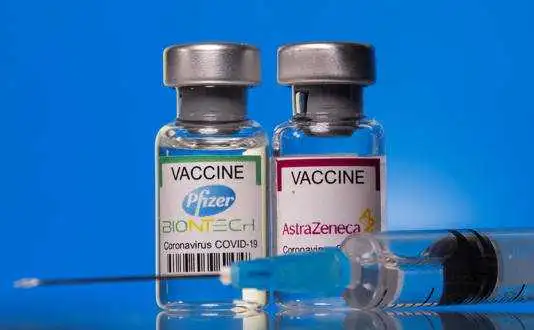
Depending on the combination, high antibody levels also develop. The mixing of BioNTech / Pfizer and AstraZeneca has been studied.
A translation of several articles on this topical subject.
What do you think?
Mixing two vaccines
Depending on the combination, high antibody levels also develop. The mixing of BioNTech / Pfizer and AstraZeneca has been studied.
Researchers have long been asking whether different vaccines can be combined. Until now it has been unclear whether mixing vaccines from different manufacturers would improve vaccination protection, which would be of interest for protection of every kind. Initial results from a vaccine study in the United Kingdom now show that mixing can trigger a protective immune response against Covid-19.
The study showed that volunteers had high levels of antibodies and immune cells after receiving a dose of BioNTech / Pfizer and a dose of AstraZeneca. According to the researchers, the order in which the two vaccines are given does not matter. Vaccine expert Matthew Snape of the University of Oxford said: “Either sequence is expected to be effective.”
Four combinations
Snape and his colleagues began the study back in February. 830 volunteers received one of four vaccine combinations. Some received two doses of BioNTech / Pfizer or of AstraZeneca, both of which have shown their effectiveness against Covid-19. Others received a dose of AstraZeneca and then a dose of BioNTech / Pfizer, or the other way round.
There was a four-week interval between the doses. Because earlier studies with AstraZeneca had shown that this works better. Studies with a twelve-week interval are being run as well — the results are still awaited.
Adverse reactions
It was found that participants who received two doses from different manufacturers reported more reactions to the vaccines, such as chills, headaches and muscle pain. These were, however, short-lived.
In those who received two doses of BioNTech / Pfizer, antibody levels were about ten times higher than in those who received two doses of AstraZeneca. Antibody levels were again about five times higher in those who received one dose of BioNTech / Pfizer first and then one dose of AstraZeneca than in those who received two doses of AstraZeneca. And in those who received AstraZeneca first and then Pfizer, antibody levels were about as high as in those who received two doses of Pfizer.
The researchers assume that the differences in antibody levels will shrink if a twelve-week interval is kept with AstraZeneca.
The study also showed that giving different vaccines leads to a higher level of immune cells than giving two doses of the same vaccine. Why mixing had this advantage is, however, unclear.
In their next study the scientists want to focus on the Moderna and Novavax vaccines and to include them in their combination research.
Austrian experts are sceptical
Even though doctors in Germany have already used different vaccines for the first and the second vaccination of the same patient and have published the results. They gave BioNTech / Pfizer as the second dose to patients who had been given AstraZeneca for the first vaccination a few weeks earlier. This is met with scepticism among local infection experts.
“Personally I think this is a very unfortunate discussion, and it comes mainly from Germany,” said Jörg Weber, infectious diseases expert at the Carinthian state hospital group (KABEG). “Even if the Robert Koch Institute says that you may change the vaccine, I would not do it and would not advise anyone else to do it.”

One vaccine is enough for the 1st and the 2nd vaccination
After AstraZeneca ran into supply problems again and again, many vaccinated people are asking what happens with their second vaccination.
Austria’s vaccination campaign was sensibly planned so that everyone who received a vaccine would have the same vaccine for the second vaccination as well.“This was not done for fun, but because the vaccines were studied very precisely in this form,” said Weber. “If you follow the safety principle, you stick to one vaccine for both vaccinations.”
A booster vaccination will most likely be needed.
At present, studies show that Covid-19 vaccination also needs refreshing.One of the reasons is the many mutations.Numerous studies are currently under way examining the intervals at which booster vaccinations should be given.
Innsbruck
A study testing the combination of different types of vaccine is also starting at the Medical University of Innsbruck. It is led by the virologist Dorothee von Laer.
From experience with other vaccines we know that heterologous vaccines are often more effective than homologous ones, that is, than repeated vaccinations with the same vaccine, said von Laer.
From an immunological point of view, mixed vaccination makes sense. According to studies, AstraZeneca offers somewhat lower protection against the South African mutant of the virus.
A study from Spain, AstraZeneca and BioNTech
Despite the lack of studies available at the time, people who had already been vaccinated with AstraZeneca were to be vaccinated heterologously.First a vector vaccine, then an mRNA vaccine from BioNTech / Pfizer or Moderna.The first results of a study are now being published.Researchers from Spain have examined the combination of the AstraZeneca and BioNTech / Pfizer vaccines — with promising results.
What did the Spanish researchers study?
The study carried out by the Spanish Instituto de Salud Carlos III is considered “the world’s first study to provide data on the immunogenicity of the combined use of two different vaccines”. It examined people under the age of 60 who had received a first dose of the AstraZeneca vaccine (Vaxzevria) and were vaccinated with BioNTech (Comirnaty) no less than eight weeks after that first dose, looking at the effectiveness of the vaccine combination and at any side effects.
How many people took part in the study?
673 people were examined, with an average age of 44.Women made up 56 per cent.About two thirds of them received the combined vaccination; the other third had no further jab after the AstraZeneca dose.
What is missing?
For now the data can be found only in the institute’s press release.The full study on the subject will be published shortly.In addition, data on the T-cell response are to be presented later.
They concluded that a vaccination schedule consisting of a first dose of AstraZeneca and a second dose of BioNTech / Pfizer is highly effective.After the second, so-called “booster”, dose the number of antibodies rose sharply.The antibodies obtained in this way are also effective against Sars-CoV-2.
"The immune system’s response is significantly stronger after the second dose of the Comirnaty vaccine, while the side effects observed are within the expected range." - Researchers at the Instituto de Salud Carlos III

Higher antibody levels through combined vaccination
The researchers will still have to supply precise data, because so far these have appeared only in a press release.
The Dortmund immunologist Carsten Watzl nevertheless considers the conclusions drawn in Spain very plausible.
“They confirm the results of earlier studies in mice. There too it was shown that if you vaccinate first with a vector and then with an mRNA vaccine, this leads to a higher level of neutralising antibodies,” says the Secretary General of the German Society for Immunology to ZDF.
I trust the Spanish researchers — but of course we first have to see what comes next.Above all, they still have to supply data on the number of T cells.
What is known about how well combined vaccination is tolerated?
The study lacks a comparison group of people who received both doses of the same corona vaccine. In the view of the Berlin immunologist Leif Erik Sander, that is the only way to answer the key question about combined vaccination: is there an advantage here compared with immunisation with two doses of the same vaccine?
The finding that the number of antibodies increases with a “booster” vaccination is no surprise; it was exactly what had been expected. Data on this should soon be coming from the United Kingdom.
British researchers are currently comparing heterologously vaccinated people with homogeneously vaccinated ones. The team led by Sander has also examined the combination of the BioNTech and AstraZeneca vaccines, but studied mainly side effects such as headache, fever or fatigue.
Their result: if you keep to the recommended vaccination interval of twelve weeks after the first AstraZeneca vaccination, the combined vaccination is tolerated better than if you were given BioNTech / Pfizer both times.
How effective is the combination of AstraZeneca and BioNTech?
As for the question of effectiveness, according to Carsten Watzl there is some evidence that giving a vector vaccine first and then an mRNA vaccine may be very effective.
Because vector vaccines are more likely to stimulate T cells, and mRNA vaccines are more likely to stimulate antibodies. Carsten Watzl, immunologist at the Technical University of Dortmund.
It has also been seen in the past that combining vaccines is not a problem. People are usually immunised with different groups of vaccines. “In the past, for example, a live vaccine was often used first and then a killed vaccine when it was refreshed. With Ebola vaccination it was also shown that it is effective and safe to give a protein-based vaccine first and then a vector vaccine,” Watzl explains. We know that both vaccines, from BioNTech and from AstraZeneca, are safe, so you can combine the two vaccines with a clear conscience.