ALL THE WORLD’S A STAGE,
AND ALL THE MEN AND WOMEN
MERELY PLAYERS:
THEY HAVE THEIR EXITS AND THEIR ENTRANCES,
AND ONE MAN IN HIS TIME PLAYS MANY PARTS.
William Shakespeare.
We are going to look, of course, not at children playing in a sandpit but at psychological games. More often than not these games are unconscious.
A game has a clear structure; there is no room in it for spontaneity. It follows a set sequence of moves that leads to a predictable ending.
A psychological game is the very opposite of emotional closeness. Eric Berne described the sequence of exchanges in a psychological game as a formula:
CON + GIMMICK = RESPONSE>SWITCH>CROSSUP>PAYOFF.
So why does the human psyche set all this in motion?
It turns out that the game "makes" us feel unpleasant but painfully familiar feelings. In doing so it lends our contact with others a certain predictability. We all need structure!
"Structure hunger" is the need to use time by creating situations for exchanging strokes and satisfying stimulus hunger. Time can be structured through:
- withdrawal (isolation, seclusion, being alone),
- rituals (greetings, congratulations),
- pastimes (social occasions),
- games,
- activity (work, study),
- intimacy.
Every story has three sides.
Every game has three sides.
Every drama has three sides.
SO: GAMES AS A WAY OF STRUCTURING YOUR TIME.
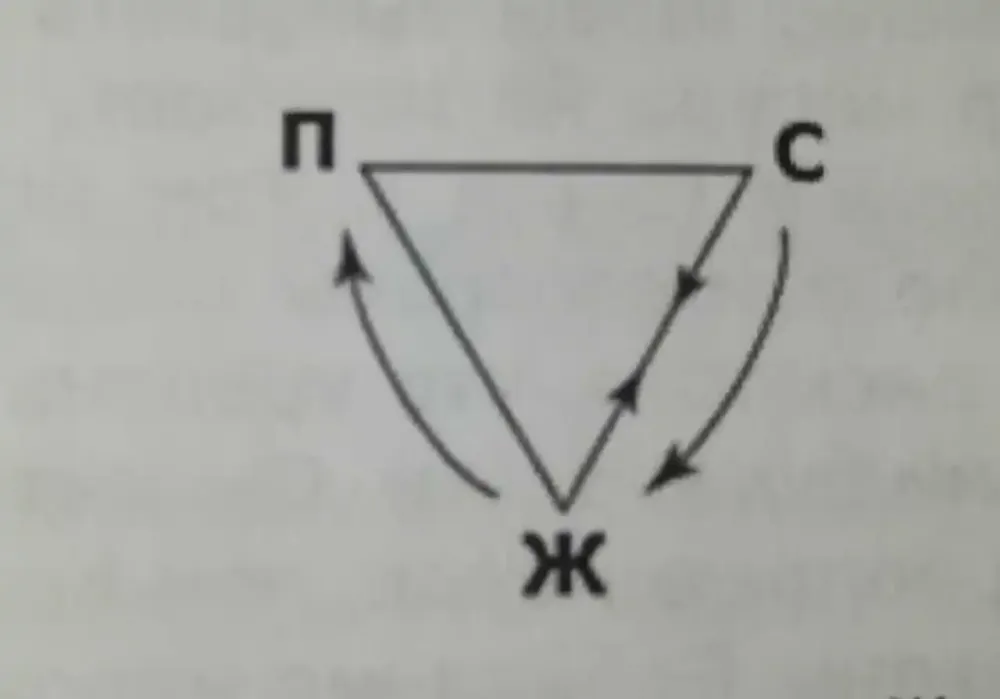
Stephen Karpman turned the Game Formula with which Eric Berne described the games people play into a triangle. It is known as the Karpman drama triangle.
It looks like this:
A Game has two crucial features:
- hidden motives,
- a payoff.
Every Game is dishonest at its core, and its ending is often dramatic rather than merely thrilling.
The drama triangle describes the players' infernal dance. It has three steps, or three roles:
- P (PERSECUTOR, TYRANT),
- R (RESCUER),
- V (VICTIM)
PERSECUTOR - RESCUER - VICTIM .
The drama in the game starts the moment one of the players unexpectedly swaps one role for another.
SO, THE VICTIM is the player who displays helplessness and an inability to cope with difficulties on their own. The telltale sign of Victim behaviour is that they spend most of their time complaining about life's difficulties and insurmountable obstacles instead of looking for new solutions and possibilities.
THE PERSECUTOR (TYRANT) is the player who criticises, applies pressure and coerces the VICTIM while at the same time confirming that the VICTIM is helpless and forever getting things wrong.
The behavioural sign of the Persecutor is that they attack their Victim openly.
For example: "You never understood me! How can anyone be so unfeeling?!"
THE RESCUER is the player who steps into other people's affairs in order to offer their help. Yet they do not know themselves how to help, or they do it when nobody has asked them to. The Rescuer confuses rescuing with real help. A typical Rescuer line:
" I am only trying to help you!"
The telltale sign of Rescuer behaviour is that they will do more than half of the work for others, even when nobody has asked them to.
All three Players have their switch and their payoff. As Claude Steiner put it:
" The Victim is not really as helpless as he feels himself to be. The Rescuer is not really helping as much as he thinks, and the Persecutor does not really have a valid complaint".
On the whole, the "drama triangle" is there to keep closeness and intimacy at bay, to put off discussing what matters and to deprive the other person of any sense of equality and joy.
A Game has three degrees of intensity:
Degree I — socially acceptable Games; people talk about them and share them with friends and acquaintances, and they can be observed;
Degree II — games with heavier consequences; people prefer to keep quiet about them;
Degree III — games that are extremely destructive; they do direct harm to the player's health and end on the operating table, in bankruptcy, in court, in prison, in injury and even in death.
An example. At the New Year party Katya took a liking to a man who works for the same company but in a different department. They had never met before and Katya knows nothing about him. She flirts with him.
Degree I — the game stopped at the level of a pleasant evening out.
Degree II — Katya left the party with the man and they spent a pleasant night together. In the morning Katya found out that the man was married. She is embarrassed, she feels ashamed and hurt. She goes home upset.
Degree III — having found out in the morning that the man is married, Katya makes a scene, accusing him of using her, and starts threatening to tell his wife everything. The story of the affair reaches the man's wife and she files for divorce.
Both Players had hidden motives, and each of them got their payoff.
So what can push people into psychological games?
One of these, for example:
- the exchange of strokes (attention, recognition),
- structuring time,
- keeping a racket system going,
- confirming or maintaining a life position,
- moving forward along their life script,
- making people predictable,
- avoiding intimacy.
When people step into the triangle or invite somebody into a Game, they do not know themselves why they are doing it. They simply want to find a solution to their problems and questions.
Once you understand how psychological Games work and start living your life consciously, A LIFE FREE OF GAMES begins.