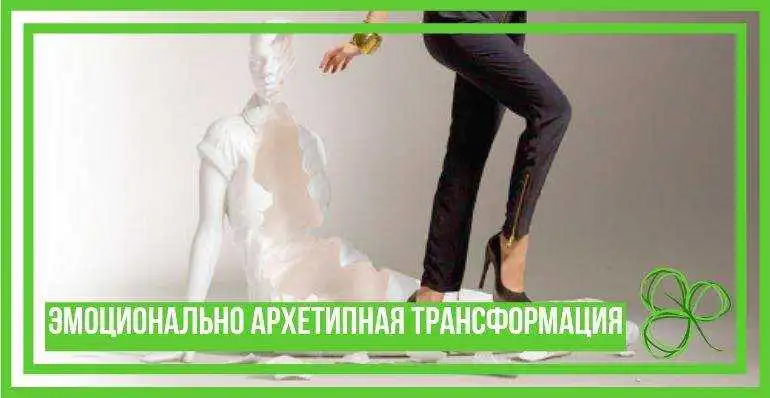
Emotional-Archetypal Transformation is a new counselling method. It gathers up the best, the most workable and the most effective in psychoanalysis, transactional analysis, Gestalt therapy and monodrama, constellations, NLP and many other approaches worked out in the field of psychology over the past 100 years.
It is a way of working with the unconscious, with painful childhood situations that have been repressed and with decisions taken back then that no longer serve us in life. It is an emotional dialogue with images. We picture a psychological problem as an imagined image inside the body (something close to psychosomatics and art therapy). Through the image we reach the problem situation in the past that gave rise to the inner conflict (this comes from psychoanalysis). Then we replay that situation, and the more emotion there is, the stronger the effect (as in Gestalt therapy and monodrama). As soon as the emotional fixation on the situation has changed, we take a new decision (as in rational emotive behaviour therapy). At the closing stage we consolidate the change and add energy through the Inner Child (as in transactional analysis and NLP). What comes out of it is an interesting, creative, image-rich piece of work that can resolve an inner conflict even when the client does not want to talk about the problem itself.
How does an "inner conflict" come about?
To paraphrase Tolstoy, all happy people are happy alike; every unhappy person is unhappy in their own way. Problems usually begin deep in childhood and, as a rule, in the relationship with the mother. We were all told off, sometimes often, and sometimes we did not understand why. For many of us, mum and dad divorced while we were still of pre-school age, and mum went on to build relationships with various uncles. Situations like these hurt children. Sometimes they hurt so much that the child takes a decision.
That decision to get away from the pain is different for everyone. One child will start to fight, doing everything the other way round and in defiance of the parents. Another will decide that everything is his fault and that he does not deserve to be a person in his own right. A third will decide to become a "halfwit", because that way he gets more attention. In childhood these decisions helped the child survive.
And the child grew up. Life changed. He is over 20, over 30, and he has long forgotten the events of those years. Yet as an adult he behaves exactly as he decided to behave long ago, as a child. And here comes the vague suspicion that something is not right.
What brings us to a session?
Usually something prompts us to come to a counsellor. As a rule there are two possible situations:
- We feel that something is "in the way", but we do not know what. For instance, I keep choosing similar partners, then break off the relationship, then step on the same rake again. I have had enough of it, but I do not know how to break out of the vicious circle. The counsellor's task is to bring that "something in the way" to light and make it visible to the client.
- We know what we are unhappy with and we understand how to change. BUT we cannot make ourselves act. The counsellor's task is to uncover the client's inner resources and to give him the strength and the motivation to act.
In both cases there is an "inner conflict". We want to, but we do not know how. We know, but we avoid it. And so we go to a counsellor who works with emotional-archetypal transformation.
Why "emotional"?
Why is an "inner conflict" so hard to resolve on your own? Because there is an "emotional fixation" on painful, traumatic childhood situations that have been pushed out of consciousness. As children we were hurt, and we decided to act in a way that would avoid the pain. And we repressed that pain out of consciousness. That is, we forgot it.
As the saying goes, it is never too late to have a happy childhood. To change that childhood decision we have to go back into that long-ago situation and live through it emotionally once more, the way we would have wanted it. New emotions - a new decision.
The technique rests on the idea that our brain does not tell the difference between reality and invention. If that is so, we can invent whatever we like. Let it be something pleasant, cheerful and, as of today, useful)
Why "archetypal"?
The painful situation has been repressed into the unconscious. The unconscious neither understands nor knows words - that is the domain of the conscious. The unconscious thinks, "speaks" and works through images. The most interesting thing is that for many people these images are similar both in appearance and in meaning. That is, they are archetypal, as Carl Gustav Jung described them through his notion of the collective unconscious.
For instance, I am irritated and I feel it. Somewhere in my body, and this irritation is like... a balloon... Or a dolphin... Or a spider... Or something else... That is the image of the problem, the one we feel in the body, and our unconscious shows it to us as an image. Congratulations: now we can talk with the unconscious)
But why are the images so alike for so many people? Why "archetypal"? I do not know, since Jung's theories have little experimental backing. All I know is that there are many identical images, and behind them lie similar causes:
- A snake, a gorilla, a spider - the image of a man
- A vase, a shark, a shell - the image of a woman
- A bird, a sphere - images of the soul or of aspirations, and so on...
The similarity of the images helps us understand what caused the problem.
Why "transformation"?
We work with the unconscious through images. We can stroke them, hit them, tear them down, talk them round and come to terms with them. As in monodrama, familiar from Gestalt therapy. Through this "processing" the images change - that is, the way the unconscious perceives the problem is transformed.
The emotional perception of the situation that caused pain in the past is transformed. The old decision to avoid pain through behaviour that no longer brings us the result we want is transformed. We take a new decision.
Where does the energy come from?
The first task is to change our emotional perception of the past. The second task is to find new sources of energy, strength and cheerfulness. Where from?
The short answer is: from the Inner Child. The longer answer is: from the unconscious again. Eric Berne's transactional analysis, which incidentally also works through imagined images, helps us picture this. There is a Child in each of us. Before the session that Child is suppressed, frightened, aggressive. Because at some point it was hurt. We changed that during the session, and now our task is to give this newly born Child back its energy, playfulness and curiosity.
How does a session go?
The client comes to the counsellor. To work. Together. And to take responsibility for his own actions. The counsellor is responsible for the process, the client is responsible for the result. The process looks something like this:
- Tell me! It is worth speaking out first and working out what this is all about. What is the problem?
- What do you want? That is a devilishly hard question, especially in life as it is today. We will start somewhere, and the client and the counsellor will agree on that.
- What shall we work on today? A "contract" is made between client and counsellor for this particular session.
- What do you feel? In which part of the body? How exactly can it be pictured? We find the problem in the body and picture it as an image.
- Take the image out of yourself and sit it down in front of you. Monodrama. The work with images begins.
- After that - it depends on the situation.
If you need help, do get in touch)