Sigmund Freud laid the foundations of modern psychology. Eric Berne's transactional analysis and most of the tenets of neuro-linguistic programming are built on his discoveries. Reading Freud's paper ‘The Unconscious’, I could not shake off a feeling of déjà vu and the suspicion that in the past hundred years psychologists have not come up with anything new. They have merely renamed things, deepened them a little and broadened them. But Freud is no writer of light fiction.
Reading him — and I am not a man short of brains — is heavy going and dull. To convey how fundamentally he shaped the psychological sciences, I shall have to do exactly the same: rename, simplify and dilute with pictures. So, here goes....
The parts of the psyche according to Freud, in modern language
First let us sort out the terms. It does not matter what a thing is called, what matters is what it means. To make it pleasanter and easier to follow, I have simplified many of the concepts. In 1915, in his paper ‘The Unconscious’, Freud described how our inner, emotional life, our Psyche, consists of three parts: 1.The Unconscious: this is the thing that our wishes and drives come from. Abbreviated as Ubw (Unterbewusstsein in German).
- In Berne's transactional analysis this is the Child. A source of endless energy and strength that wants to play. The Child's basic emotions are fun or fear.
- In NLP this is that same unconscious which NLP masters love to petition, hack and anchor. The one that remembers everything and memorises nothing.
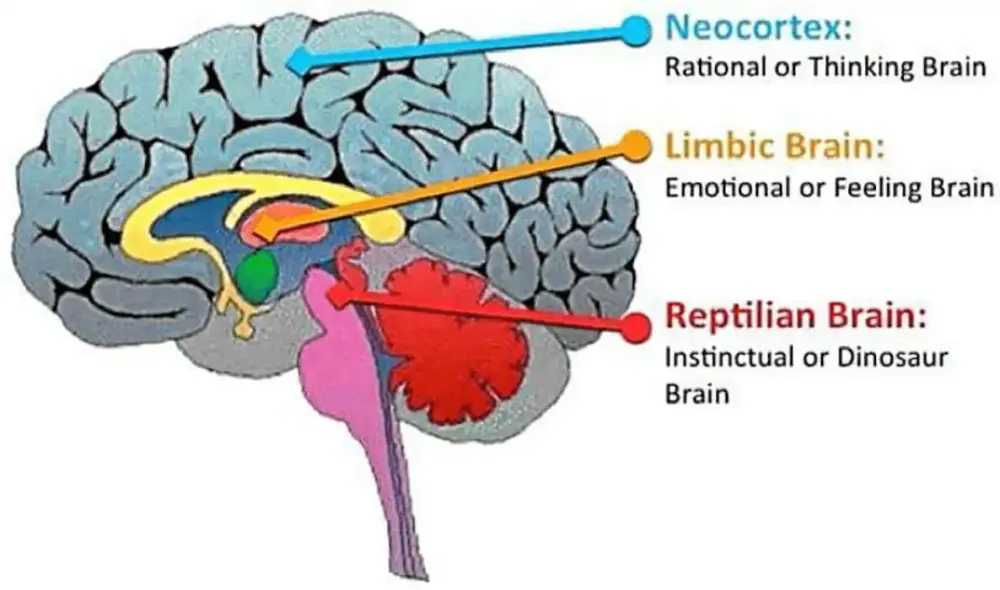
- In the pick-up artists' model this is the reptilian part of the brain, the oldest one, the one in charge of sex. The reptilian part of the brain supposedly answers, in this order, the questions: (1) ‘Is it dangerous?’, if not — (2) ‘Can I eat it?’, if not — (3) ‘Can I have it?’, if not — (4) we lose interest. Pick-up artists, naturally, like the third question, and most of their tricks are aimed at the reptilian brain.
2.The Preconscious. Abbreviated as Vbw (Vorbewusstsein in German). This is where beliefs, notions and emotions live. ‘Preconscious’ is too scientific and uncool a name, but it is the most telling one for explaining Repression. I would call it conscience or morality, but I have kept the original term out of respect for science.
- In Berne's transactional analysis this is the Parent. A stern one, forever pulling the child up, telling it what to do, what is allowed and what is not. This is the one who lays down the rules.
- In NLP I know of no exact equivalent. They prefer working with the Unconscious.
- This may be the limbic part of the brain. The place where emotions and feelings.
3.The Conscious. That clever, quick-witted thing we are aware of right now. Abbreviated as Bw (Bewusstsein in German).
- In Berne's transactional analysis this is the Adult. Cool-headed, thinking logically and calmly looking for solutions
- In NLP this is all the manipulation aimed at matching the other person, at covert influence and at work with the Unconscious.
- This may be the neocortex. Evolution's newest gift to human beings. The seat of logic and thought.
Now for the main processes according to Freud, or how all of this works. We shall use our own simple terms.
Impulses. Freud calls them psychical acts. Dreams, drives, anxiety. Thoughts, wishes, memories. Fantasies, instincts, processes. Psychical acts are an umbrella concept standing for everything that goes on in our psyche. The word Impulses sounds less scientific and more down to earth to me.
Censorship. Not every Impulse from the Unconscious goes down well in public. The wish to smash your neighbour's window, for instance. Freud found that our Preconscious performs a sort of censorship function, keeping all manner of ‘dirty’ wishes out of the Conscious. And then those wishes become repressed.
Repression. This is precisely the result of Censorship at work in the Preconscious. Not everything we wish for unconsciously is let through by the Preconscious into the Conscious. And then we do not consciously perceive that Impulse. We do not ‘know’ that it exists. But here is the snag: the Impulse does not go away. You still want to smash that pane of glass. And then discomfort sets in, the kind that leads to neurosis and inappropriate behaviour. And that is where Freud began treating people. And that is where we can begin working through his paper ‘The Unconscious’, published in 1915.
The relation between the unconscious and the repressed
How can the Unconscious be known? NLP masters love experimenting with this thing. They put questions to it, set it simple tasks and check the answers. For example, starting from the assumption that the Unconscious notices everything, you can ask it how many steps there are in a flight of stairs, and then go and check. In this way you can gently build up trust in your own Unconscious, and in yourself. In psychoanalysis and psychotherapy this is the overcoming of resistance, the bringing to light of the dark secrets of our past that neurosis has repressed. In this way the Unconscious holds a twofold experience:
- what we acquired consciously and do not necessarily remember at the moment, as in the example with the number of steps, and
- painful experiences that our organism ‘chose’ to forget.
Grounds for assuming the concept of ‘the unconscious’
How can we prove that the Unconscious exists? We are all familiar with urges that are beyond our control. Dreams, drives, anxiety. Thoughts that come from who knows where, yet are consciously perceived by us. And what if we suppose that thoughts arise out of the Unconscious, following laws of their own? Then the connection between these urges and the processes leading to them becomes clear.
And what if we try a couple of techniques on ourselves, where by acting on unconscious processes we can influence conscious urges and states? Will the nerves at an interview go away, for instance, if you picture the people across the table naked? If they do, is that not proof of the Unconscious — and that it can be worked with?
What else points to the existence of the Unconscious? RIGHT NOW we can consciously perceive only what we see right now. If asked, we shall remember what we saw yesterday. But until then, the information about yesterday sits in memory, in a latent, unconscious state. We do know that under hypnosis one can recall even what we did not consciously notice yesterday, or had forgotten. NLP masters claim that with their techniques you can learn to retrieve this information from the Unconscious without hypnosis too.
Rather frightening, all this
And still, many will ask why anyone should dig around in this mumbo-jumbo. You can put your mistakes down to plain bad luck or a blow of fate, and so it will be for as long as a person has no knowledge of the inner laws of the Unconscious. Carl Jung wrote: ‘When an inner situation is not made conscious, it appears outside as fate».
Anyone who regards the faulty actions of normal people as accidents and is content with the old wisdom that dreams are so much sea foam need only ignore a few more riddles in the psychology of consciousness, and then there will be no need to assume any unconscious activity. Freud
There is another difficulty in the way of knowing the Unconscious, and it takes courage. People are inclined to ascribe their own thoughts to other people and even to nature. We invent unworthy motives for someone else, but we do it through our own experience. We assume that plants enjoy listening to Mozart. That is no more than an inference. In the same way one may infer that the Unconscious exists. And then we shall have to admit that all the behaviour we cannot explain seems to belong to another person. That is, to admit that I am not alone — several people live inside me. A thought like that gives you goose bumps....
How does one come to trust the Unconscious? Access to it is a special thing and takes great trust in oneself. It is especially hard when you observe your own habits. They are convenient, more or less acceptable here and there, and honed to automatism. Only in the moments when something starts going wrong with them does a person have to make a choice. Either to say it is fate, or the stars. Or to admit that the habits will have to change. And they come from somewhere in an inner unknown, from the Unconscious. To start studying yourself afresh is a journey with an unknown outcome, and it takes strong trust in yourself to believe that in the end the road of self-knowledge will lead to something good — though sometimes to something the conscious mind never foresaw.
The many meanings of the unconscious
All Impulses originate in the Unconscious. The Unconscious holds, on the one hand, experiences and processes that are simply not conscious, latent ones, and on the other hand ‘repressed’ ones, not admitted into consciousness. An example of the latent work of the Unconscious can be found in a well-known NLP technique, the ‘six-step reframe’. In a simplified version, a person consciously puts a question to the Unconscious and asks it to find a solution and to carry it out in life in the way that is best for them. Translated into Freud's language, the Unconscious ‘latently’ and unconsciously begins to work and to change the person's actions, bringing about the result requested consciously. For me this is an example of ‘latent, temporarily unconscious’ processes.
Repressed Impulses, by contrast, ‘would differ in the sharpest way from the rest of the conscious ones if they made their way into consciousness’. They go through Censorship, a test against this criterion of sharp difference. If the test is failed, the Impulse is not admitted to the level of consciousness and remains ‘repressed’ in the Unconscious.
In working through the Unconscious, Freud asks how the brain works. Is an Impulse admitted from the Unconscious into the Conscious preserved as a new ‘copy’ of the original experience — in which case the same information is recorded twice in the brain? Or are we dealing with the same material in the same place, which has merely acquired an additional feature? Freud declines to draw any final conclusion that conscious processes take place in the cerebral cortex and unconscious ones in the subcortical parts of the brain.
All the same, in today's amateur posts, especially those about picking people up, it is customary to distinguish the reptilian, the monkey (limbic) and the intellectual (neocortex) brain. The reptilian mode of thinking answers, in this order, the questions ‘Is it dangerous?’, ‘Can I eat it?’ and ‘Can I have it?’, and is the zone of sex and fear. The monkey brain is in charge of emotions, the intellectual one of conscious decisions. It is hard not to notice how these popular present-day explanations correspond to the division into the unconscious, the preconscious and the conscious.
Are there unconscious affects?
An affect — from the Latin for ‘emotional agitation’ or ‘passion’ — is (1) a strong, short-lived Impulse, (2) accompanied by reactions in the body, (3) usually appearing in critical situations to which we cannot respond adequately. As a rule it is a reaction to a negative experience in the past, where some minor detail sets off a response, as if warning the organism that the event may be about to repeat itself. If you ‘explode’ at a remark aimed at you that looks harmless from the outside, that may be exactly such an affect. Following later psychoanalysts such as Karen Horney, I would call an affect an outward manifestation of neurosis.
By definition alone, an affect — an Impulse with bodily reactions — cannot be unconscious. That is the whole point of its being bodily: it is there to be perceived. What, then, is ‘unconscious love’, ‘an unconscious sense of guilt’ or ‘unconscious fear’?
Love is easy to sort out. Whichever way you look at it, it is a form of drive. According to Freud a drive can only be a product of the unconscious — something the NLP practitioner Timur Gagin sets out beautifully in his primer on the basics of erotic influence.
To get to grips with fear, let us settle what an emotion is. At trainings you will hear that an emotion is an evaluative reaction to an external event. The evaluation is an inner notion of whether the event is positive or negative, which matches Freud's view. Can an affect, as a form of emotion, be unconscious?
Freud gives an example of a vivid feeling being perceived wrongly. Take a drive, which always comes from the Unconscious: it may fail to be admitted into the Conscious. A child's need for closeness with the father may be repressed by a busy father who sets aside no time for the child. Or it may be repressed by moral attitudes, if what is at stake is a different form of drive.
In both cases the drive has to wait in the Unconscious until it finds a substitute idea. Activity towards the object of the drive turns into flight from it. The nearest idea for flight is the avoidance of danger. And the emotion that goes with avoiding danger is fear. So it turns out that an unconscious drive is perceived as fear, although in essence it ought to have been felt as love. Freud calls such a process an unconscious affect: the wish has started up and been ‘repressed’ back into the Unconscious, while consciously it is evaluated in a completely different guise.
One of the tasks of the Conscious, according to Freud, is control over affect. As long as the Conscious controls voluntary motor movements, the mental state of the individual may be considered normal. It is far harder for the Conscious to influence the very arising of an affect, where it comes up against the Unconscious.
The economic approach to describing repression.
The economic approach in psychoanalysis, formulated by Freud, is based on describing psychological activity in terms of psychical energy. Repression, for instance, is the refusal to admit an Impulse from the unconscious into consciousness. How does that refusal work? If the assumption is right that a conscious Impulse differs from an unconscious one only in its features and is not a new copy of the same information in the brain, then that feature may well be energy.
An Impulse becomes active, and can rise into the Conscious, when energy is attached to it. The source of that energy may be an affect as a defensive reaction, or a drive (interest). Since any memory in the Unconscious retains its activity, the energy may be taken away from something else — namely from the Preconscious. The task of the Preconscious is to protect the Conscious from the onslaught of the Unconscious. Creating and maintaining repression takes constant effort. Thus the energy taken away from an Impulse is spent on counteracting that very Impulse.
In amateur psychology this approach of Freud's finds expression in slogans and self-set tasks such as ‘find yourself’ and ‘bring yourself into harmony with yourself’ — the point being to free up inner energy and direct it at achieving your goals.
The properties of the Unconscious and its products
The Unconscious receives information through perception and has no censorship. All the paths of perception remain open. This chimes with the tenets of NLP, according to which the subconscious notices everything, even when we are distracted by our own thoughts.
At the same time, Impulses repressed into the Unconscious differ from information heard consciously, even when they have one and the same content.
What is the Unconscious made of? Freud compares it to ‘the aborigines’, a sort of sum of animal instincts and childhood experiences repressed out of consciousness, which with age come to be seen as inadmissible. Instincts may show themselves in the form of fantasies. Repressed childhood experiences — in the form of defensive neurotic reactions.
What I found most interesting was not the products of the unconscious, but what happens when the Conscious and the Unconscious work together. Unconscious wishes and drives pass through the Censorship of our beliefs in the Preconscious and are, as a rule, repressed back without ever reaching the conscious level. But if the aspirations in the Conscious match the unconscious Impulses, cooperation arises. The Preconscious takes the activity of the Unconscious for a continuation of the intentions of the Conscious, switches off the censorship and reinforces the Impulses!
Freud: ‘reinforced aspirations nevertheless show themselves differently from normal ones: they make possible achievements of an exceptional perfection, and they put up the same resistance to objections as obsessional symptoms.’
One person's Unconscious can influence another person's Unconscious, bypassing their Conscious. According to Gagin this shows itself especially in flirting, or erotic influence. To arouse the other person (and not necessarily one of the opposite sex), it is enough to arouse yourself inwardly first. That inner arousal is then passed on to the other person, even if they consciously resist it.
What is psychoanalytic treatment really about?
The analyst's work consists in acting on the Unconscious through the Conscious. But these changes take time. The process is difficult and long.
..
psychoanalytic treatment is built on acting upon the Unconscious through the Conscious and in any case shows that such an influence is not impossible, though it is achieved only with great difficulty. ... a change in the Unconscious taking place on its own under the influence of the Conscious is a difficult and lengthy process. If you tell a patient about an idea he once repressed, which you have guessed at, at first nothing changes in his mental state. The main thing is that this does not undo the repression and does not remove its consequences, as one might expect from the fact that an idea previously unknown has become known. On the contrary, all one gets at first is a fresh rejection of the repressed idea. The patient now really does have the same idea in two forms in different places of his mental apparatus: first, he has a conscious memory of the analyst's words, thanks to the idea having been communicated to him; secondly, as we know for certain, he retains within himself, in its former form, the unconscious memory of what he lived through. In reality the repression is not undone until the conscious idea, having overcome the resistance, enters into connection with the unconscious memory. Success is achieved only when it is this latter that becomes conscious. Freud
The speech of the schizophrenic and its relation to the unconscious
What language might the Unconscious speak? Freud suggests that the Unconscious shows itself most fully through the speech of schizophrenics. In this illness the original Impulse, having gone through Repression, does not look for new objects; a state of narcissism sets in, an inability of patients to transfer their feelings. That is, the Impulse remains directed at the Unconscious. As a result, in schizophrenia the unconscious state of the patients is voiced through conscious speech.
Speech becomes peculiarly fastidious, unnatural, mannered, often focused on the relation to the organs of the body. Freud calls this ‘schizophrenic word-formation’ and ‘the hypochondriacal language of organs’, where the whole content of speech is replaced by a relation to organs (the eye, the hand) or to bodily sensations (to push, to shift, to substitute).
Any object — a chair, for instance — may have a thing-presentation, consisting of activity and tactile sensations (size, weight, hardness), and a word-presentation (the term ‘chair’ itself, or perhaps ‘stool’). Freud notes that in schizophrenia the word and the thing do not coincide, which is not the case in neurosis.
All the same it seems odd that it should be the word-presentation, normally under the control of the Conscious, that becomes the chief sign of schizophrenia in the case of Repression. Freud answers that this is rather an attempt by the organism to recover and to regain its lost objects. To restore the lost connection with the object, the Conscious turns to the Unconscious through what it has — through the word. This path is not a safe one:
When we think in abstractions we run the risk of neglecting the relations between words and unconscious thing-presentations, and it cannot be denied that our philosophising then takes on an unwelcome resemblance, in content and in form of expression, to the mental work of schizophrenics. Freud
The differences between conscious and unconscious mental presentations
On the basis of the same idea — that an object in the mental world has both a thing-presentation and a word-presentation — Freud formulates the foundation not only of the transference neuroses but also of the modern explanation of psychological trauma. The Unconscious contains only the thing-presentation of objects, their tactile description. The Preconscious adds an idea to it, a kind of evaluation. The Conscious adds the word-presentation, thanks to which we can describe the object in speech. Thus in neurosis what is repressed is the word-presentation which, in a normal mental state, ought to have been linked to the object.
An idea that is not put into words, or a psychical act that is not endowed with reinforced activity, then remains in the unconscious — as repressed Freud
This proposition underlies modern methods of treating trauma, after a road accident for instance. In an accident the patient may ‘forget’, or ‘repress’, many of the details of what happened, after which they may be tormented by nightmares and develop phobias. The treatment proposed is to live through every moment of the event again in the smallest detail, to live through the repressed emotions again; as a result the repressed thing-presentation is given a word, the event passes from the unconscious into consciousness, and the neurosis disappears.
The NLP tenet ‘we do not know what has no name’ is very much in tune with this. In Japanese, for instance, blue and green are denoted by one and the same word, ‘ao’. Many Japanese of the older generation do not distinguish these colours.
Freud also laid the groundwork for one more tenet of NLP, ‘the map is not the territory’. Word-presentations are so far removed from thing-presentations that ‘thinking goes on in processes so remote from the original residues of perception that they retain nothing of their qualities and need reinforcement by new qualities in order to become conscious.’
A few brain-teasers to finish with
Freud really is hard to put into plain language. By way of demonstration, here are three quotations from Freud and what they might mean.
..We shall establish the important, but also awkward, fact that unconsciousness is only one feature of the psychical and by no means characterises it Freud
Freud means that we are unaware of most of our thoughts, impulses, wishes and memories. They lie buried deep inside us, in the brain, in memory, and find expression in spontaneous reactions beyond the reach of our attention. That is why the ‘unconsciousness’ of processes is a feature of the psychical. At the same time these Impulses may simply be latent, not consciously needed at this moment, while I can still make ‘conscious’ use of them. Right now, for instance, the memory of what I ate yesterday is unconscious for me, I am not aware of it. But if I need to, I shall consciously recall it. So, because Impulses can be latent, unconsciousness is typical of the psyche, but does not describe it in full.
What you hear and what you live through are, by their psychological nature, entirely different things, even in the case where they have one and the same content Freud
This quotation from Freud is pure gold, and it is the foundation of NLP. ‘The map is not the territory’. ‘We are not aware of a thing until we give it a name’. ‘What matters is not the information but its interpretation.’ With this sentence Freud describes how information from the outside world first reaches the Unconscious and is stored there in the form of an Impulse. In the Preconscious it is supplemented with information from our beliefs. And if it passes Censorship, the Conscious gives it a name in words. What is consciously called by a word (what is heard) is already a long way from what the organism felt at the start.
Sometimes the dream-work treats words as things and then creates very similar ‘schizophrenic’ utterances or new formations of words Freud
The main sign of ‘schizophrenic’ speech is that the word and the thing do not coincide. Impulses locked in the Unconscious and directed not at an object but at the Unconscious itself find expression in words directed at parts of the body. A schizophrenic may, for example, talk about a hand while describing a chair. Something similar can happen in dreams, when a single word can stand in for a whole event.