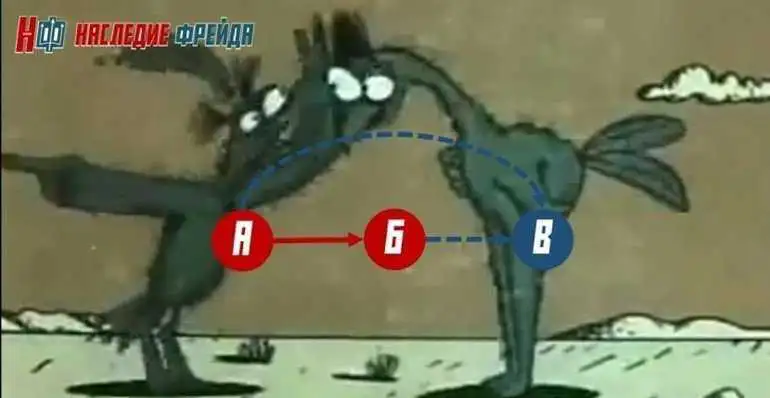
How do you get someone to act without proving anything and without demanding? Voluntarily, so that the person thinks it was their own idea? In practice it works like this: «I read that mint is bad for a man's potency.» One sentence, and the damage is done! The poor young man has not touched mint tea since.
Why the woman needed that is beside the point. What matters is that it was a beautifully placed piece of influence through the control of concepts. After reading this article you will be able to do the same. And if you come and practise with us at the Club meetings, you will do it better and on the spot)
What do we usually do (wrong)?
Suppose we need the person we are talking to, who is at point A (sitting on the sofa), to move to point B (closing the window). Usually we:
- Ask him to get up and close the window. He may well do it, if you are his boss, or his parent and the child is well brought up. Or he may explode: «What am I here, the servant? Do it yourself!» Or he may agree and then quietly sabotage it, because he will think exactly what is written above and simply not say it out loud.
- Persuade him with arguments that the window has to be closed and that he is the one who should do it. We cite facts about saving energy, about clean air indoors, about laziness, and so on. This is usually where «truth is born in argument» starts, then it turns personal, and off it goes.
- Women, as a rule, put the question obliquely: «What do you think, wouldn't it be good to close the window?» And then wait for a reaction. Or they curl up: «Ooh, it's chilly in here!»
All three practices are either difficult or flawed
- A request works if you have already made the person feel warmly towards you. That in itself is an art
- Asking questions as if in passing is subtle, but manipulative. For every manipulator there is another manipulator.
- Arguing is especially flawed, because the saying «truth is born in argument» has a counter-argument: «To persuade is to do violence.» And that is indirectly true:
There is a gentler approach, and it suits women too))). Don't argue — show the benefit, even if you invent it on the spot.
What moves a person to act?
We all act out of our beliefs, that is, out of our experience, that is, out of our map of the world, that is, out of our CONCEPTS OF THE WORLD, that is, out of our definitions, that is, out of our APPRAISAL of situations. A person's experience sets the directives for how to appraise a situation and how to act in it. Everyone appraises situations differently, because everyone's experience is their own.
If a man knows that mint is bad for potency and he wants things to work down there, he will not put mint in his tea. If a man knows that mint gets him going, he will drink it. If a man knows that the woman across the table would like to take his share of the mint, he will say «I can see you fancy some mint, I'll share», and he will go on drinking mint in future. If a bird likes to eat, it will answer the call «Hey bird, let's fly over there — there's plenty of tasty stuff!»

It is harmful to put another person's beliefs in order. That is one more flawed practice: believing that you owe it to people to enlighten them with your truth.
No truth is truer than another truth
Folk wisdom
Beliefs are useful to a person: they save him from perceptual overload, from madness and from behaving inappropriately, and all of us have them. That is exactly why influence of the «mint is bad for potency» kind works on everybody, myself included. Beliefs free a person from appraising the surrounding world all the time, and in that way they make his actions effective (for him). Our job is to make his actions effective FOR US.
Experience is described in pictures, images in the head.
- «Potency» is a visual picture drawn from experience. Anyone can picture it visually and by sensation, can't they? Differently, though.
- If the person you are talking to has a concept of «patriotism», he will work out for himself how «patriots» ought to behave. If there is no such concept, he will not act.
- If the client has an image of a «happy old age», he will open a savings account.
Usually a person's experience is «digested» over nights, and sometimes over months. Has it ever happened to you that someone tells you something in the evening, then comes the night with its «the morning is wiser than the evening», and by morning new ideas about what could be done come crowding in? The hardest influence to pull off is the one that has to work now, immediately.
Influence has to come in advance. So we need to plant in the other person's head a justification for the behaviour we want. We separate the actual behaviour from the subjective reason that prompts it. What to do, he will work out for himself. Whoever controls the meanings of concepts and what is inside them controls the negotiation. Information does not matter — what matters is its interpretation. Influence through the control of concepts means:
- getting inside the person's head,
- making changes to his picture of the world, and
- waiting for actions and results.
Where do you look for concepts?
Here your imagination has no limits, BUT you are on safe ground if the topic is abstract, general and speculative, and meets these requirements:
- It has to sit inside what matters to the person, otherwise you get «We Couldn't Care Less»
- It must not be an everyday, tangible topic for him, otherwise you get «I Don't Buy It». For example: «What bin lorry? Our rubbish hasn't been collected in a year!»
The Nominalisation technique is our friend here. Verbal nouns (reflection, love, movement), broad slogans (democracy and the will of the people, image, competence) — all of them are tied to the other person's subjective experiencing, built on his personal experience. To start with, you can lean on authorities that most of the population shares:
- MEDICINE. Murky, complicated, and everyone admits it. Except doctors. Especially if something already hurts — then the person is inclined to believe in any miracle pill. For example, «urine cleanses the body, especially when it reaches the stomach».
- SCIENCE.Torsion fields, solar activity and eclipses and global warming. If warming comes from carbon gases, then we should buy economical cars. And if it comes from solar activity, then we needn't bother.
- HISTORY. Chinese wisdom is always appealing. Egyptian priests are always right, especially because nobody will check. The Maya knew we would die in 2012, therefore...
- MYSTICISM: astrology, feng shui, the Bible. «Darling! What you know about the world isn't all of it. There are aliens arriving too, and it pays to take that into account!»
How do you sow concepts?
How do you plant a new belief in someone's head? What do you say? To start with, there are three templates.
- REWRITE. If a person already knows what «patriotism» is, explaining it to him differently is the hardest route; it can provoke opposition. It is another matter if our friend is unhappy with «patriotism». Then we can serve his need for something new and explain to him that he has the world wrong. «Thrift? Where has it got us? No loo paper? Thrift is investing in yourself so as to avoid costs tomorrow. Which means...»
- WIDEN what the other person already knows; show him that his concept has many facets. «Thrift is spending little money. But there is thrift at home and there is thrift on holiday. On holiday we have little time, and what we have to save is not money but the time spent hunting for cheap goods. And if that is so, then....»
- Invent A NEW concept, broader than the original one. «Besides saving there is also meeting your basic needs. Without them being met, saving is nothing. And a beauty salon is a woman's basic need. And if that is so, then....»
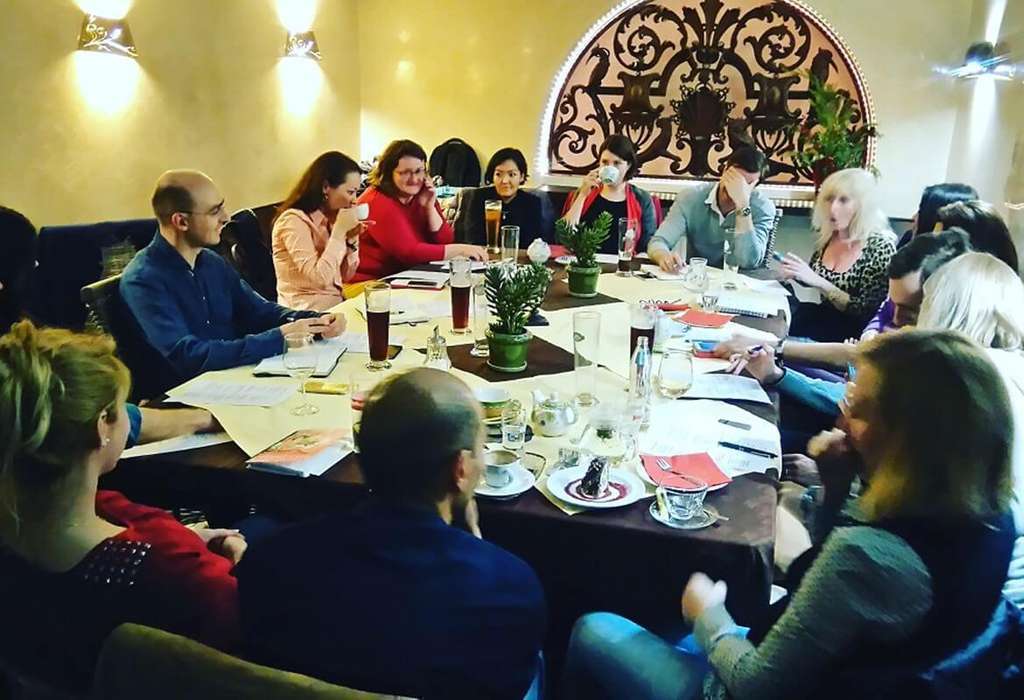
That is the theory. The practice we work through at the "Freud's Legacy" club. For that, see the events calendar. Enjoy your influencing!