Love and hate. Sadism and masochism. Voyeurism and exhibitionism. As it turns out, these are two sides of the same coin — ambivalences that keep turning into one another. That is exactly the fate of the drives described by Sigmund Freud in 1915 in his paper “Drives and Their Vicissitudes”.
What matters more today is to see that Freud studied NOT SEXUAL subjects, as it is popular to think, but mental processes in general. This article sets out the theory that leads us towards an understanding of the ambivalence of love, and the practice of how love turns into hate. As he explored new territories of the psyche, Freud handled the term “drive”, der Trieb, with great care. For his research he looked for terms among words typical of the German language of the early 20th century. According to the German dictionary Duden, der Trieb means many things, in particular:
- an inner urge, prompted by instinct, aimed at satisfying strong and as a rule vital needs.
- In engineering it is a part that transmits force or torque — a cogwheel, for example.
Sigmund Freud on love
Why does the public associate Freud with sexual matters? Freud himself acknowledged this over-simplification and explained it by the origins of psychoanalysis. Its first object of study was the “transference neuroses” with a sexual basis, hysteria above all.
So far psychoanalysis has been able to give us more or less satisfactory information only about the sexual drives, because it was able to observe this group of drives in the psychoneuroses as though in isolatio
Freud
What is a “drive”?
Searching for a concept “still rather obscure, but indispensable in psychology”, Freud tried to approach a definition of the “drive” from several different angles.
Freud: “The true beginning of scientific work consists in describing phenomena, which are then grouped, ordered and set in relation to one another. Yet even in describing them one cannot avoid drawing on certain abstract ideas in working the material over — ideas taken from somewhere else and certainly not from the new experience alone.”
By 1915 Freud was only beginning to shape his ideas on the basis of the experience gathered so far — limited, by today's standards. He himself notes that his attempts to find definitions, origins and regularities of the drives are a first offering of ideas which (1) are needed in order to build a theory and test it, and (2) make it possible, once tested against experience, to formulate a more precise definition. So he starts with a biological comparison:
1. Is a drive a bodily stimulus?
If a fly lands on my hand, I feel it as an irritation or an itch on the skin. I jerk my hand (a single reflex movement) to get rid of the fly as the source of the stimulus. But the comparison has its limits, because (1) in mental processes the stimulus comes from within and not from outside, and (2) a bodily stimulus is a one-off event (the fly landed on my hand and I chased it away), whereas a drive has the character of a constant force. So Freud moves on to his second attempt at a definition
2. A drive is a need that comes from within with a constant force
A need, accordingly, can be satisfied. But since the need arises from within and not from outside, Freud's second conclusion has a very practical value for me:
3. A drive can only be satisfied! There is no running away from it.
A drive can be changed only by switching to another need. There is no escaping a drive by flight:
Since it (the drive) operates not from outside but from within the organism, no flight can be of any help against it… (Satisfaction) can be achieved only by an expedient (adequate) change in the source of the internal stimulus.
Freud
Since a drive cannot be got rid of by simple actions, the nervous system has to come up with more complex ones. Higher organisms try out various actions to reduce the stimulation and judge them by the pleasure principle. Pleasant actions lower the stimulation, unpleasant ones raise it. But since in neither case is the stimulation removed altogether — only regulated — the conclusion is:
4. A drive cannot be removed by pleasure.
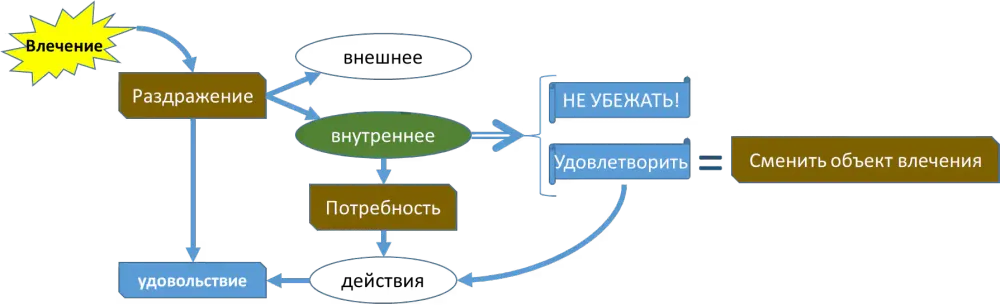
In fact all four conclusions are of a purely practical use. Ask yourself whether the following actions are an effective way for someone to settle their inner questions:
- To build up self-confidence, he goes to a two-day seminar (see conclusion 2)
- To get over a divorce, he sets off travelling (see conclusion 3)
- To forget the past, he goes hunting for the opposite sex (see conclusion 4)
The four characteristics of a drive
For Freud a drive has four characteristics:
- Pressure — the measure of the activity, of the motor force contained in the drive
- The aim of a drive is satisfaction through the removal of that pressure.
- The object of a drive is that by means of which the aim can be reached. Something external, but also a part of one's own body. The objects of a drive change all the time. In the case of fixation, however, a close attachment to the object appears, and any attempt to separate the drive from the object meets resistance.
- The source of a drive is a somatic process in an organ of the body whose stimulation gives rise to the drive in mental life. Chemistry, anatomy — territory that no longer belongs to psychology.

Take Romeo and Juliet: in both of them, at the right age, an itch begins somewhere down below (the Source) — that is Pressure. It grows, and in order to reduce it (the Aim) the two find in each other the Object of their longing and even begin to reach the Aim, to remove that pressure. But both are at an early stage of development. A fixation takes place, and any attempt from outside to separate the drive from the object is met with resistance.
What drives are there?
Very much to my taste, Freud supposes that all drives work in qualitatively the same way and differ from one another only in quantity.
All drives are of the same kind, and their effect depends only on the magnitude of excitation contained in them
Freud
But the conclusion that there is an endless number of drives is of little use in practice, where you need concrete subjects to study. Drawing on his own experience, Freud proposes to single out two basic drives: self-preservation and the sexual drive.

At the time of writing, in 1915, Freud proposes to keep to this simplified “auxiliary construction” for as long as:
- It remains useful
- Replacing it with another one would not change the results of description and classification
- No findings appear from other neurotic illnesses, schizophrenia for example.
One could go on complicating not only the classification of drives, but also their forms and combinations. For example:
- Drives can be partial (Zielgehemmt). This is when the partial satisfaction of a drive leads to a delay and a deflection from the aim.
- Drives can also become interwoven (Triebverschrankung), when one and the same object serves to satisfy several drives at once.
Happily, Freud gave up on such complications in 1915. He also gave up the demand that classification be done through psychology alone. He himself suggests borrowing assumptions from other sciences, especially from biology. Today we could invent an endless number of drives: biological ones for food, sleep, a home; social ones for contact, recognition and exchange; cultural ones for knowledge, music and religion, and so on.
Polarities and the fate of the drives
To explain the opposites in love and hate, we need to single out the polarities of mental life that move us. The “I”, the subject, the inner world. Or the “not-I”, the object, the external world. Every living being comes to know the difference between these “real” polarities by removing stimuli. External stimuli are removed by moving the muscles. Internal ones cannot be got rid of by muscles. Pleasure — unpleasure (Lust–Unlust). This “economic” polarity is known through a change in stimulation. Stimulation has gone down — pleasure. It has gone up — it feels bad, unpleasure. The opposition “active” — “passive” Freud describes through the action of the ego. This is the “biological” polarity. Passive is when the ego RECEIVES stimuli from the external world. Active is when the ego REACTS to stimuli.
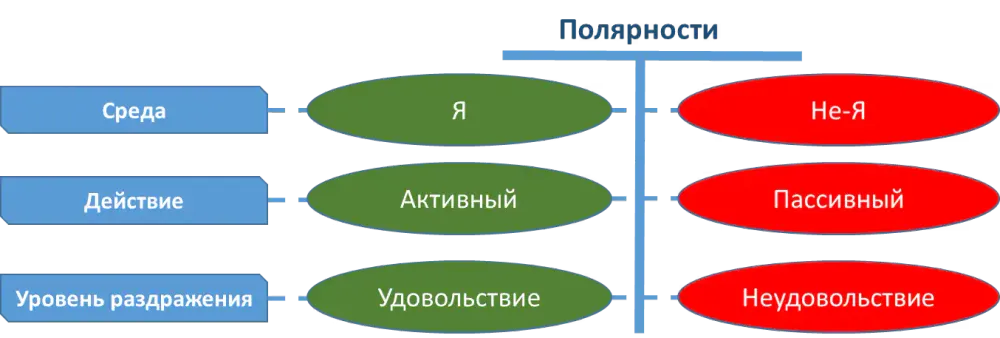
The three polarities describe eight ways in which an individual behaves and reacts. For example:
- I have been smacked, and it feels good.
- I am looking, and what I see is repulsive
- I love and I am active, and it feels good.
What is more, the fate of the drives, as Freud sees it, is that they change all the time and pass from one polarity into another. The object keeps changing (the “I” — the “not-I”), and activity turns into passivity. A drive may turn into its opposite. For instance, out of the need for active doing (to torment, to look at) grows the need for passive receiving (to be tormented and looked at). In this case what changes is the aim of the drive. Sadism turns into masochism, voyeurism into exhibitionism. Or, in terms of content, love turns into hate. A drive may also turn against one's own person, and then the object changes while the aim stays the same. Masochism is sadism turned against oneself. The exhibitionist takes pleasure in looking at his own body. A drive lends itself to other transformations too — sublimation, for example (the form of the drive moves far away from its original aims), reaction formation (against the drive), or repression. These transformations lie outside Freud's paper “Drives and Their Vicissitudes”.
The ambivalences of love
So, back to our muttons ))). At a certain point in the development of a drive one can observe its (passive) counter-current. This is ambivalence, and it shows itself most vividly in the turning of love into hate! To keep the argument short, the following definition applies:
Love = the relation of the ego to its sources of enjoyment
Freud
So, back to our muttons ))). At a certain point in the development of a drive one can observe its (passive) counter-current. This is ambivalence, and it shows itself most vividly in the turning of love into hate! To keep the argument short, Freud's definition applies: Love = the relation of the ego to its sources of enjoyment. Love and hate can be felt at one and the same time towards one and the same object. What makes it even more complicated is that love is capable of three ambivalences:
- To love or to hate — indifference.
- To love — to hate.
- To love — to be loved
Indifference
How can there be so many opposites? At the beginning of mental life the ego is able to satisfy its drives on its own. The child takes pleasure in itself. This state is called narcissism, and the ability to satisfy oneself is called auto-eroticism. It is in the state of narcissism that the first ambivalence of love appears — indifference. It simply means that a person does not need the world around them in order to satisfy their needs.
Love and hate
The world around us may not be needed, but the basic drive of self-preservation leads us into interaction with it. Some external objects arouse unpleasure, and a hostile part splits off from the ego — the “not-I”, bound up with the external world. This is how hate comes into being: the relation of the ego to an alien external world that irritates it. If, on the other hand, an external object arouses pleasure, then “attraction” appears — the external object is drawn closer to the ego and the two merge. Out of the passive form of receiving stimuli we actively begin to love that object by way of attraction.
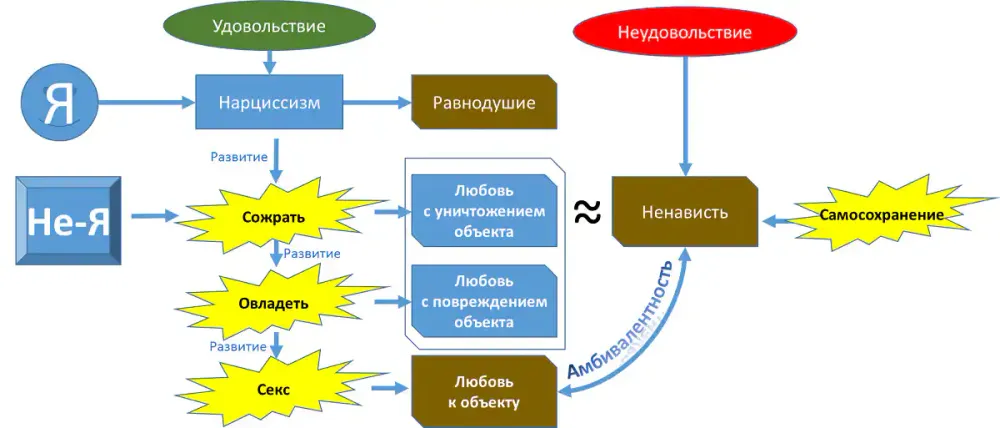
The move from narcissism to an active capacity for love happens gradually, as the sexual drive develops:
- At the beginning the child's sexual drive is directed at itself, which shows itself as auto-erotic narcissism.
- At the first stage of sexual development an urge appears to devour (fressen) or to incorporate (einverleiben). Analogies with the reptilian brain suggest themselves here. This form of love destroys its object.
- At a higher stage an urge appears towards possession. Here it makes no difference whether the object goes on existing or not. The analogy that comes to mind is jealousy, which in extreme cases destroys its object.
- Only as the sexual drive develops does love become the ambivalence of love.
Freud pointed to two basic drives: self-preservation and the sexual drive. We do not say of the objects of self-preservation that we love them. In everyday speech love is used in the context of the sexual drive. The word “hate” is used far more often in connection with unpleasant sensations, and it comes out of the ego's struggle for self-preservation.
When a loving relation to some object is broken off, hate not infrequently appears in its place, which gives us the impression that love has been transformed into hate. A wider view, however, reveals that hate motivated by real causes is reinforced by a regression of love to the earlier sadistic stage, so that hate takes on an erotic character and the continuity of the loving relation is thereby preserved.
Freud
Being loved and masochism
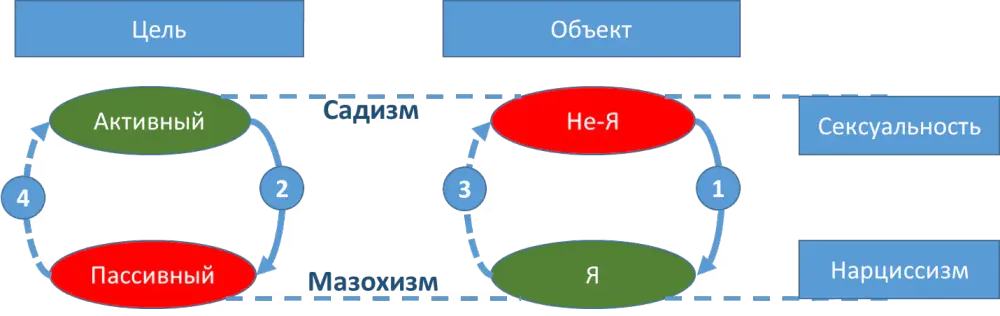
The third ambivalence, to love — to be loved, is best explained with the help of other pairs of opposites: sadism/masochism, exhibitionism/voyeurism, and the move from the active through the reflexive to the passive voice. In the case of sadism, the turn against one's own person and the reversal into the opposite work together. It all begins from an active position. Sadism consists in active violence (Aim no. 1) towards another person or partner (Object no. 1). Then:
- A turn against oneself takes place: the outside person is given up. The sadist returns to the narcissistic formation and identifies the partner with himself. By turning back towards his own ego, the sadist himself becomes Object no. 2.
- Reversal into the opposite: at the same time the active aim of the drive changes into passive aim no. 2. In the narcissistic state the ego can satisfy its needs auto-erotically. No active position is needed.
- A new object is then sought, because the aim has become passive. “Growth” happens again, the ego expands once more, and external objects begin to be associated with it. The ego starts moving towards those objects.
This cycle of transformations can go on endlessly, just like the need not only to love, but also to receive love.
So why?
So why do the drives have such a fate? What lies behind this merry-go-round of ambivalence? I, for one, would rather avoid the hate inside love. Is that possible? This is the moment to recall that using oneself passively as the object that satisfies one's own needs is a mark of narcissism — the earliest level of mental development, typical of a child. It is an earlier stage, and it stays with a person all their life. The active, later stage of development, meanwhile, is bound up with the development of the sexual drive.
…the vicissitudes of the drives — the turning against one's own ego and the transformation of activity into passivity — depend on the narcissistic organisation of the ego and bear the stamp of that phase
Freud
Eric Berne's transactional analysis holds that three personalities live in a human being at once (the Child, the Parent, the Adult). This is an echo of Freud's discoveries: he maintained that the transformation of a drive is only ever partial, keeping in itself elements both of the later active direction and of the earlier passive narcissistic one. Both stages of the drive's development exist at the same time in a permanent middle stage — ambivalence.
All the manifestations of the drives can be broken down into separate thrusts, spread out in time and each of them uniform throughout its own interval, related to one another like successive eruptions of lava.
Freud

So the turning of a drive from active to passive (from loving to needing to be loved, from sadism to masochism, from exhibitionism to voyeurism) happens because the drive — or the person? — goes back to an earlier stage of development. A return to childhood. The adult's experience is preserved through it, and after these sharp but short leaps “into childhood” the psyche comes back, keeping the passive elements of that earlier development. We all want to go back to childhood, don't we? Although people who have reached a certain maturity begin to see the advantages of their age. I once heard someone say: “Would I like to be young again? Not for anything in the world! No money, you have to chase after something, and nowhere to go!” I think it is exactly at that moment, when you no longer want to go back to childhood and youth, that the ambivalence comes to a halt and the narcissistic need begins to be satisfied by other means.
This fate may correspond to the attempts at defense which at higher levels of the ego's development are achieved by other means
Freud
What brings about the “growth” back from the passive phase to the active one (from masochism back to sadism, from needing love to showing it, from voyeurism to exhibitionism)? I can think of two reasons:
- Interaction with the surrounding world goes on, and external stimuli once again bring unpleasant sensations. One has to switch to an active position and deal with external objects. This mechanism resembles the way hate appears.
- It may be that the successful auto-erotic satisfaction of needs leads to an expansion of the ego and to a search for new sources of pleasure.
How can the ego be expanded? Is it fair to conclude that this circling of the drives through their opposites depends on a person's level of development? And that at higher levels we can find other means, so that one could love steadily without leaping over into hate? That is the subject of another paper — both Freud's and mine.