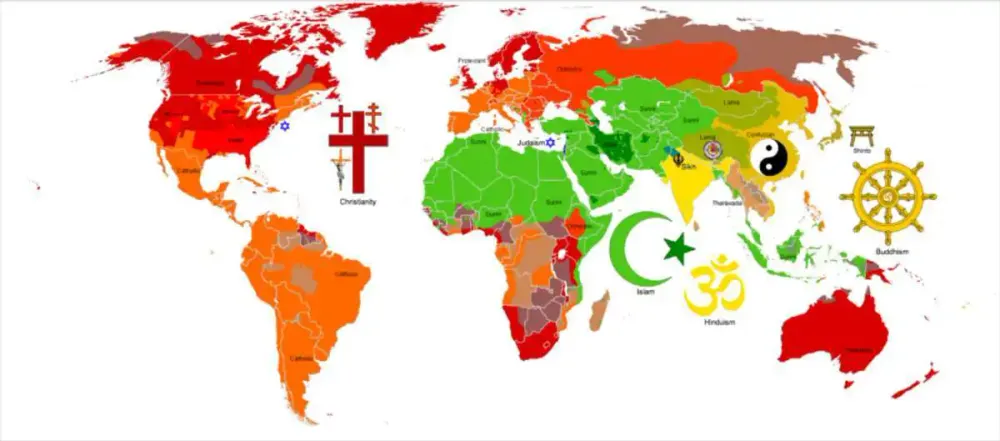
To each their own, and we are all one of a kind? If we had nothing at all in common, there would be no psychology, and certainly no religion would ever have arisen. Because every religion is an answer to the personality's demand for its own development.
Religion as an answer to what we share
When people look for answers to their life questions, those answers coincide, one way or another, with the answers of a particular group. Besides questions there are difficulties, problems and complications, and these too are similar for a whole group of people. One of the first therapeutic effects of any consultation is that a person feels better the moment someone explains to them what is happening to them. Because it becomes clear that I am not the only one with this problem. And if I am not the only one, then it can definitely be dealt with. Religion has exactly the same effect.
Every religion answers the main questions:
- How is the world arranged?
- How is a human being arranged?
- Where do a person's problems come from?
- What are we to do to solve those problems?
If we take any large, decent non-religious philosophy, we will notice a similar attempt to answer those very same questions. The big theories of personality, in their own way, also try to answer them, just from a slightly different angle: it is all a different view. Looking at a problem from several sides does not make it any worse, it makes us better educated.
Sergey Shishkov, the founder of the S-Theory, on the link between religion and personality typologies:
Take Islam, for example.
There is a particular personality type for whom Islam is the answer to all these questions. There is, for example, the psychopathic personality type. The main difficulty of these people is that they have trouble feeling the boundary of a personality, of a territory. At the same time they have an enormous amount of physical or spiritual personal strength. Vladimir Vysotsky, for instance, was this personality type. A man living in a closed country where you were not allowed to speak to foreigners, he married a foreigner and travelled abroad. He was banned from singing, and his songs poured out of every crack. He was banned from acting on stage, and he started acting in films. This is a man who went past the limit all the time, which is exactly what he kept singing about.
And yet these people have an astonishing ability to feel other people's inner world. On the one hand he does not see the boundary; on the other, precisely because he slips past boundaries, he can very easily go deep into another person's inner world. Front-line veterans said of the songs of Vysotsky, a man who had never been to war, that they had been written by someone who had sat in the same trench with them. He went up into the mountains later than he wrote his songs about the mountains: climbers said that this was a man who had been roped up with them.
And the basic religious tenets of Islam help a person of this personality type very precisely to develop that very personality. On the one hand they say: do not wrong your neighbour, respect boundaries. On the other hand they do not press down on the person. What is a church in Christianity? It is the house of God, the place where God lives. What is a mosque in Islam? It is a place where religion is taught and where it is convenient to pray. But it is not the house of God, because the house of God is the whole world: a Muslim spreads a rug on any patch of ground, goes down on his knees, and he is in a temple. There you have the absence of boundaries!
So on the one hand it supports this and gives it a socially acceptable outlet, and on the other hand it teaches. Because when you do not feel boundaries, it is very hard to be kind, genuinely kind. Islam has many festive rites tied to generosity, hospitality, supporting those in need and sharing what you have. In other words, the teaching is quite deliberate.
On the link between religions and philosophies
The same holds for philosophies and for the schools of psychology: each of them broadcasts what it is predisposed to, what has become its sore point, or what comes out of its dominant passion. Which leads to the old, familiar three pillars of worldviews
Bertrand Russell, a philosopher of the 20th centuryThere is another way of classifying philosophies, less precise but perhaps more useful to non-philosophers. Here the principle of division is based on THE DOMINANT PASSION THAT LED A GIVEN PHILOSOPHER TO TAKE UP PHILOSOPHY.
And so we get three kinds of philosophy:
- (1) philosophies of feeling, inspired by the love of happiness,
- (2) theoretical philosophies, inspired by the love of knowledge, and
- (3) practical philosophies, inspired by the love of action.
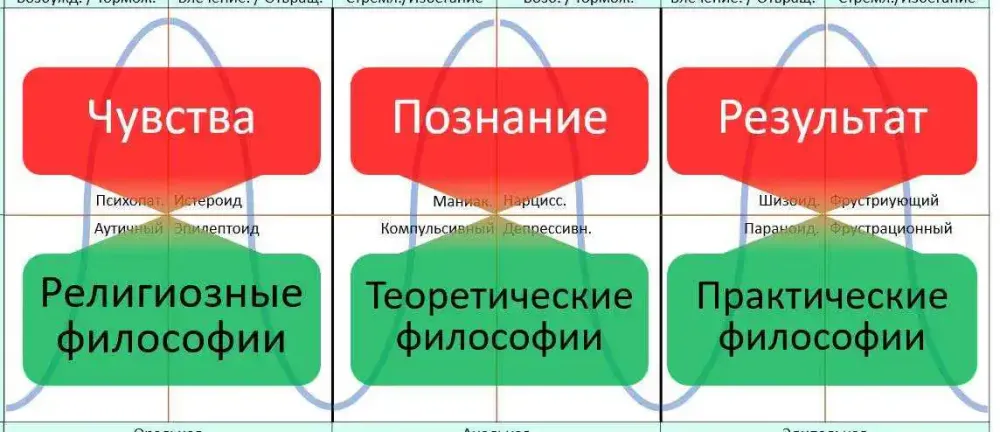
Among the philosophies of FEELING we will place all those that are above all optimistic or pessimistic, those that offer schemes of salvation or try to prove that salvation is impossible; most philosophies connected with religion belong here. (P.S. for students of the S-Theory: this is about the first four types, the autistic and the psychopathic, the hysteroid and the epileptoid)
Among the theoretical philosophies we will place most of the great systems, since, although the passion for KNOWLEDGE is rare, it is precisely that passion that has been THE SOURCE OF ALMOST EVERYTHING that is BEST in philosophy. (P.S.: this is about the second four, the compulsive and the manic, the narcissistic and the depressive)
Practical philosophies, in turn, are the ones that regard action as the highest good, treating happiness as a practical RESULT and knowledge as merely a tool of successful activity. Until recently such philosophies were rare; in fact their main representatives are the pragmatists and Bergson. In the rise of this kind of philosophy we can see the REVOLT of modern man.
Why all this philosophising?
Why understand and admit that religions, philosophies and schools of psychology alike merely answer the questions of a part of the population? So as truly to recognise both your own uniqueness and the particular features of other people, for instance. The road there, however, runs through an understanding of your own limitations, that is, of the features of your personality type.
Carl Gustav JungRecognition and respect for
the subjective conditioning of knowledge in general, and of psychological knowledge in particular, is the first condition for a scientific and fair appraisal of a psyche different from that of the observing subject. But this condition
can be met only if the observer knows precisely the range and the nature of his own personality
.
You can come to know your personality type in our Dating Club. Until then, all that is left is to philosophise.