Ever since the world began there has been an unspoken argument among women: should you wait for your prince or hunt him down? Does the woman win the man, or the man the woman? Who makes the first move, the man or the woman. Openly or not. And what counts as a first move anyway: a hello, asking for a phone number, an invitation for coffee, or simply an interested look? How do you tell whether the other person wants a relationship at all? What kind of relationship do they want: a couple of pleasant evenings, or one for life? Do they want a relationship with you in particular? Millions of young people torment themselves with these questions, toss and turn sleepless in their beds, eat their stress away, lose weight from nerves, run round training courses, bars and dating clubs, hope, are disappointed and start dreaming all over again.
Background: The stories are published from the feedback we received and with our clients’ consent. The names have been deliberately changed. At the end you will find a counsellor’s commentary analysing the relationship.
Skip to the counsellor’s commentarySome of us, myself included, decide that since we are all waiting for our prince on a white horse, we might as well learn to ride — it would be awkward otherwise when he finally turns up. A small digression: my own prince on a white horse caught me off guard as I was hauling 20 kilos of gear home on foot, twisted with the strain and dishevelled after a dive. The horse really was beautiful, by the way; the prince, not so much. On the other hand, riding is exactly where I met Masha. And Masha was not riding for any prince.
No, Masha was not like that. She deliberately stepped out of that endless running in a wheel like a squirrel, out of that pointless race, that competition for a highly dubious prize. She proudly declared her independence from public opinion, from norms and proprieties, from worrying and proving something to herself and to others, and — unheard-of impudence — decided to live for her own pleasure. Masha celebrated her personal Independence Day in the company of her girlfriends and some alcohol, and from then on she held sacred to the line she had chosen.
Her friends, who had decided that Independence Day was just another way of showing off, spent a long time watching sceptically as Masha first went on a motorbike tour of Europe (well, obviously, just for the men — why else would anyone in their right mind do such a thing?), then tried a bit of skydiving (well, bikers are brutes, that is clear, but paratroopers are definitely cuties!), and then took to rafting in Karelia (interesting, what sort of freaks are mad about kayaks?). When Masha started roaming the developing world and staying with couchsurfers, her friends decided that this was rock bottom: penniless student dropouts and rivers of cheap beer... All the same, Masha managed to come back every time alive and unhurt, with new friends all over the world, new photographs and new stories about her adventures — stories that made some of her friends clutch their heads and others clutch their cocktails, because only with cocktails did their own lives seem a little less boring. And the years went relentlessly by.
Over those years her friends got married, got divorced, suffered, searched and hunted. Masha did not turn a hair. Her friends frightened her: this way she would never find anyone, she would be alone forever, nobody would even look at her unless she put in some effort — and anyway, what man needs a “gift” like that, one who cannot sit still in the same place for a month. Yet, oddly enough, Masha had no shortage of men. Long relationships, though, were also missing: the few who passed “quality control”, who met every requirement set for them, she simply did not like, and Masha did not stand on ceremony with them — it was all graceful, respectful and without open conflict. Simply unattainable. Something out of a fairy tale: “he crossed himself three times, leapt into the cauldron and was boiled alive”.
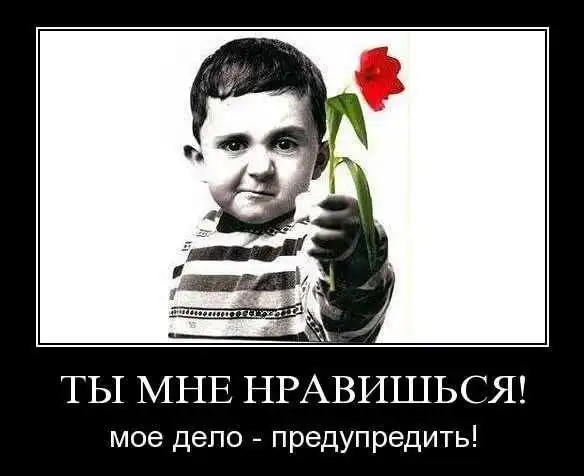
Until Maxim appeared in her life. Maxim was astonishingly logical, a man of few words but extremely stubborn. Behind his outward restraint you could feel an enormous strength. Incredibly calm and certain that he was right, a little blunt, with a somewhat peculiar sense of humour. Masha did not even register him as a possible suitor until he came up and announced that he liked her and wanted them to be together. An old internet meme flashed into her mind: “I like you. Consider yourself warned!” It was endearing, but plainly not enough.
Maxim was sure that he and Masha ought to be together. So he doggedly made attempt after attempt to win her. He met her after work with flowers, took her to expensive restaurants, gave her presents. Masha’s whims were not chaotic or scatterbrained, but she only had to raise an eyebrow or nod in the right direction and Maxim would calmly and with dignity do whatever was required, performing the impossible when necessary. A case of “a man’s word is a man’s deed”. And at last Masha “acknowledged his existence”, as her friends sarcastically put it.
Their relationship was like a dance: Maxim led, but it was Masha who somehow set the direction.
“How can you be courting a girl when your own flat is cluttered from floor to ceiling? It is just not nice!” Masha might say, and after a short protest Maxim would start clearing the piles and throwing out the surplus. After which he would stare in astonishment at what a spacious flat he apparently had.
“And what do I get out of you sitting in your little corner? You may not mind, but I want a husband with prospects...” Masha would say, wrinkling her nose, and Maxim would slowly get himself moving, weigh up the options and land a promotion. And then wonder in astonishment why he had not done it long ago.
“Sweetheart, who dresses like that these days? We are not going to your office — you are taking me to a restaurant!..”
And every time Maxim discovered that in doing something for Masha he was doing something for himself, becoming better, reaching a new level. And that broke the pattern completely. Maxim had always sneered at henpecked husbands and all the others who granted every wish of their overbearing wives, yet now he was doing the same thing, and it was making his life better in every sense. The euphoria of the opportunities opening up went to his head so much that he forgot everything around him and threw himself into an ocean of possibilities and prospects. People noticed him, plainly respected him, began to listen to his opinion, and he was in demand as never before.

He remembered Masha only when the flat became suspiciously empty and quiet. He did not quite understand how he had missed it, what exactly he had done wrong, how he had failed to notice her packing her things and vanishing. He had won her, conquered her, obtained her consent... Everything had been fine... Anger swept over him: as if he needed to put up with whims like that! And then doubt: or maybe he did? Away with doubt! He was a man! Why should he have to run after her and spend his whole life not knowing when something might go off in her head and she would leave again, and he would not even know why! And what did he want with that kind of bother?
He convinced himself that emotions had nothing to do with it, that he had already done everything he possibly could, that it was time to stop fooling about and letting Masha twist him round her finger as she pleased. And Maxim went back to normal life. On his own, owing nothing to anyone and depending on no one. But life suddenly lost its taste, its colours. Bland weekdays, black-and-white feelings, everything somehow gone flavourless. And meanwhile everything — the furnishings of the flat, the job, the wardrobe — reminded him of her, because everything he had achieved, everything he had become, was thanks to her. He could not understand how it had happened. He had never believed in love; he had thought it either an invention so that people could make trouble for themselves, or simply a feeling entirely beyond him. But now he walked around lost, asking himself whether this might, after all, be that very love.
When it became truly unbearable, he tried to call Masha. She did not pick up, so he went to her flat, but she was not there either. Luckily, at that moment a neighbour came into the entrance hall with her nose in her smartphone — the same neighbour who was Masha’s companion for tea and TV series on rainy, lonely evenings. The neighbour did not hesitate for long and soon “grassed her up”: Masha had gone away to the farm for a week. Maxim knew about that farm; Masha’s favourite horses were there (mine too, by the way). Without a second thought he set off out of town.
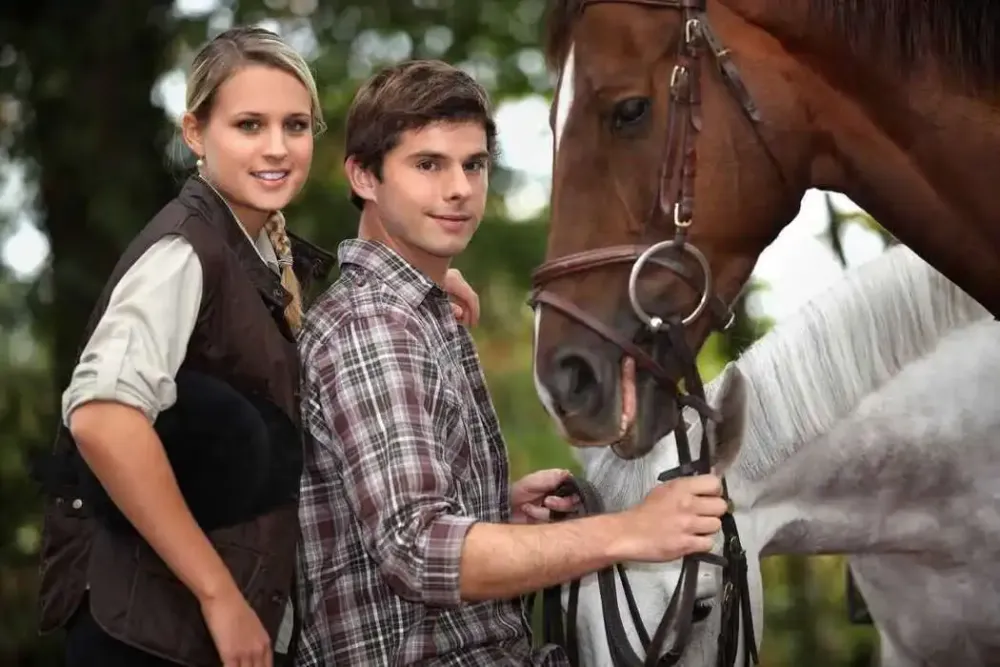
Maxim had been to the farm only a couple of times. Masha had laughed for ages at how wooden he was in the saddle and urged him to come more often — and anyway, what kind of prince was he if a white horse could not keep him on its back? Maxim would grit his teeth and try to stay calm, memorising the instructions and doing his best to follow them, but he was a very long way from Masha’s level. And now, too, they recognised him, were glad to see him and told him that Masha was “in the mountains” — that was what they called the stony path in the hillier part of the wood behind the farm. Maxim was about to set off there on foot, but the staff stopped him. Too far, they said, and too long. Easier to wait here, or to ride Aramis.
Aramis was a fairly phlegmatic twelve-year-old horse used for teaching the smallest children. There were no lessons that day, and one of the staff had just tacked him up simply to give him some exercise. Importantly, Aramis was white. Ten minutes later Maxim regretted his decision, but at the moment of deciding the colour had been the clinching argument: Masha had always valued beauty, and Maxim fully intended to supply her with that beauty. Which is precisely why, those same ten minutes later, Maxim was cursing himself for all he was worth while trotting towards the “mountains”, trying to fit his bouncing in the saddle to Aramis’s rhythm. About a third of the way there Aramis worked out that his rider was even less experienced than most of the children, so there was no need to obey him, and stopped.
God alone, who created all his creatures the creatures they are, knows what part of a horse it is that senses the rider’s mood. Aramis understood perfectly well that Maxim had no intention of hurting him and would do everything to avoid radical measures in the shape of the little whip he had been handed before setting off. Maxim tried coaxing, pleading, begging and swearing, tapping Aramis’s sides gently with his heels and tugging at the reins, but despite his name the horse behaved rather more like Grimaud: silently and in his own way. Having run through every possible method, Maxim had to resort to the impossible: he raised the whip and caught Aramis a crooked blow on the rump. Aramis gave Maxim a distrustful sidelong look, then looked at the whip, and then wrinkled his nose maliciously (at least, Maxim swore that was exactly how it went). And then the snow-white phlegmatic turned into a raging choleric, tearing off between the hills at full gallop. Maxim could not understand by what miracle he was still in the saddle, or where he found the strength to hug Aramis’s sides with his heels and his neck with his arms. Beneath him a mighty engine of one furious horsepower was straining to be free — and Maxim, a lover of sports cars and everything to do with them, realised for the first time what that single unit of power is actually capable of. He was not frightened: he quickly ran through the options and came to the depressing conclusion that the whole situation could be summed up by a pithy Russian word of six letters beginning with “p” and ending with “ts”, and so he waited almost meekly for that Russian word to happen. It happened on the approach to the farm, where Aramis burst out of the wood and decided to apply the emergency brake in front of the electric fence. Maxim had not expected such treachery, and so performed a graceful somersault over Aramis’s head, to land on the grass somewhere beyond the fence and black out.

When he came round, Masha, a couple of other visitors and the farm staff were standing over him. Maxim tried to smile and hold out his hand to Masha.
— “I will not do it again», he croaked.
— “I very much hope not!» the owner of the farm cut in, “and what possessed you to head off to the “mountains” at your level?!! Who gave him a horse in the first place?!»
— “But Aramis is the calmest one»... somebody mumbled guiltily.
— “So you got Aramis worked up too», Masha snorted tenderly.
— “I will not do it again... Come back... Please...»
— “If you ask me, we were called out for nothing», chuckled the paramedic who had just arrived. By the look of him he was one of those seasoned old hands who turn into the greatest cynics in the smoking room, “We thought somebody was dying here, and instead they are declaring their love! Take him, madam, do not think twice. Material this hardy does not get thrown away!»
Counsellor’s commentary
Masha is the narcissistic personality type. She tries with all her might to prove her independence, yet she still depends on appraisal from outside and wants everybody to like her, to be admired. She is sociable, she knows how to find an approach to anyone, a common language. Narcissistic people build an image of themselves that everyone else can only admire, an image unlike anyone else’s; with all their might, though usually unconsciously, they show that they are better, cooler, more interesting, more beautiful. And their lives really are fundamentally different from the average and the ordinary. Masha lives for her own pleasure, entirely sincerely.
Maxim is the manic personality type. The basis of this personality type is seeing oneself as the sole bearer of the truth, since the truth is one and he is the one who voices it. He has his own fixed beliefs and principles. At the same time it is the notion that the idea stands above the person, and service to that idea. To find this truth of their own, manic people will look into a subject deeply enough and study a great deal, but their conclusions and results will still be largely “black and white”, which is why Maxim is drawn to emotions and to the whole palette of expression typical of narcissistic people. The actions of manic people are built on logic, on what can be calculated and analysed. Along with that, their theme of service to an idea, to society or to the family is exactly what fuels Maxim’s persistence in reaching his goal — in this case, a relationship with Masha.
The manic man courts her, conquers her, and at some point the narcissistic woman gives in. That is where the moment of overcoming shows itself. He needs to overcome, to attain, to cope, to conquer, to get through difficulties — and then she will be a worthy prize. She, once she is ready to give in, sets conditions that genuinely matter to him and that are at the same time a developmental theme for him. Conditions like these are both a test and something to overcome. At the same time she softens him. He becomes more social, more oriented towards being correct than towards being right. He is the man, she is the woman, but it is he who accompanies her. This is a partnership marriage of the male type, where both partners are active and both strive to make their mark in society. For a relationship like this to succeed it is crucial to be able to negotiate with each other and to compromise.