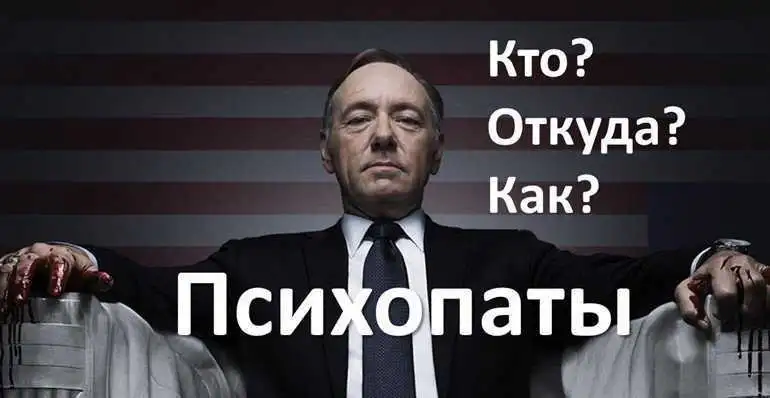
Psychopaths. How do you spot one? What goes on inside them? And, most interesting of all, how do you deal with them so as to get what I want and get away with it? That is what this article is about.
Psychopath or sociopath?
What is the difference between a psychopath and a sociopath? None, they are one and the same). The personalities we now call antisocial were labelled “morally insane” back in 1835. Later they were renamed “psychopaths”, then “sociopaths”. To make it sound politically correct. And quite right too, because Frank Underwood in the series “House of Cards” is a textbook psychopath.
Psychopaths often hold key positions in business and politics, in the CIA and in organisations of covert influence; they become cult leaders and religious leaders, legends of the advertising business and the entertainment industry, and equally outstanding criminals, rapists and murderers. In short, wherever the work involves POWER, MANIPULATION and COVERT INFLUENCE.
Here is a curious thing: one of the basic ideas of NLP — that “speech carries no meaning of its own and is behaviour for changing the behaviour of those around you” — matches the inner world of Psychopaths perfectly. Hmm... But that is another topic.
How do you spot a psychopath?
A psychopath is a personality organised around the pursuit of a sense of OMNIPOTENCE. How do you spot one? At the root of a Psychopath’s behaviour lies a flaw carried over from childhood — the inability to put emotions into words. Which comes out in these markers:
- “FEELINGS ARE FOR WIMPS”, “Stop babbling!”, “WHAT MATTERS IS ACTION!” — these are the slogans of people who replace feelings, the inability to say those feelings out loud and the anxiety of inner emotional churning with activity and hyperactivity.
- “IN LIFE YOU HAVE TO FEEL EVERYTHING” — a craving for thrills and danger, and an inability to enjoy simple things. Accordingly, psychopaths know two emotional states: hatred or manic joy.
- AGGRESSIVENESS combined with PRAGMATISM in behaviour. With one person the Psychopath is charming (if it pays off); a minute later he is yelling at somebody else and punching them in the face, and then he walks calmly on as if nothing had happened. The source is the same — the absence of emotions.
The psychopath’s games
How do psychopaths satisfy the feeling of “Omnipotence”? It is achieved through:
- MANIPULATION. There are two psycho-types that use it: hysteroids, who manipulate sincerely and unconsciously. And Psychopaths, who manipulate skilfully, deliberately, to a plan. Stepping over other people, bending those around them to their will in order to confirm their Omnipotence — that is their main occupation and their source of pleasure.
- DISOBEDIENCE to authority. Those very parents who take offence when teachers, counsellors or officers of the law set limits on children’s behaviour.
- DEVALUATION in an aggressive form, which turns into “self-fulfilling prophecies”. “You psychologists (bankers, lawyers, bin men, people of a certain nationality) think of nothing but how to cheat somebody.” This defense mechanism is called PROJECTIVE IDENTIFICATION. When you are talking to a person who is absolutely certain of the “truth” of your indecent feelings and who fights tirelessly to make you feel exactly that — well, that is just the sort of person one longs to be.
How will you feel?
How will you feel when you deal with a Psychopath? On the one hand, you have to understand that for psychopaths a human being, a dog and a pot plant are objects of equal value. That is, to him you are not a person. On the other hand, aggression and manipulative pragmatism are aimed at you to confirm his Power. What does that add up to?
- You will want to justify yourself and prove your good intentions
- You will experience hostility and coldness, and possibly
- A sense of foreboding.
The psychopath’s inner world
What is churning away inside them? How did they grow up? To put it very simply, a Psychopath is a CHILD with the basic NEEDS OF THE 6-TO-12-MONTH STAGE. An infant perceives that magical warmth is something he obtains himself, without realising that control over his life rests with people beyond him. This is the sense of infantile OMNIPOTENCE, which in a healthy form remains as a feeling of competence. Somebody who did not get enough of that sense of strength at the age when it is needed may spend a whole lifetime looking for confirmation of his strength.
How do you become a psychopath?
- GENETICALLY. There is some connection with innate aggressiveness, but it is not the decisive factor. A child who is hyperactive, demanding and inattentive from birth needs far more active parental care than a calm one who is easy to soothe.
- through UPBRINGING in a family with a HARSH, HOT-TEMPERED AND INCONSISTENT FATHER and a weak, depressive, masochistic mother. Where the family offers no consistent, loving, protective influence, you get psychotic Psychopaths of the Frank Underwood sort from “House of Cards”. A child needs self-respect through experiencing love and pride from his parents. If there is “not enough” parent, all that is left is his own “I” and its urges towards power.
- A more curable case is when the parents OPENLY broadcast DISOBEDIENCE TO AUTHORITY, stressing that their child is the exception to any grown-up outside the family. Mother, for instance, reacts with indignation when teachers, counsellors or officers of the law set limits on children’s behaviour. This leads to a failure to grasp the consequences of compulsive actions — that society sets limits on the individual’s prerogative to apply pressure. “There is no answer to a tank except another tank.”
- EMOTIONALLY, in an environment where nobody taught the child to name emotions in words. There are families where speech is used exclusively to control behaviour. Statements of emotion such as “I can see you are angry right now” or “You are probably upset” are out of place there. The result is a Psychopath unable to put his feelings and sensations into words (to speak them out loud)
- SOCIALLY. Frequent MOVES and family BREAK-UPS make it impossible to develop a sense of attachment to (a) caring parents, (b) society, and (c) culture and society. Where there is no identification with the caregivers, there is also no transition from the sense of Omnipotence (I make everything happen myself) to Idealisation (others make things happen for me).
How does a psychopath feel inside?
Their personality is polarised between a state of personal omnipotence and a frightening state of their own weakness.
- STRENGTH, dominance and deliberate MANIPULATION give psychopaths self-respect, confirmation of their right to be and a sense of being good.
- EMOTIONS are a sign of WEAKNESS. A Psychopath who experiences emotions sees himself as bad. Even inner irritation makes psychopaths anxious. To discharge it, “toxic” feelings are acted out on those around him (picked a fight — punched him in the face — calmed down)
From the chain “FEELINGS = ANXIETY = WEAKNESS” another piece of Psychopath behaviour follows: insistently convincing the other person that his emotions are “toxic”. “You lot, people of that particular nationality, are always thinking about how to swindle somebody.” If a psychopath cannot talk about emotions, then the only way to understand others is to impose on them what he himself understands — that is, the drive to dominate. - If manipulation has not worked, then AGGRESSION is the Psychopath’s calling card. Psychiatrically this is where it becomes ambiguous: some say it is primitive ENVY, the wish to destroy everything that gives other people pleasure and that he has been deprived of. I take the view that envy is too complex an emotion, one that can only be felt towards persons. And for psychopaths a pot plant, a family member and the cat are objects of equal value, and the aggression is aimed at REMOVING THE OBSTACLE. That is exactly why Psychopaths “cool down” so quickly: one second he is yelling, the next he is calmly making coffee.
How NOT to deal with them
- Being PEACEABLE, SYMPATHETIC, EMPATHIC, FLEXIBLE, making concessions — this not only fails to work, it provokes the psychopath into showing off his destructive strength. Any departure from the agreements and boundaries you have set, any behaviour that can be read as weakness and vulnerability, will be read exactly that way.
- Empathy is experienced as a sadistic triumph over the other person. Since a psychopath cannot put emotions into words, it is also impossible to establish emotional contact by mirroring feelings.
You do need to be honest (see below), but honesty is not the same as SELF-DISCLOSURE. Baring your soul is read as fragility (unlike with narcissists))). - MORALISING about what a shameless, immoral, sinful creature the psychopath is, and APPEALING TO HIS CONSCIENCE, is useless and betrays ignorance of psychology))). A psychopath “sins” in order to feel GOOD (omnipotent), and to show weakness (that is, emotions and not being strong) means, for him, to be bad.
How you CAN deal with them
You can only become a person in a psychopath’s eyes, and earn his respect, through stubborn resistance and by making demands of him. That is exactly how you show love and care, because “not caving in” answers the psychopath’s need.
- STRENGTH is the only quality a psychopath respects. Your task is to deal with him from a position of “INDEPENDENT STRENGTH BORDERING ON INDIFFERENCE”. Your tools are calm presence, firmness, incorruptibility, keeping to the frame — and all of it without emotional investment. Like a police officer, never show that it matters to you to be recognised. Strict persistence and a rock-solid steady attitude are the best combination when dealing with antisocial people.
The psychopath will, both at the start and regularly afterwards, test you, manipulate you and pragmatically tempt you into violating the boundaries. In time, if you stay firm, these attacks will weaken and change will come. - UNCOMPROMISING HONESTY, including admitting negative emotions. “Yes, I hate you” — said to a psychopath, a statement like that gives him what he lacked in childhood: emotions spoken aloud, words used to express a state and not only to manipulate. If you are a counsellor, you can openly own up to your greed and selfishness as the reason for your fee. And voicing the negative helps you to discharge your own inner tension on the psychopath and to be less afraid of him.
- Use BANTER (good-natured teasing) and HUMOUR (absurd exaggeration) to point out the consequences of the psychopath’s behaviour. You will show care for a psychopath by steering him towards more responsible behaviour, showing him that (a) there is a better way of getting the same results, (b) doing so without moralising, and (c) being consistent, punishing and impossible to exploit.
Here is an example of handling a psychopath properly:
A pimp once came to see me and started talking about his way of life.
— You know, I am ashamed to show myself and all that, but still it is a pretty good way to earn a living, and a lot of guys would like to live like this. You know how a pimp lives. It is not so bad — you get the girls to hustle for you. So why would you not do it? Why would anybody not live like that?
I answered:
— You are a punk. Look, I live off the earnings of prostitutes. I am writing a book about them; that gets me respect and makes my name. I have made far more money out of prostitutes than you will ever make. And besides, you, you lowlife, can be arrested any day and put away for ten years, while I enjoy respect and admiration and have an excellent reputation.
That he was able to understand. The lad saw that somebody he had taken to be just like himself knew a better way of getting the very same results
from McWilliams’s book
If you decide to “change” a psychopath, here is the secret: psychopaths burn out by middle age and often become respectable citizens. Old age is no fun, strength drains away, and pragmatic aggressive youngsters pragmatically start looking for new ways of showing strength. And here they take enormous pleasure in developing the ability to acknowledge the anxiety their feelings cause and to control their reaction to it. Holding back the impulse and taking pride in self-control — that is the path of development for a psychopath.
Cheat sheet and thanks
So, after such a long article, here is a cheat sheet on psychopaths:
Psychopaths are people preoccupied with a sense of omnipotence. Their main psychological problems arose between the ages of 6 and 12 months.
You can spot them by the markers: (1) “feelings are for wimps”, (2) a craving for thrills, and (3) pragmatic aggressiveness.
Psychopaths achieve “Omnipotence” through (1) manipulation, (2) disobedience to authority, (3) devaluation. Meanwhile you will feel the urge to justify yourself, and you will feel hostility and anxiety.
People become psychopaths: (1) rarely — genetically, (2) often — in a family with a psychopath father, (3) when parents do not teach them to put emotions into words, and (4) through frequent moves and family break-ups.
Inwardly psychopaths live by (1) strength and manipulation, (2) fear of weakness, which includes emotions, (3) pragmatic aggression.
How to deal with a psychopath. DO NOT: (1) be peaceable and pliant, (2) show empathy and disclose yourself, (3) moralise. DO: (1) act from a position of “independent strength bordering on indifference”, (2) be uncompromisingly honest, (3) banter about the consequences.
Who deserves the thanks?
All of this material was written after the work of Nancy McWilliams in her book “Psychoanalytic Diagnosis: Understanding Personality Structure in the Clinical Process”. Nancy — a seasoned former president of the psychoanalysis division of the American Psychological Association — set out in 1994 a formidable body of experience in the individual approach to patients: first determine the personality type, then relate to the person on the basis of its features. But as a writer Nancy is an unstructured person, she scatters her thoughts all over the book, and I did the structuring for her. Since 1994 the field has moved further still and made the approaches simpler and more systematic. The next step is the S-Theory of Personality Development (http://s-teoria.niirus.ru/), but that is a separate conversation.
P.S.: The psychopathic personality type

That was about people with mental disorders. Now you can read something rather healthier: about the psychopathic personality type. These are very well-known people, such as
- the singers and songwriters Vladimir Vysotsky and Grigory Leps,
- the actresses Cameron Diaz and Meryl Streep,
- or the politicians Hillary Clinton and Donald Trump.
In our psychology Club, for instance, we had a much-adored woman host and counsellor of the Psychopathic type. And in the Dating Club there are some very charming women of the same cast. Follow this link to read what these people are like.