The way a person positions themselves in relation to society is exactly what a life position is. In Jung's terms, and within the S-Theory, it is an inborn feature of the human psyche that stands for the masculine and the feminine principle, anima and animus, Yin and Yang. Or, to put it another way, it is the property that divides people into the “active”, who are set on expansion and dominance, and the “passive”, who are set on harmony, stability and increase.
Alongside the Attitude (Introversion and Extraversion), the life position is the second inborn, unchangeable property of a person. Recalling Jung, we know that there is a feminine principle in every man and a masculine one in every woman — that is, the “anima and animus” system is inborn in us.
These qualities show themselves quite readily in real life, and they are easy to spot, to assess and so to establish.
The masculine and the feminine are not only outward sexual characteristics. Outward sex is what we see in the mirror, the physical features. Inner sex is how we picture ourselves in our own minds, the behaviour we are hormonally “tuned” for.
There are men who look very masculine but have a dominant feminine principle — that is, they are in the Passive life position. Leonardo DiCaprio, Dmitry Medvedev and Robin Williams, for example.

There are women who look feminine but have a dominant masculine principle — that is, they are in the Active life position. Charlize Theron, Alla Pugacheva and Scarlett Johansson, for example.

Thus the combination of outward and inner sexual characteristics can vary.
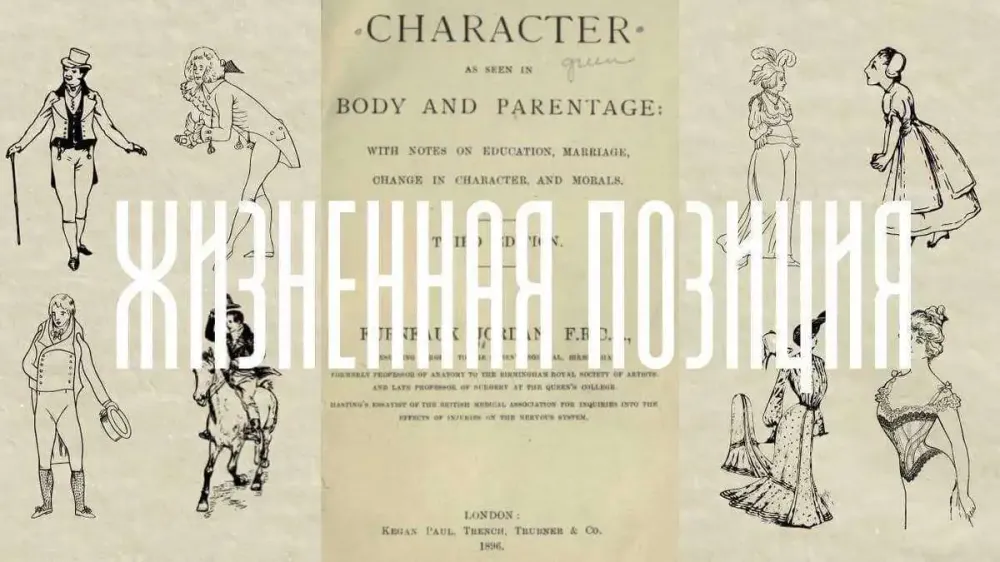
Different schools of psychology describe the term “life position” in different ways. Berne, for instance, folds the combinations of “OK-ness” into this concept: “I'm OK, you're OK”, “I'm not OK, you're not OK”. What interests us, though, is what Furneaux Jordan had already noticed back in 1896 in his book “Character as Seen in Body and Parentage”. He wrote:

Furneaux Jordan, 1890, “Character as Seen in Body and Parentage”There are two characters, fundamentally distinct from one another, two clearly marked types of character: in the one the tendency to activity is strong and the tendency to reflection weak; in the other the inclination to reflection predominates, while the impulse to action turns out to be the weaker
As he was working out the first typology of personality, Jung assessed Jordan's hint like this:
Gustav Jung, 1914In my view the factor of activity should be dropped as a main characteristic; as a characteristic of secondary importance, however, it still plays a part, in so far as the extraverted person, true to his own nature, is as a rule far more mobile, lively and active than the introverted one. But this quality certainly depends on the phase the individual happens to be in at that moment in relation to the outside world