Dividing people into introverts and extraverts is frowned upon — and quite wrongly so. The difference between them is so fundamental that it lies behind domestic quarrels, religious reformations and the irreconcilability of whole ideologies. It is so striking and so obvious that you might think these were people from different planets. If we grasp this difference, not only will our own lives get easier — the world will get better.
The concepts of introversion and extraversion were first introduced by Carl Gustav Jung in his book “Psychological Types” in 1914. He called them by a single word: the “ATTITUDE” towards objects. Put simply: our relation to the outside world.
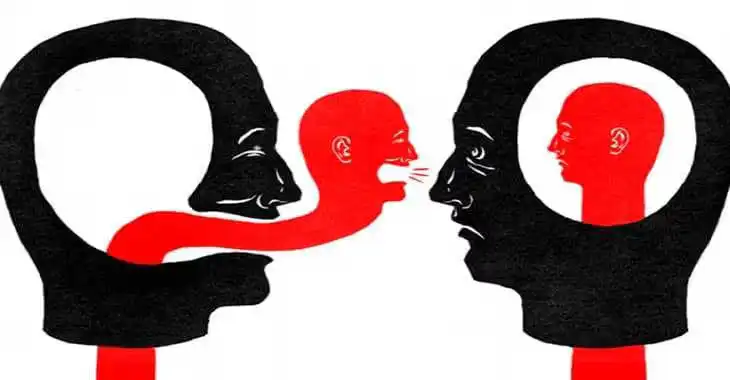
For Jung, the introvert relates negatively, moves away, protects himself and his inner world from the outside (from people, objects, ideas). Extraverts, by contrast, relate to the outside world positively.
Jung wrote:
Jung in the book “Psychological Types”“Everyone is, of course, familiar with those reserved, hard-to-read, often timid natures who form the strongest possible contrast to people of an open, sociable, often cheerful or at least friendly and approachable character, who get on with everybody, and sometimes quarrel with everybody, but who in any case stand in a relation to the world around them, influence it and are influenced by it in their turn.”
But then Jung grew bored and went off into archetypes, the collective unconscious and other mystical worldviews. Later on, among the many researchers abandoned by their “teacher” Jung, the concepts of introversion and extraversion “merged” with the active and the passive life position, that is, with the manifestations of the masculine and the feminine principle. As a result, it has fallen to the authors of the S-Theory to untangle today's confusion around these concepts.
Introversion and extraversion are innate qualities that are formed perinatally and do not change over the course of a life. From the moment of birth we are either introverts or extraverts. Our attitude depends on the conditions in which the foetus develops during pregnancy. Introverts are uncomfortable in the womb, and because of this their bone system and tendons develop more strongly. The result is “tucked-in” people with markedly expressed hypercontrol.
Extraverts develop in relatively comfortable conditions. Because of this their muscular system develops more, and in adult life their movements are smooth and unfinished. This, by the way, is very noticeable when a person dances:
In pop psychology the concepts of introversion and extraversion are more often mocked. The most striking example of the trolling of Jung's concepts is the term “ambivert”: people who are neither introverts nor extraverts. But that is not what we observe.
According to the S-Theory, a state in which a person behaves indistinguishably is possible only at so-called “death points” — a state of short-lived maximum tension in the psyche. In practice, in determining personality types, we have noticed the same thing: if a person is psychically balanced, he will match his attitude exactly. But if a person is in distress (psychically, under stress, going through a divorce or a period of strain in life), he will try to behave now like an introvert, now like an extravert.
Jung, too, was not particularly fond of “ambiverts”. He wrote:
Jung again“The two types are so different, and their contrast is so conspicuous, that their existence becomes obvious even to a layman in matters of psychology, once his attention has been drawn to it.
It is understandable that at first people are inclined to see such differences as individual cases of a peculiar character structure. Anyone who has had the chance to study a large number of people thoroughly, however, will discover without difficulty that this contrast is by no means reducible to isolated individual cases, but that what is at stake are typical attitudes, far more general than a limited psychological experience would suggest.”
Today introversion and extraversion are properties of the human being recognised by science. Practically every legally recognised psychological test contains these characteristics. A scale of introversion and extraversion is there in the Minnesota Multiphasic Personality Inventory (MMPI), in the “Big Five” model and in the personality models of Hans Eysenck and Raymond Cattell.