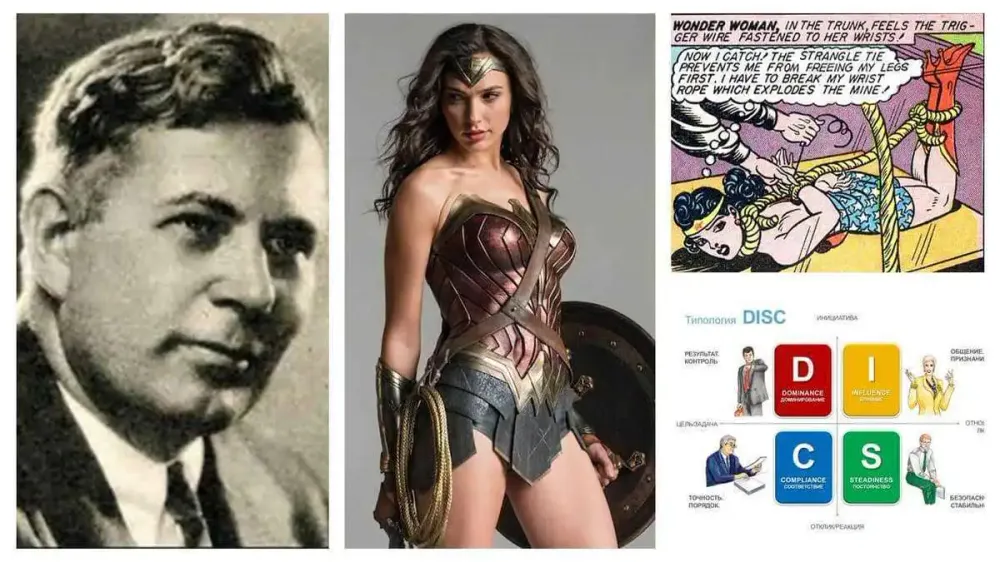
The life of William Marston (1893–1947), the founder of the DISC typology, was anything but dull: he built the lie detector, invented the comic-book heroine Wonder Woman, lived in a polyamorous family with two women and was drawn to BDSM, which he acted out under a pen name in feminist comics. The DISC test is just as many-sided: HR departments use it everywhere for hiring, while scientists cannot see the point of it — yet admit that it is stable. In truth it is simple: Marston arrived experimentally, and independently of Jung, at the four temperaments.
The DISC test is at the end of the article. If you would rather skip the author and his adventures, click the “Go to the test” button.
For examples of DISC personality types among famous people, well-known figures and celebrities — presidents, actors and characters from films, books and TV series — see above the test
Well then, let us start with our headline-grabbing author. At 28, having graduated from Harvard, William Marston became a doctor of psychology in 1921. Rumour has it that he was taken with the theories of Gustav Jung, whose book Psychological Types — with its account of introversion and extraversion, of the active and the passive life position and of four distinguishing features — came out in 1914. But personally I could see no connection with Jung either in Marston's books or in the direction of his work.
How a psychologist invented the lie detector
What interested Marston was not personality types but human LYING. Over the next 10 years he refined his version of the polygraph, the lie detector. The first version appeared in 1921, but it did not work very well. Marston's final idea was inspired by his first wife, Olivia, who had come to work for him as an assistant. One day she shared an observation with him: her blood pressure rose when she was angry or agitated. That was the moment Marston realised that there is a link between lying and blood pressure.
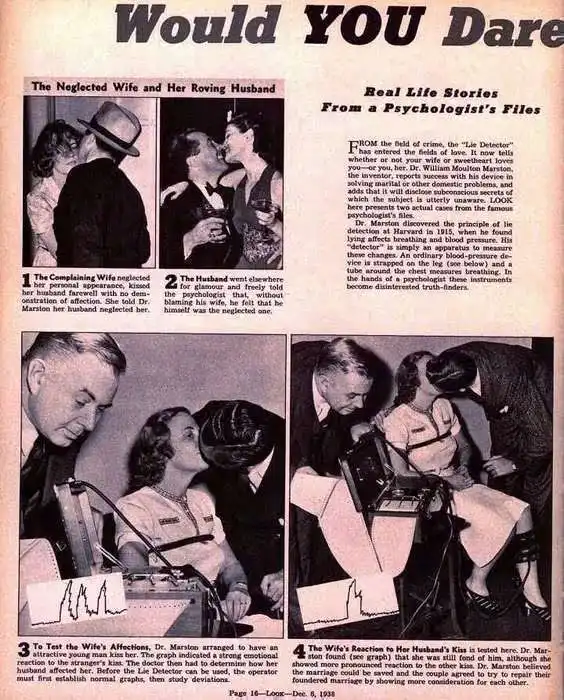
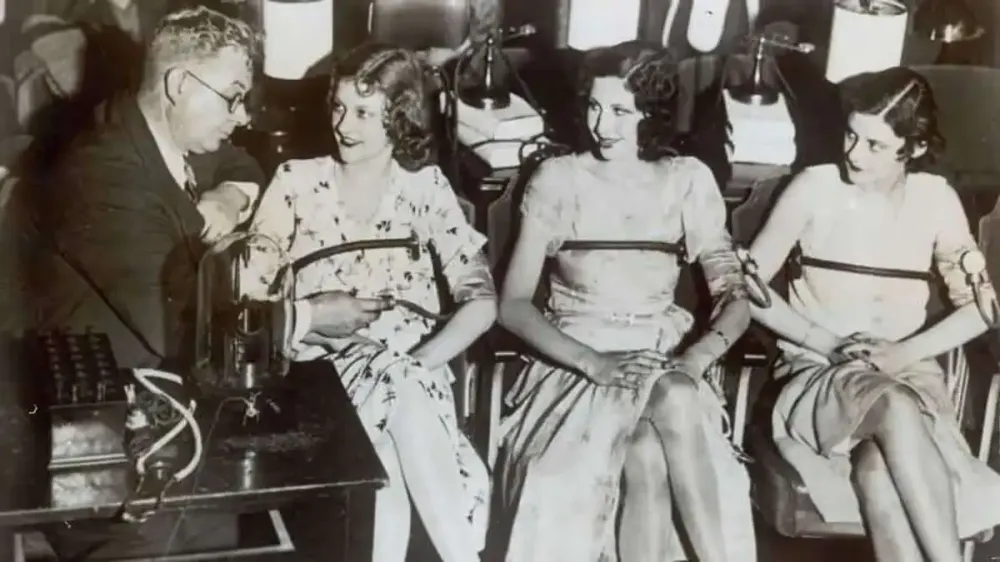
Marston took out a loan to fund laboratory experiments, and in 1923 he presented the first working lie detector — the one still in use today. Using cuffs and a stethoscope, the polygraph picked up the spikes in blood pressure during questioning, at the moments when the subject was lying. Since our blood pressure signals even what we are not aware of, Marston saw a future for the device in love as well. Two young people, for example, who were NOT engaged to anyone else, were found by the lie detector to be in love with each other, and as a result they were able to realise their feelings and marry.
How a physiognomist invented the DISC typology
Since most people cannot control the spikes in their blood pressure when they express emotion, Marston extended his research on lying to emotions. He soon noticed that people react to favourable and to stressful situations in typical, automatic ways and show similar emotions. That is how DISC was born — a system for classifying personalities by measuring their behaviour: dominance, inducement, submission and compliance. Marston set out the DISC theory in 1928 in his book Emotions of Normal People. But more on that later. For now — the juiciest part.
Marston was the first person to put a personality typology to practical use. Universal Studios was just then moving from silent film to sound, and over the course of a year, in 1929, Marston used the typology to help actors find more realistic gestures and facial expressions.
Marston derived the typology from three sets of empirical data:
- His work on the lie detector
- His observations of 250 children with behavioural problems
- A study of the personalities of inmates in a Texas prison
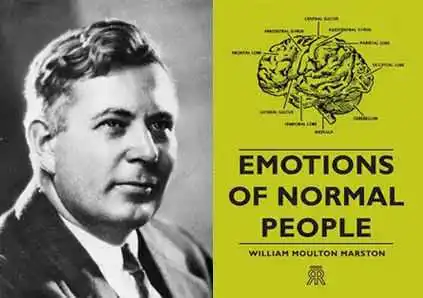
Marston first mentions his results in 1924, in the book Emotions of Ordinary People, and expands them into the DISC method in 1931 in Integrative Psychology. The test itself was developed by many of his followers, among them the American psychologist Professor John Geier and Walter Clarke
Walter Clarke and Activity Vector Analysis (AVA)
The story of the DISC test begins with Walter V. Clarke, 20 years after Marston published Emotions of Normal People.
Walter Clarke was an industrial psychologist. In 1956 he developed a test for personnel selection called Activity Vector Analysis (AVA). AVA was designed as a ‘brief measure of personality’ and used as a screening tool in hiring across a range of industries.
To build the assessment, Clarke drew up a list of 81 adjectives commonly used to describe a person. He then asked participants to tick the particular words (from his list of adjectives) that in their view described them best.
Having collected and analysed the data from this instrument, he found that it could be summed up in four factors:
- aggressive,
- sociable,
- stable, and
- avoidant
If you are thinking that this sounds very much like DISC — yes, it does. Clarke concluded that the data was best explained by Marston's model of human behaviour. Clarke's AVA, however, was not built entirely on Marston's DISC theory; he also drew on the work of Prescott Lecky to create his test.
The DISC methodology, along with the test, is described below. For now, let us go back to our racy author and his taste for spice.
How a feminist invented Wonder Woman
In the 1940s Marston became interested in comics and made a career in the entertainment industry. It all started with the 1940 article ‘Don't Laugh at the Comics’, in which Marston pointed to the high educational potential of comic books. And that, by the way, is quite true:
Having become an important part of US mass culture, comics were at the same time, right up until the arrival of television, a powerful instrument of ideology. You could say that the whole history of modern American ideology is inseparably interwoven with the history of comics... And comics achieved this extraordinarily effective ‘capture’ of a mass audience precisely by combining text with visual images.
Sergey Kara-Murza in the book Manipulation of Consciousness
Marston was noticed by Max Gaines, head of DC Comics — the very studio that competes with Marvel and has been making films about the superheroes of the DC universe since 2016: Suicide Squad, Wonder Woman, Justice League, Aquaman, Joker, Batman.
In the 1940s the comics industry was going through a rough patch. Male superheroes had grown boring, Max Gaines was looking for something new and asked Marston to throw in some fresh ideas. And so in 1941 Marston's new creation came into the world: the superhero Wonder Woman, Diana
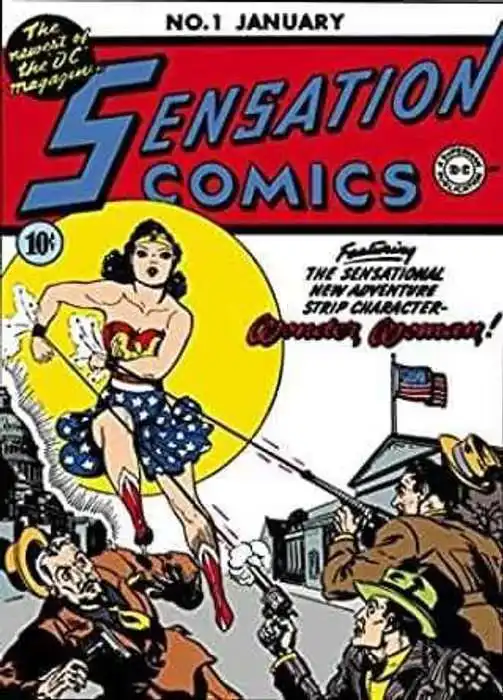
Marston was a supporter of feminism and had studied Greek literature in his youth. He took a classical plot to illustrate the idea of women's rights and created a female superhero as strong as her male colleagues, but with the mind, kindness and charm of a beautiful woman. By the way, did you happen to see the 2017 film Wonder Woman?

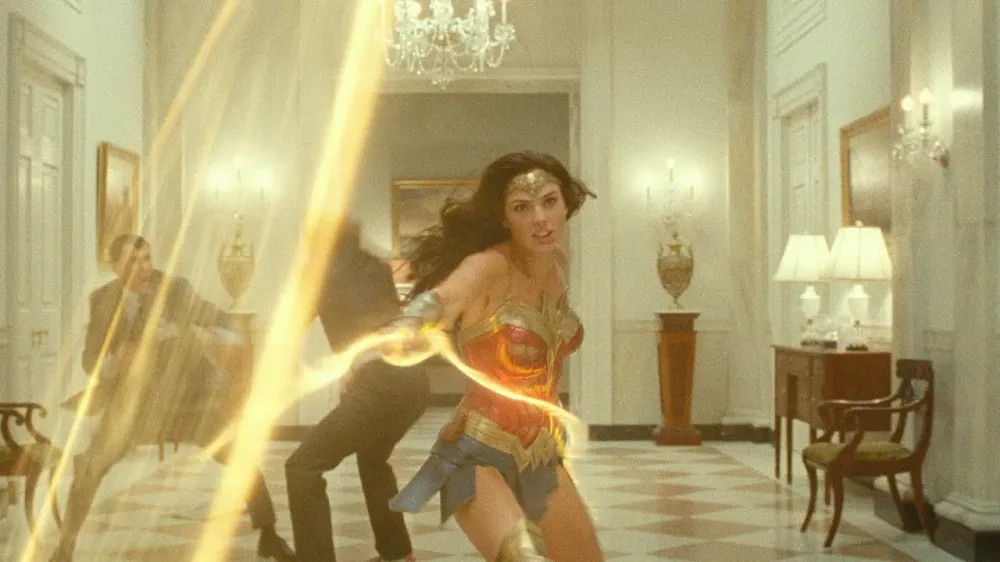
In the 1940s that was an act of courage. Little wonder Marston did not dare publish her under his own name and chose the pen name ‘Charles Moulton’. And, taking his cue from the polygraph, he gave her a lie detector of her own in the form of a magic ‘lasso of truth’, which forced anyone caught in it to tell the truth. In the film Wonder Woman 1984 the actress Gal Gadot wields that very lasso.
But Diana, the Wonder Woman, would never have appeared without Marston's women.
How a champion of women's rights polyamorously loved bondage
For a little spice and a fuller picture, let us touch briefly on Marston's private life. Marston's first wife was his fellow student Elizabeth; they married in 1915. She took part in her husband's research, earned a degree in psychology and worked as a teacher.
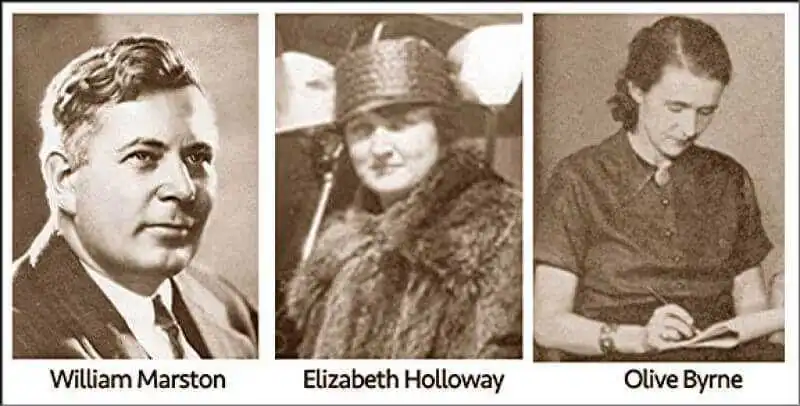
In the 1920s Marston, by then a lecturer in psychology, met a student named Olivia. Stories like this usually end in divorce — but not this one. Olivia, Elizabeth and William lived in a polyamorous family until their deaths. Remarkably, after Marston died in 1947 Elizabeth and Olivia lived together for almost another 40 years, and each of them had two children by Marston.
The story of Marston, of the creation of Wonder Woman and of how he met Elizabeth and Olivia is told, by the way, in the film Professor Marston and the Wonder Women

It was Elizabeth and Olivia who were the prototypes for Wonder Woman. And given that, it is very curious what kept happening to Wonder Woman in the comics: she and the other characters were constantly being captured, tied up, chained, thrown into prison and put in handcuffs.
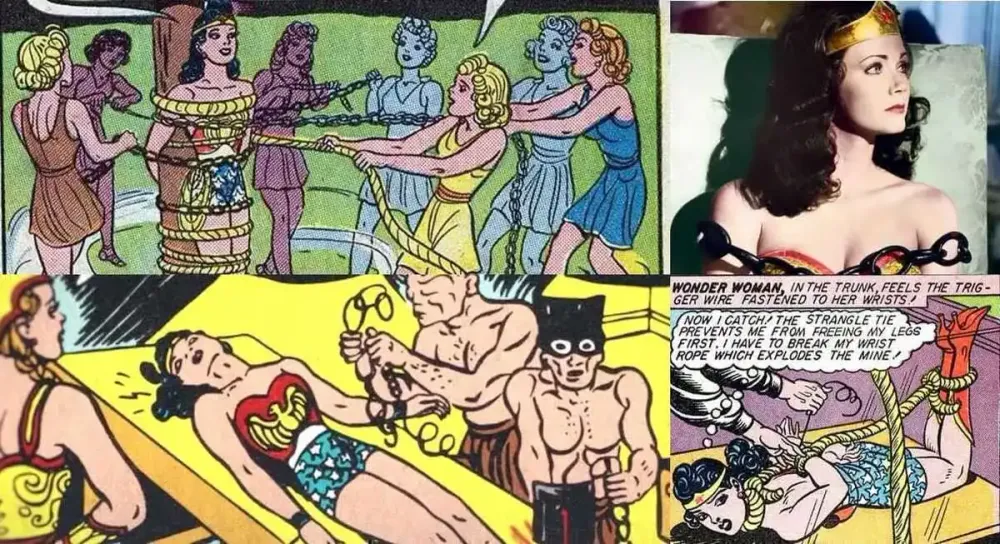
The parallel with BDSM practices in the comics became so obvious that even Max Gaines, the head of DC Comics, asked him to halve the number of bondage stories. Marston objected that readers liked it, and that women themselves like submission. This pointed to Marston's moral philosophy, according to which one has to submit to truth in order to find freedom.
How British scientists missed the point of DISC
Now we can come back from BDSM to the original acronym. DISC is an abbreviation made up of the names of four types of people:
- Dominance — the type of people particularly capable of taking charge, of leadership and of asserting themselves
- Inducement, Influence — people with well-developed communication skills, geared towards social connections
- Submission, Steadiness — this is about patience, care and constancy, and also about submissiveness
- Compliance — the type inclined towards orderliness and structure.
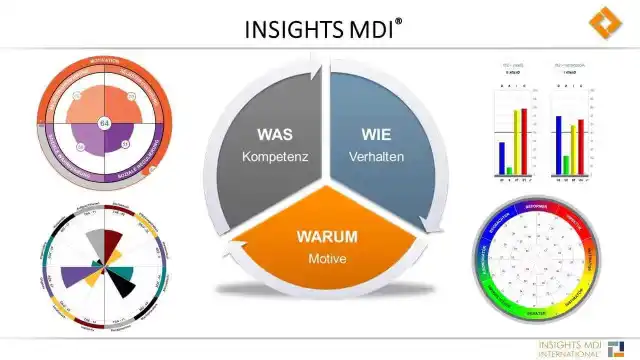
Today various versions of the test are marketed by various commercial companies, for example Scheelen AG (as Insights MDI) or Persolog GmbH (as the Persönlichkeitsmodel). The main licence belongs to John Wiley & Sons Inc. It is used mainly in recruitment, for assessing candidates and building teams.
As for scientific recognition, Wikipedia is unequivocal here (en.wikipedia.org/wiki/DISC_assessment, de.wikipedia.org/wiki/DISG):
- DISC has not been shown to have any scientific validity and is widely regarded as pseudoscience
- DISC assessments rarely, if ever, correlate with job performance and do not predict effectiveness at work
- As far back as 1936 the US National Research Council concluded that ‘the popularity of DISC in the absence of proven scientific value is a matter of concern’.
In Sweden in 2018, for instance, Thomas Erikson — the author of Surrounded by Idiots, a book describing the DISC model that has sold 2 million copies — was named ‘Charlatan of the Year’.
And that is a pity, because the very same scientific community notes the RELIABILITY and STABILITY of the test — that is, it acknowledges that a person will consistently get the same result over time.
- A Russian study of pilots found a coefficient of 0.89 for retesting after a week.
- A study by the Scandinavian psychological association also found a high level of internal consistency in the normative DISC assessment.
- A 2013 German study examined the validity and reliability of the Persolog DISC assessment to see whether it met the standards of the TBS-DTk test review system of the Diagnostics and Testing Board of the Federation of German Psychological Associations. The study showed that it ‘largely’ met the requirements in terms of reliability, but not in terms of validity.
In other words, the scientific community simply does not know what to do with this thing — while noting how reliable the typology is. Let us give those British scientists a hand!
So, what does DISC show?
I invite anyone who knows the modern S-Theory to look at how the four dimensions are laid out: D — Dominance, I — Influence, S — Steadiness, C — Compliance.
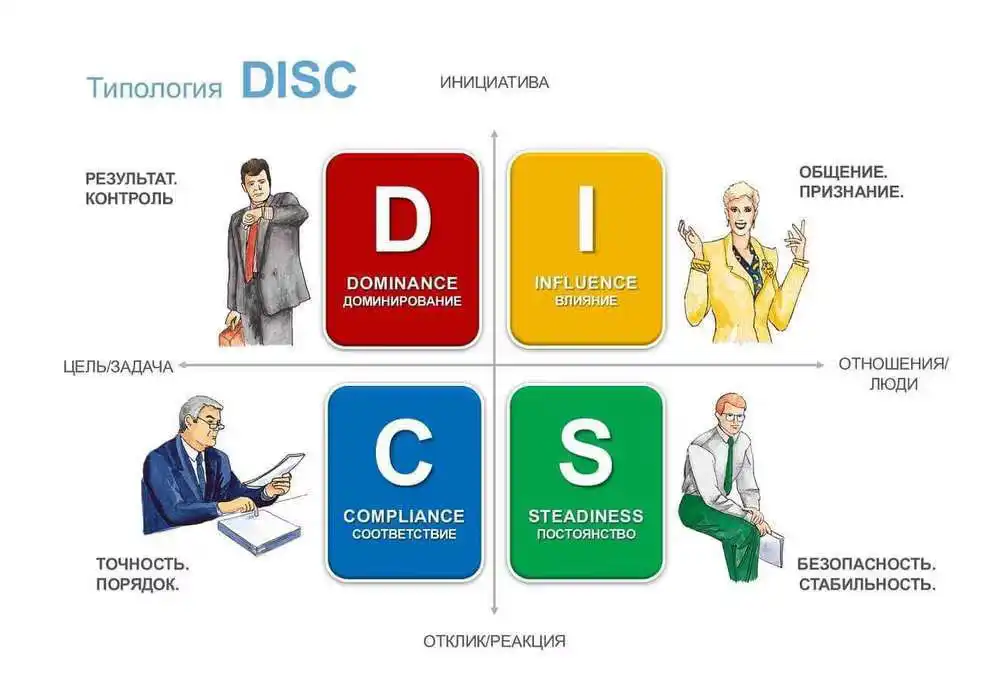
They are grouped into a matrix in which the vertical axis shows ‘Assertiveness’ (at the top) or ‘Passivity’ (at the bottom), while the horizontal axis represents the factors of ‘Openness’ (on the right) and ‘Caution’ (on the left).
- D — Dominance and I — Influence are at the top, C — Compliance and S — Steadiness at the bottom.
- D — Dominance and C — Compliance are in the left-hand column and represent a focus on the task, while I — Influence and S — Steadiness are in the right-hand column and represent the social side.
And this is nothing other than introversion on the left and extraversion on the right along the horizontal, and the active life position at the top and the passive life position at the bottom along the vertical. What we get are the good old temperaments, first derived by Hippocrates, extended by Jung and explained psychically and physiologically within the S-Theory.
For more on temperament as a combination of the attitude (introversion–extraversion) and the life position (active and passive), read here:
The features of temperament: what you need to know
What is very interesting is that Marston, independently of Jung and on the basis of entirely unrelated observations, arrived at the same typology, one that describes the innate and unchanging qualities of a person. That is exactly why DISC tests show reliability and stability.
So what do we end up with, seen from the standpoint of modern approaches?
D, Dominance — the active use of force to overcome resistance in the environment — is nothing other than the choleric, an introvert in the active life position. In the S-Theory cholerics are represented by three personality types:
- The psychopathic personality type (by Ego type geared towards action)
- The manic personality type (geared towards cognition and logic)
- The schizoid personality type (geared towards emotions)
I, Influence — using charm to overcome obstacles — is the sanguine, an extravert in the active life position, represented within the S-Theory by:
- The hysteroid personality type (emotional)
- The narcissistic type (geared towards action)
- The frustrating type (geared towards cognition)
S, Steadiness — the warm and willing acceptance of a request that has to be met — is the melancholic, an extravert in the passive life position, represented by:
- The epileptoid personality type (emotional)
- The depressive type (geared towards action)
- The frustration type (geared towards cognition)
C, Compliance — a fearful adaptation to a superior force — is the phlegmatic, an introvert in the passive life position, with the personality types:
- The autistic type (by Ego type geared towards action)
- The compulsive personality type (geared towards cognition and logic)
- The paranoid personality type (geared towards emotions)
Examples of celebrities in the DISC system
Perhaps the DISC system is easier to grasp through characters from films and TV series, or even from books? That makes sense: screenplays, too, are written with typologies in mind, with an understanding of psycho-types and with examples drawn from the lives of celebrities. Well-known people like Marston inspire directors — and that is a system as well. So which famous figures and celebrities can we take as examples of the DISC personality types?
D, Dominance — that is, the choleric, an introvert in the active life position:
- a striking president: Donald Trump
- a striking film character from the Marvel universe: Thanos
- a striking actor: Robert Downey Jr.

I, Influence — that is, the sanguine, an extravert in the active life position:
- a striking president: Bill Clinton
- a striking film character from the Marvel universe: Thor
- a striking actor: Tom Cruise

S, Steadiness — that is, the melancholic, an extravert in the passive life position:
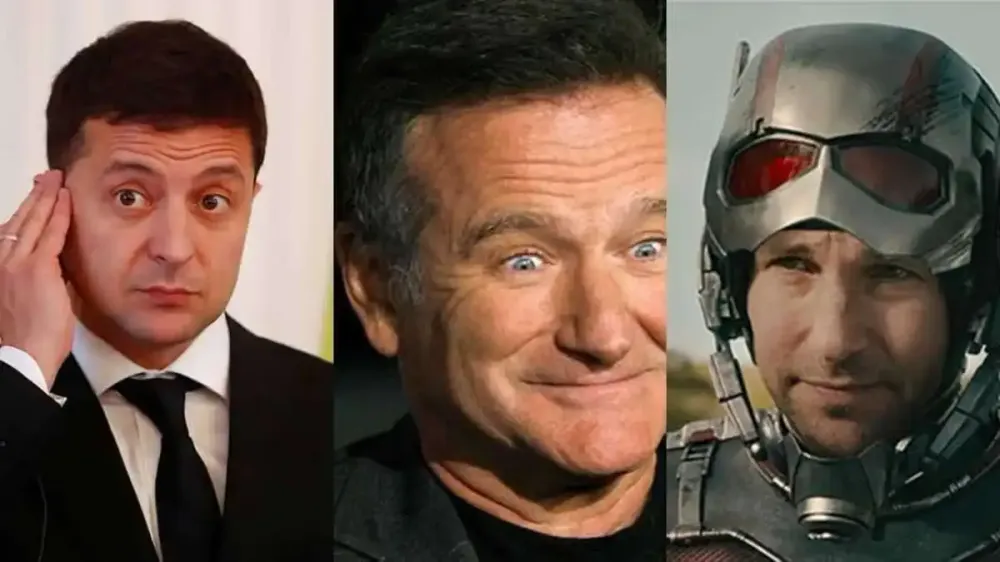
- a striking president: Volodymyr Zelensky
- a striking film character from the Marvel universe: Ant-Man
- a striking actor: Robin Williams
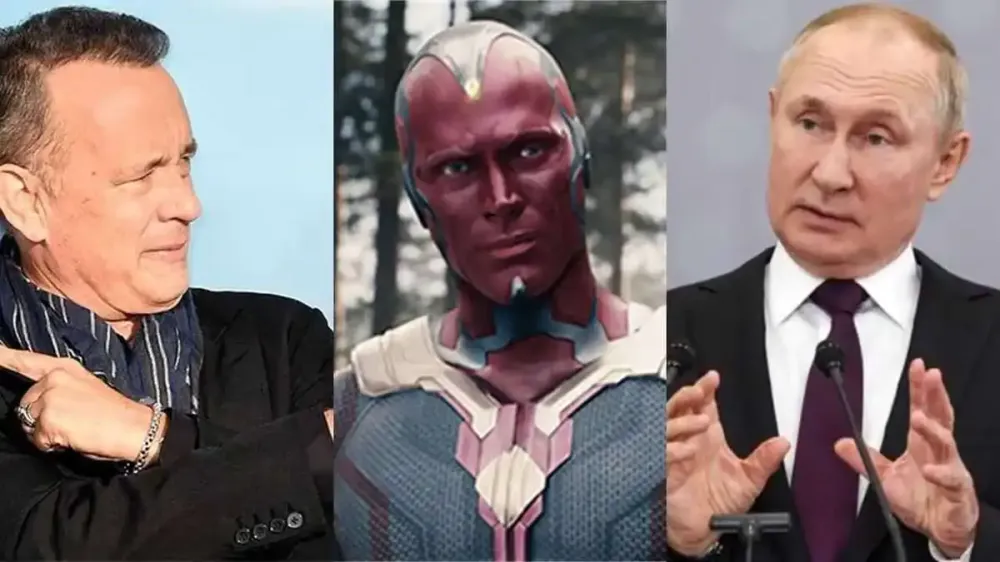
C, Compliance — that is, the phlegmatic, an introvert in the passive life position:
- a striking president: Vladimir Putin
- a striking film character from the Marvel universe: Vision
- a striking actor: Tom Hanks
Take the DISC test
Now I invite you to take one of the versions of the DISC test below for yourself. The main condition for a trustworthy result is that your answers be honest. Answer sincerely, not from the position of who you would like to be. Answer the way you usually act (if you have been in such a situation) or the way you genuinely feel like acting (if the situation is unfamiliar to you).