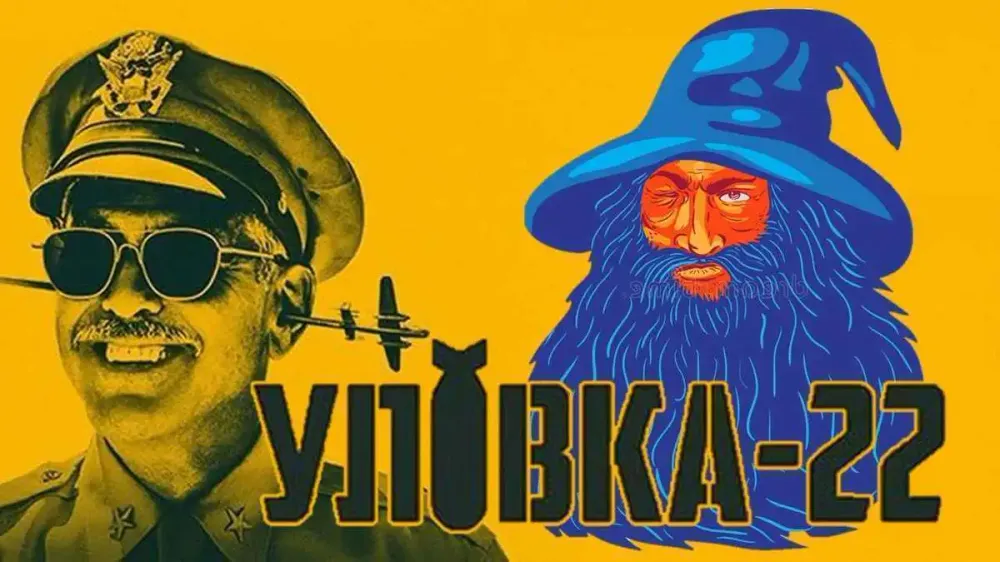
Catch-22 is what happens when you are hemmed in by mutually exclusive rules or conditions that work against you. Try to break one and you comply with the other. Break the other and you have complied with the first. Once such rules or conditions apply to you, you cannot control them, because trying to break the conditions means keeping them. How does Catch-22 show up in real life?
The term was coined by the American writer Joseph Heller in his novel "Catch-22". The book came out in 1961, and in 2019 it was turned into a TV series. The main character is a bomber pilot in the Italian campaign against the German and Italian forces in 1944. He has already flown his quota of missions and has the right to go home. What keeps him at the front is his superiors and their so-called "Catch-22", an absurd piece of bureaucratic red tape.
"Catch-22" says: anyone who tries to get out of combat duty isn’t really crazy. A concern for your own safety in the face of a danger that is real and immediate is the work of a rational mind. Say you are crazy, and you can be grounded. All you have to do is ask. But the moment you ask, you stop counting as crazy and you are sent back up on missions. You are crazy because you keep flying. You would be sane if you wanted to stop flying; but if you are sane, you have to fly. If you fly, you are crazy and therefore must not fly; but if you don’t want to fly, you are sane and are obliged to.
From the novel "Catch-22"
The game "Now I’ve Got You"
All of us know Catch-22 from another game as well: "Now I’ve Got You". You know the sort of people who use psychological tricks to provoke a reaction, so that afterwards they can say: The point of the game is that it makes no difference how the victim defends herself: whatever you do or say will be used against you.
See, I knew it. I was right about you — you’re the bad one!
the author
The game is best known from the tale of Bluebeard.
A certain gentleman whose wives kept dying married again and soon went away. In his splendid house he forbade his wife to enter one small closet — if she did, she would die. Forbid something, and that is exactly what a person will want to do. The woman was curious, she opened the closet — and there were the dead wives!
The tale of Bluebeard
The game "Now I’ve Got You" is played very, very often, and you may well recognise yourself in the leading role right now. Bluebeard uses psychological tricks to provoke an uncertain reaction, so that afterwards he can say: "see, I knew it. I was right about you — you’re the bad one!" The point of the game is that it makes no difference how the victim defends herself: whatever you do or say will be used against you. This kind of vampirism is a favourite of:
- managers who have reached their level of incompetence and start fighting for quality instead of results.
- subordinates who invoke morals or rules and demand they be followed, paralysing whole departments.
- men or women in a relationship, in the service of some inner goal (finding a pretext, confirming their negative view of the partner, a power struggle)
How do you get around Catch-22?
In real life, when it comes to laws, it is probably hard. The hero of the book never did outwit his commanders. So how do you deal with Bluebeard in real life?
Here is the tactic:
- Stay in the adult position, at the level of facts. That is, take the manipulation at face value. For example: "look how unprofessionally you’ve written this!" — "It says ’abc’ here. What should it say?"
- Agree with what Bluebeard says. For example: "It should be ’cba’!" — "Got it!"
- EXAGGERATE THE CONSEQUENCES TO THE POINT OF ABSURDITY, make them inconvenient for Bluebeard — while backing his position: "Fine, I’ll rewrite the entire letter right now!"