It has been building up, aching, asking to be written, itching and nagging — in short, it is high time this article was written. Whom we choose as a partner, and how. There are plenty of theories describing compatibility. Some go by the stars, some by coffee grounds, some by the I Ching; the Kama Sutra goes by the size of the genitals, and one man I know seriously believes that compatibility should be matched by absolute body weight in kilograms. In short, there are many theories, but we work with one — coherent and very logical.
The S-Theory is a highly original psychological framework that has absorbed the work of leading psychologists around the world. Among other things, it describes personality types and the relationships between them. Knowing the personality types of two people, you can describe in considerable detail how exactly their relationship will develop, what they can give each other and what conflicts are possible. And on top of that, you can ‘rank’ their compatibility.
And what is a ‘relationship’?
To begin with, what is a relationship? It is the interaction of two people aimed at achieving a shared goal. Relationships can be family, working, romantic, business, partnership and so on. As one very clever specialist once put it, friendship is the kind of relationship that does not fall into any of the categories listed above. So what is a relationship within the S-Theory? I cannot recall an official definition, but going by everything I have studied so far, I would put it like this:
Without development, without mutual comfort and without shared goals there will be no relationship. Or there will be — a friendly one. That is the sort where everything is complicated, where nobody is sure of anything and nobody knows where it is all heading. Incidentally, we are all modern people and we remember that these days no friendship rules out privileges.
The first ‘sacred commandment’
I have written more than once about the first ‘sacred commandment’ of a successful relationship: an extravert needs an introvert, and an introvert needs an extravert. They will both complement and balance each other. The extravert gives the introvert ways out into the world, a new understanding of their surroundings and a new way of seeing. The introvert gives the extravert a new understanding of themselves and that very footing which, deep down, the extravert needs. And that is far from all.
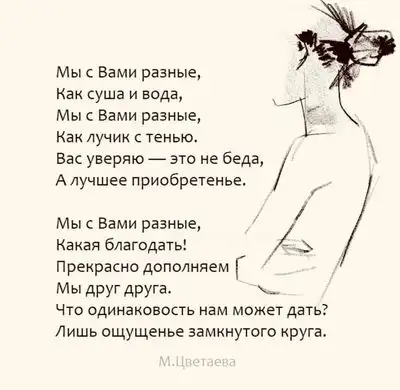
What can two introverts give each other? Mutual understanding, the feeling that ‘I am not the only one like this’, the sense that there is someone to stand back to back with against an aggressively extraverted world. But development they will not give. What can two extraverts give each other? Brightness, new acquaintances, long conversations (recently two extraverts I know spent 4 hours on the phone with each other and then complained that they had forgotten to say the most important thing, the very thing they had rung about).
But an answer about who they are, a footing and an understanding of themselves — that they are unlikely to give, which again means no development. And so it turns out that in these cases the desire is there, the friendship is there, but from then on it gets harder and harder. I have written about this in more detail in the article ‘An extravert needs an introvert’
The second ‘sacred commandment’
The second ‘sacred commandment’ is simpler still. Active characters find it easier to come to terms with passive ones. The active ones are those for whom it matters to prove themselves, to move up the career ladder, to strive, to take risks and to reach the heights. For passive ones, friendship, harmony and the absence of risk and aggression matter more.
This by no means implies that an active person and another active person, or a passive person and another passive person, cannot come to terms. They can, but for that they will have to reach agreement consciously. I will describe below what that looks like.
The third ‘sacred commandment’
The third ‘sacred commandment’ is finer and more delicate. It says that it is easier to get on with those whose attitude to society and to the system is the same as yours. And here there are three types and three approaches. The first, the so-called ‘antisocial’ ones, are the sweetest and most sociable people who, for all their loveliness, will always keep themselves and their own interests in mind. The second, no less sweet and lovely, are the ‘social’ ones. With them the sense that one's own advantage comes first recedes into the background at a subconscious level, while relationships in society and their own usefulness and being needed matter to them very much. The third sweet and lovely group are the ‘extra-social’ ones. For them advantage and being needed matter less than ideas, theories and similar above-the-system whimsy. Clearly, people with the same approach to society can understand each other more easily.
Incidentally, if you are already trying this on for size, let me say that I have galloped through the theory very briefly. To understand what comes next you need exactly the theory I have set out above. And if you want to know where precisely you fit, we will happily profile you, since we look at a number of further indicators as well.
So, on the basis of intro/extraversion, activity and social orientation, the 12 existing personality types can be grouped by types of relationship.
12 ‘perfect’ unions
These are the unions where an introvert is with an extravert, an active person with a passive one, and the social orientation is the same as well. It is a kind of jackpot, because the partners in such a union give each other support, development and understanding. Such unions may be patriarchal or matriarchal; as a rule they have a clear hierarchy, everyone knows their duties by default and — no small thing — gets a kick out of them. The main thing is not to confuse the word ‘perfect’ with ‘love until death’ — that is beyond any science. Nor does it mean that the partners will never irritate each other or never quarrel — of course they will, we are all human. It is simply that in this situation making up is easier for them too.
12 ‘second-best’ unions
Among ourselves we also call this ‘number two’. Second-best means that this is the second most harmonious kind of union. Here too there is an introvert and an extravert, and here too one is active and the other passive. But their social orientation differs. For example, one is focused on their own advantage and the other on being needed — clearly the relationship risks flowing in one direction only. Or one is focused on being needed and on society while the other is focused on ideas and could not care less about society — here there is a risk of misunderstandings and arguments. And so on. These relationships can also be very harmonious and pleasant, but here a need arises for a set of ground rules of sorts. And the rules still have to be worked out, which costs time and effort. That is why the union is called the ‘second best’
18 ‘equal’ unions
These are what we call partnership marriages. Here there is no permanent leader or follower, no one in charge and no one doing as they are told. Here either both are active or both are passive.
Where both are active, someone will regularly have to give way or compromise. With two balanced and well-worked-through partners these compromises may not even be noticeable, but they will certainly be there. Life here can be made simpler by a straightforward rule — for instance, that both spouses contribute equally to the family budget.
Where both characters are passive, the situation is different. People can live in perfect harmony for a long time and need no one but each other, but... The big ‘but’ arises at the beginning of the relationship, because somebody will have to take the initiative, and passive people usually prefer to leave that honour to the other one — not because of social norms, but simply because that is their character.
Here, by the way, there is little point in comparing the partners' social orientation separately. The ability of two equals to reach agreement outweighs everything else so heavily that they will settle this too, more or less along the way.
6 ‘utopian’ unions
These are unions of two passive characters in a particular combination. Such unions really can be strong and dependable. They are called utopian because it is very hard for both partners to start a relationship at all. Either they wait, or they cannot bring themselves to, or something else. So in practice they are met incredibly rarely. It is even surprising that I know as many as two such couples.
Which of these groups is met most often? No such research has been done so far. Even if perfect unions are the most harmonious, that does not yet mean that they will suit us in particular. People's reaction to a description of the perfect partner is often ‘yes, we know people like that, we get on well with them, but a relationship — never!’ An excess of stereotypes about relationships leads us to choose something other than what would be comfortable. And that something else usually matches our ideals and preferences, so perhaps we should forget about the perfect option? In the end it means harmony in communication, complementing each other and development — but it in no way obliges us to fall in love only with that.
‘Friendly relationships’
The 12 personality types give far more than the 48 combinations of possible relationships described in the ‘Love Stories’ project. Naturally, we understand best those types who are compatible with us, and that is what makes up those very 48. Knowing our own personality type and who exactly suits us, we can always weed out unsuitable people in advance. Simply not start a relationship with them. But now and then you come across situations where a relationship is built by people who are not compatible with each other. That happens when people get stuck in a neurosis or a psychosis, or when they choose a partner on the basis of similarity to themselves. And sometimes they even manage it. Only the effort and the nerves it costs are beyond belief.
And then the question inevitably arises: does it really all have to be broken off? It is a difficult and unpleasant question, especially when it is asked right after a profiling session. It is far easier, on the basis of any theory, to explain why a conflict already exists than why one is most likely to arise. And it is harder still when people already have expectations and ideas of how everything will be, and here comes a dry, unemotional theory telling them that it cannot be.
We are all the sole masters of our own decisions and the only ones responsible for our own fate. And if the theory says ‘no’, that does not mean — it absolutely does not mean — that you have to drop everything, cut off contact and burn all your bridges. The S-Theory is first and foremost a fine instrument for understanding yourself, your strengths and your weaknesses, as well as for understanding the workings of group interaction. But it is nothing more than an instrument. A gun can take a life or save one. A knife can be used to do harm or to cook a delicious dinner. Knowing about your compatibility or incompatibility can likewise help you keep a relationship at least positive and free of false expectations. I, at any rate, would find it more pleasant to go on getting on well with someone incompatible with me than to fall out with them for ever after a certain, possibly wonderful period of time.