To make sense of personality types, you first have to make sense of Ego types. The Ego is easy to explain through vivid examples and hard to explain in scientific terms. There is a reason for that: the Ego is the individual's awareness of themselves as a separate “I”, the centre of self-awareness formed in the course of a person's development.
Becoming aware of yourself is no easy matter, so this article will be full of vivid attempts to grasp the Ego. We shall make three of them:
- The Ego in philosophy and religion — as a worldview, as the way we perceive the world around us
- The Ego in the physiology of the body — as a feature of how the brain works, or what a person's internal systems (the endocrine, nervous and neural ones) are “wired” for
- The Ego in psychology — as part of the structure of the human psyche (the Id, the Ego, the Superego, or their many synonyms)
The Ego in philosophy and religion
There is the world around us, there is our perception of that world, and there is our attitude toward it at this particular moment. It is no secret that the world around us does not care what we think of it: the river flows, the stone lies in the path, and the rain falls whether or not we have an umbrella. Whether the rain puts us in a good mood or a bad one is our image of the world, our current attitude toward it.The image of the world is a moving thing, and it is close to personality types. So what decides whether we like the rain or not? The answer is the Ego, or our worldview.
A worldview takes in more than that: the image of the world, the way I see myself and other people in that world, the way I explain to myself how the world is put together. Any worldview answers the basic questions that any philosophy or religion answers:
- “how is the world put together?”,
- “how is the human being put together?”,
- “where do problems come from?”,
- “how are these problems to be solved?”.
These questions have always occupied people, and philosophy and religion have striven to answer them. In other words, the answers to the basic questions are exactly what forms a worldview.
For how philosophical currents and religions reflect the personality types of their authors and of the people around them, read here:
? Is it all individual? Religions and theories of personality
A worldview is long in the making, it takes knowledge and experience, and it is settled on by the conscious years of adolescence. The foundation of a worldview is the Ego. It is a rigid structure, added to throughout life within the bounds of the self-image.
Any changes that may occur in the Ego are directly linked to a transformation of the worldview. A worldview changes only with difficulty. Everything that does not match it is automatically declared false and provokes argument and resistance. Only when our own experience has refuted our current worldview several times over do we agree that such a reality is possible too. The aim of any spiritual practice is a transformation of the worldview.
The Ego in human physiology
There are three Ego types, wired for reality, emotions and cognition (more on that later). This threefold nature becomes vivid through the concept of the triune brain formulated by Paul MacLean in the 1970s.
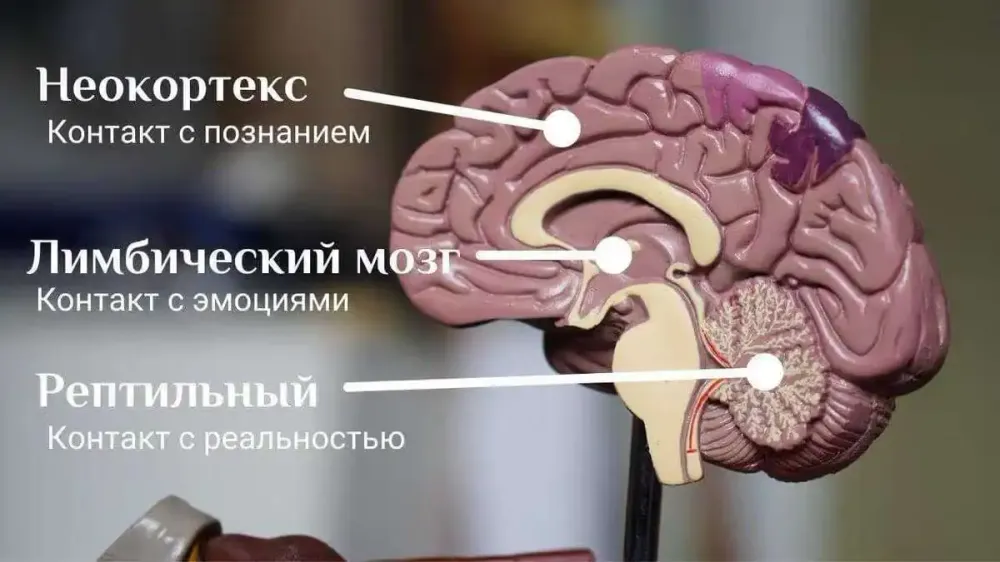
MacLean divided the brain into three functions matching its physiological structure:
- The reptilian brain, also known as the brain stem and the cerebellum. Supposedly the most ancient part of the brain, developed as far back as the dinosaurs and reptiles, responsible for the basic functions of survival: eat, mate, defend yourself. Its main reactions: “freeze — flee — turn aggressive”. And there are people “wired” for exactly these functions: first we act, then we make sense of it or feel about it.
- The limbic system, or the middle, “emotional” brain. Supposedly developed in mammals, responsible for emotions in all their forms, plus for socialisation. We all know emotional people for whom feelings come before everything else, don't we?
- The neocortex, or the cognitive brain, the cerebral cortex — the youngest part, responsible for thinking, reasoning and decision-making. Very much like people “wired” for logic, rational and forever calculating the consequences.
MacLean's concept is wonderful for how vivid it is, and it is not accepted by the medical profession at all. The brain works in a far more intricate way, that is true.
The Ego in psychology
One hundred and fifty years ago Freud brought into circulation the very first structure of the psyche, made up of three parts.
- The Id: the animal beginning, basic instincts, urges we are not aware of, desires, irresponsible behaviour, the “wild streak under the robe” — that is, everything dark, suppressed, repressed, uncivilised, so to speak.
- The Superego: the notion of oneself as the finest of people, and everything bound up with civilisation, culture, rules, society, ideals, cultural ones included.
- The Ego: the centre of awareness and of self-awareness, the “I”, the very notion of oneself, the sense of oneself, the centre of knowing oneself, my soul.
After that every self-respecting psychoanalyst set about arguing with Freud, but the substance of the argument was always one and the same:
The unconscious consists not of three parts, but of three parts
how the psychoanalysts argued with Freud
Each of them proposed different names for these parts, shifting the emphasis onto particular areas of what goes on in the SE (superego), E (ego), id. There were attempts to subdivide, attempts to work it out and take it apart. Assagioli came up with nine levels of the unconscious, Grof with four.
An analysis of Freud's paper “The Unconscious”, written in 1915, can be found here:
? The Unconscious according to Freud
The first to disagree outright was the crown prince of psychoanalysis, Carl Gustav Jung, who was thrown out of the psychoanalysts and, as a result, created his own analytical psychology, an entirely separate school. Jung said that the unconscious consists not of three parts but of three parts: the psychoid, the individual and the collective. And in the conceptions of Freud and Jung the only thing that differed was the attitude toward the unconscious.
But out of the whole chain of researchers, among whom there are a great many well-known names, it is worth pausing on Eric Berne. First, he too was not accepted by the psychoanalysts, and second, he created his own magnificent new school of psychology — transactional analysis. Berne agrees with Freud, he does not argue with him; what is more, he likes psychoanalysis, and he was kept out of the psychoanalytic association for having revolutionary thinking.
As far as the structure of the unconscious goes, Berne did something quite brilliant: he said that the Ego shows itself in life at the level of a person's behaviour and emotional reactions, in the way they speak. And he pointed to three features of behaviour:
- “The Child”, as the representative of Freud's Id,
- “The Parent”, as the representative of the Superego, and
- “The Adult”, as the figure of the Ego.
The Adult is the part that is aware, that acts as the centre, that assesses, weighs things up and lends its strength either to one part or to the other — that is, it stands between the Parent and the Child. The difference is that in Freud the Ego is under pressure and withstands it, whereas in Berne the Adult balances two forces. The charm of Berne's conception lies, among other things, in the simple names, which turned out to be obvious and clear to anyone, even to someone far removed from psychology.
What is my Ego type?
So, good things come in threes. Within the modern framework of the S-Theory there are three Ego types. But that is a more detailed conversation, and it is unfolded in other articles
You can learn more about the three Ego types in these articles:
? The Ego Type “Contact with Reality”. Excitation and Inhibition
? The Ego Type “Contact with Emotions”. Attraction and Aversion
? The Ego Type “Contact with Cognition”. Logic and Experiment