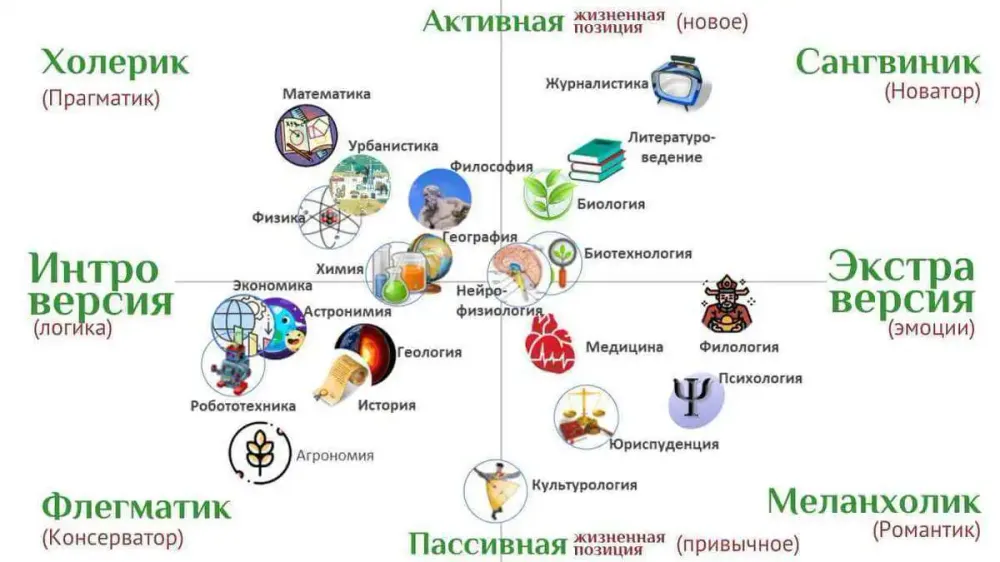
Psychology for the melancholic, journalism for the sanguine, mathematics for the choleric, history for the phlegmatic: does an interest in a particular science — and, consequently, the choice of career — depend on temperament? It does, of course, and there is statistical evidence for it from… commerce.
What follows is an editorial repost of material by the company DataFuel, published at vk.com/wall-68884413_1830. Unfortunately the company does not publish its material in open sources, while its findings are of scientific value. We had to put that right in a separate publication, recasting the material in scientific terms
A long preamble about being scientific
A great deal has been written about the temperaments in cheap pop-psychology literature, starting with the fact that there is no single agreed definition even of the temperaments themselves
- Sanguine
- Choleric
- Phlegmatic
- Melancholic
There is not even a shared understanding of what introversion and extraversion are (Jung's “attitudes”) and how they differ from life “positions”. Because of that, any question about statistical evidence runs into a void, which fairly turns the whole field of personality typologies into “pseudoscience”.
But things are not entirely hopeless. Many authors and communities have arrived independently at very similar ideas about the temperaments, only under different names. In academic psychology these are DISC, the MMPI with its scales for gender and introversion, the CNMI-46 masculinity index and the S-Theory. In commerce it is the Russian company DataFuel, which turned these theories into a commercial product. Working from data in the vKontakte social network, DataFuel identifies the very same temperaments, only under its own names, within the Spectrum psycho-types:
- Sanguine, an Extravert in the Active life position = the Innovator
- Melancholic, an Extravert in the Passive life position = the Romantic
- Phlegmatic, an Introvert in the Passive life position = the Conservative
- Choleric, an Introvert in the Active life position = the Pragmatist
You can learn more about the temperaments and how they are combined from the Attitude (introversion and extraversion) plus the life Position in the article
? The features of temperament: what you need to know
Unlike researchers in psychology, DataFuel puts its ideas to work in real projects, gathering a mass of analytical data for every commission, and proves the effectiveness of the typology through higher conversion rates from adaptive advertising. And in the absence of scientific statistical knowledge we have to make do with DataFuel's practical experience.
And here we come to the main subject of the article — how temperament influences the choice of career. DataFuel analysed how the temperaments take an interest in various sciences. And since an interest in different fields of human knowledge shows up one way or another in the choice of career, DataFuel also answered the question of which careers sanguines, melancholics, phlegmatics and cholerics choose.
Since DataFuel published the material only in a social network closed to search, never bringing this valuable experience to the wider public of the WWW, I have taken the liberty of “translating” their commercial experience into the manner of the S-Theory, which is closer to the ground of science. Here is what came out:.
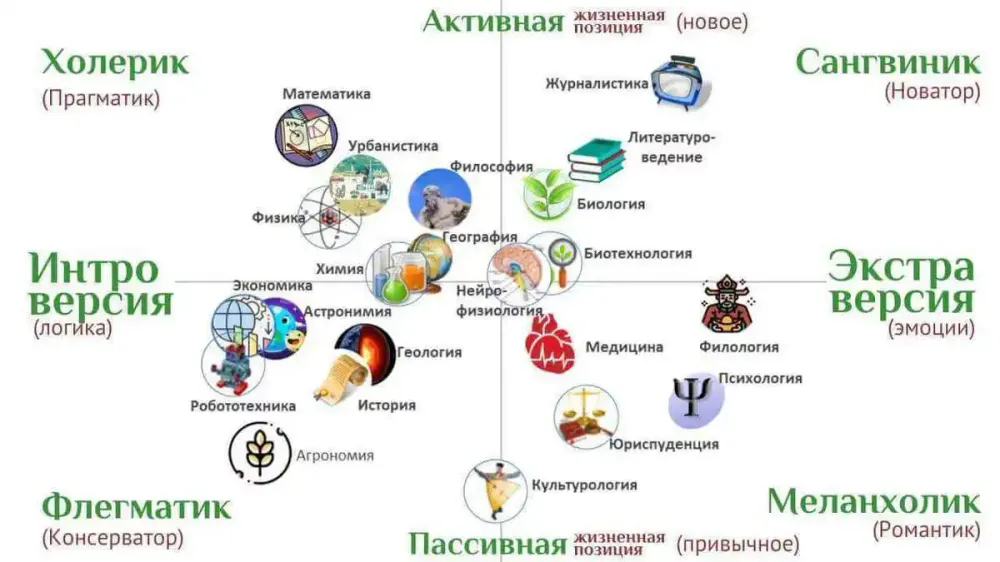
Along with a good deal of other market research on the preferences of the temperaments (a dozen studies have piled up by now — on presents, on cars, on preferred words, on careers, and so on and so forth) we have collected it all in a mini-application. Choose the subject of the study at the top, switch between temperaments at the bottom and see what they like, look for and adore.
So, over to the company DataFuel, with a psychological translation into the language of the S-Theory
How was the data analysed?
The groups for each science were assembled on the principle that the community had to be focused on the subject in question; wherever possible we tried to avoid the communities of educational institutions, but we did not go to the other extreme of looking at overly popular takes on a given science either (we excluded excessively simplified views of psychology, for instance).
In the course of the analysis, temperaments (Spectrum psycho-types) were assigned to more than 4.4 million subscriptions, which told us about the interests of an audience considerably larger than that figure.
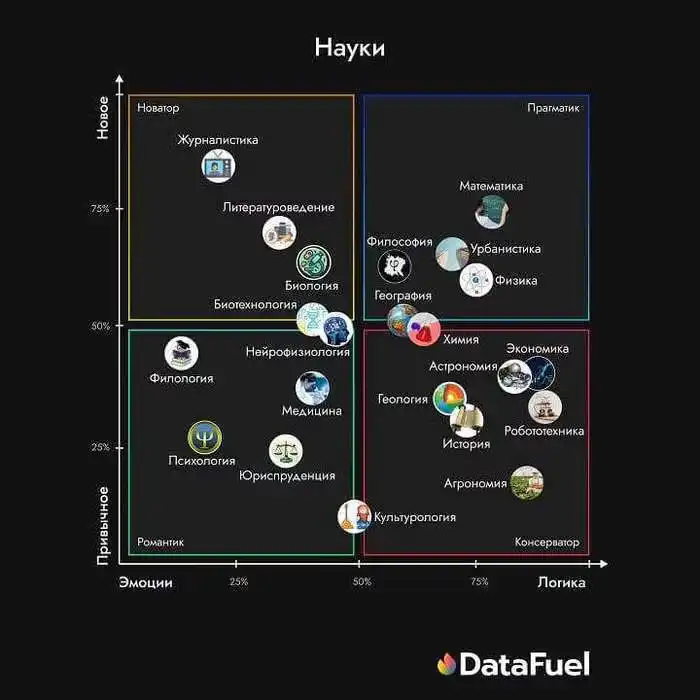
DataFuel analyses openly available information about the followers of social network pages. The average temperament (psycho-type) of each community is determined with the SPECTRUM technology (to find out more about it, download the personalisation guide: write ГАЙД or НАЧАТЬ in the group chat — vk.me/datafuel). The resulting data is plotted on a map of values, along ranges running from the Active life position (the New) to the Passive one (the Familiar), and from Extraversion (Emotion) to Introversion (Logic). The centre of the axes is normalised against the average figure for all audiences in the field being studied.
The demographics of the study
First, a word about the social and demographic picture. By age, the core of the audiences studied was the 22-27 segment, but in most clusters interest stays high up to the age of 45. An interesting finding came up at this stage already. In Extraversion (the left-hand side of the map, where the decision-making function is feeling) there was not a single cluster with a male majority. In Introversion (the right-hand side of the map, where the decision-making function is logic) men are in the majority (exceptions: philosophy and chemistry).
Men dominate among the introverts, women among the extraverts
By average Temperament (Spectrum psycho-type), all the sciences in today's analysis can be roughly divided into those that clearly belong to a particular quadrant and those that occupy an intermediate position. The latter include
- biotechnology,
- neurophysiology,
- geography,
- chemistry and
- cultural studies.
Among the clusters whose quadrant was in no doubt, some sciences turned up in psycho-types we had not expected.
Careers for the sanguine
… or which sciences interest the "Innovator", in DataFuel's terms?
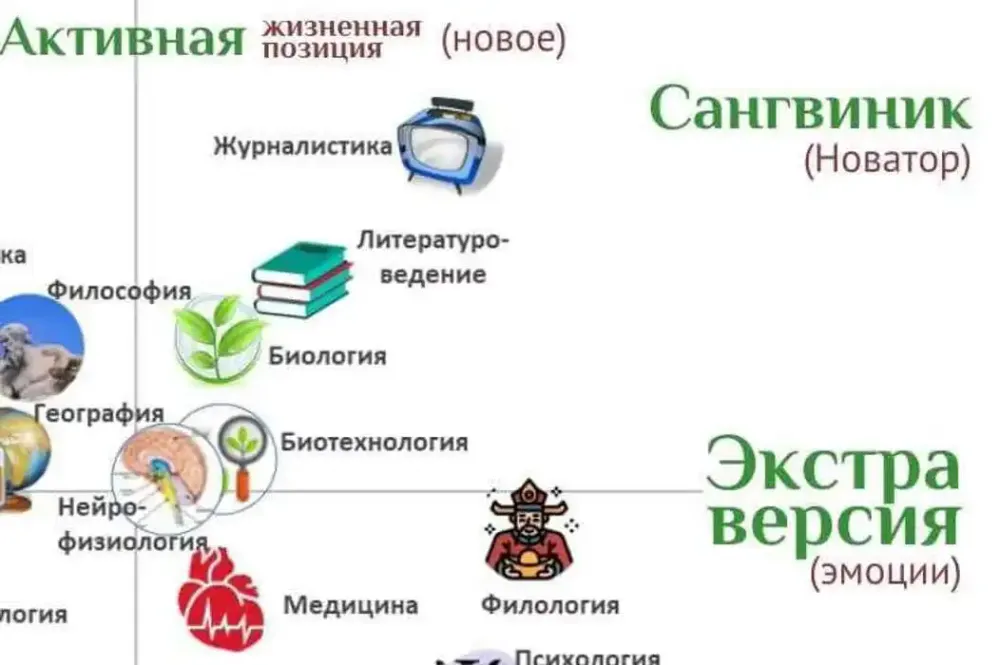
Of the audiences gathered, the sharpest interest among Sanguines (Innovators) goes to journalism. The majority in this cluster are girls and women aged 22-35.
- DataFuel's view: Journalism offers interesting opportunities to gain experience, sharpen your communication skills, explore new aspects of the world, and create and publish your own material, projects and research, which brings recognition and public attention. Journalism also offers the chance to take an active part in social movements and to draw attention to issues that matter both to journalists themselves and to a great many other people.
- The counsellor's verdict: journalism really is, above all, contact with people, active engagement with them and… pushiness. And sanguines are pushy indeed!
You can read about sanguines here:
Literary studies (F 73%, 22-30) give you the tools to understand and analyse various works of literature, the chance to learn about writers' lives and work, to develop literary skills and to improve your own writing.
- DataFuel: The discipline offers plenty of scope for creativity and analysis, studies many aspects of history and culture and helps you develop subtle interpretations. Beyond that, literary studies can give access to a deeper understanding of social and ethical problems and to the ability to develop ideas of your own.
- The S-Theory: art criticism is usually the passion of Extraverts, but in the Passive life position. That is, we would expect to see Melancholics predominate here.
Biology (F 67%, 18-27) studies living organisms and reveals the variety and the regularities of nature. This field is bound up with human life and death, with the study of various diseases, the search for ways to prevent them and the development of medicines.
What do journalism and literary studies have in common?
Both disciplines examine and analyse various texts and ways of thinking. Journalism, however, is more taken up with current events, while literary studies concentrate more on historical texts and on the study of fiction. Both subjects use literary analysis of texts to find effective ways of setting out ideas, as well as thematic and historical analysis to bring out meaning and context.
Careers for the choleric
That is, for the "Pragmatist" in DataFuel's terms
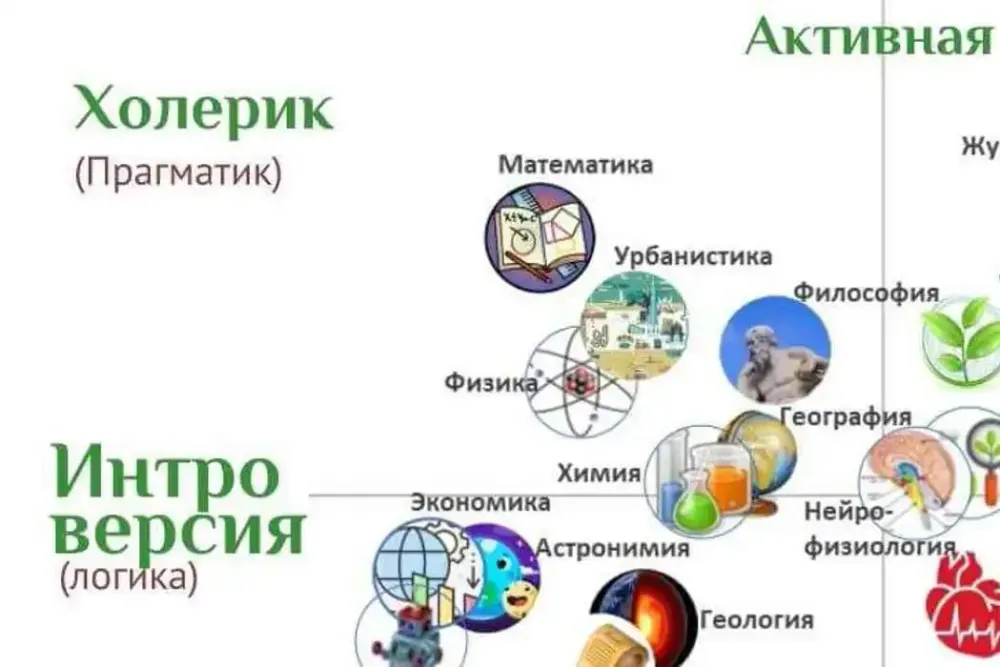
Mathematics (M 53%, 18-27) is a flexible instrument that can be used to design all kinds of systems and processes and to study abstract concepts. Expressing and analysing ideas and processes through mathematical formulae and laws helps you understand and picture the world better. Mathematics also answers difficult questions to do with data analysis, forecasting and decision-making.
The choleric is an Introvert in the Active life position. The details are in the article:
Urban studies (M 59%, 22-45) let you understand better the changes taking place in our cities, how urban environments are changing and how they affect the lives of residents. How different cities affect the national and the world economy. Studying urban planning, you can get a deeper grasp of the logic behind developing and improving city districts, see how its principles can be used to build a sustainable future, and examine how cultural, political and social factors all shape a city's development. Using the principles of urban studies, you can set out to take part in projects that improve life and develop urban spaces.
Physics (M 57%, 18-30) is one of the oldest sciences of natural phenomena. It means grasping the regularities of the world and looking for cause-and-effect links between events. It makes the hidden mechanisms of nature plain, while giving us the tools to apply theoretical knowledge and create practical solutions, so that we can understand material processes and phenomena and model life and the world around us.
The counsellor's verdict: definitely yes! Reason, a formula for the universe, the search for regularities — that is the lot of Introverts.
Philosophy (F 56%, 22-30) may appeal to those who like pondering difficult questions and trying to get to the bottom of serious problems. Philosophy can also be useful for a deeper understanding of yourself and of others. It can be applied to the problems of life, including purely practical matters.
- DataFuel's view: Studying philosophy gives you the ability to picture the world as more alive and whole, more vivid, and helps you reach deeper levels of understanding of civilisation.
- The S-Theory view: yes, a predictably introverted field, though the slight female majority is surprising
Careers that suit the Phlegmatic
That is, the "Conservative". Most of the core audiences are aged 22-45.
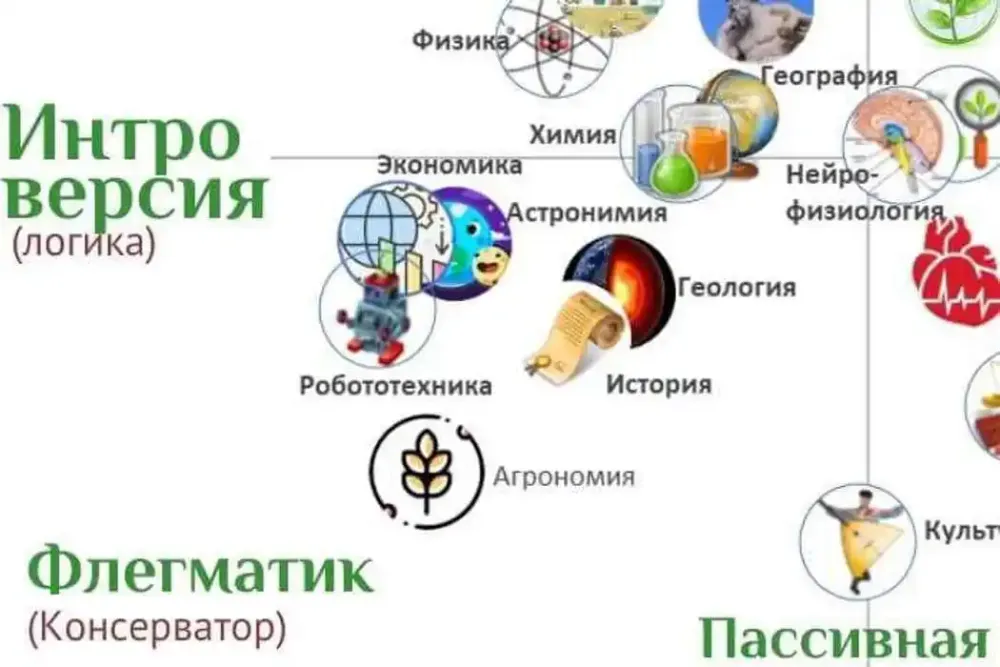
Agronomy (M 69%, 22-45) offers a whole range of practical insights for making the right decisions in farming: from choosing a suitable plot to growing different crops. The knowledge you gain from agronomy lets you optimise your farming methods, make the right decisions about irrigating the land and treating seed, and keep an eye on moisture levels and soil quality.
The phlegmatic is an Introvert in the Passive life position. Read more at the link:
? The phlegmatic temperament — a definition
Robotics (M 70%, 22-45) attracts people with the chance to explore technology and science hands-on, to develop and modify new mechanisms, to design whole systems and build all sorts of machines, and to apply knowledge and engineering skills to practical tasks and to greater efficiency.
History (M 60%, 22-45) not only lets you look into the past but also helps you understand the present and how society is being shaped today. Studying history can teach you about the mistakes of the past so that they are not repeated in the future. It builds the skill of critically analysing situations, documents and sources of information, and that makes for better-considered decisions.
Geology (M 56%, 22-45) is the science of our planet's past, from which we can draw an understanding of how changes in the structure of the Earth come about. Taking up geology, you can take part in the search for mineral resources and carry out research that enriches our understanding of the problems of the natural environment.
Astronomy (M 60%, 22-45) is not just observing celestial bodies and other objects, it is understanding the processes that take place in space. The scope for searching and researching here is truly limitless. For some, astronomy is an adventure in the course of which the secrets of the Universe are revealed — a Universe which, incidentally, is not nearly as far away as it seems. For others astronomy may simply be an absorbing hobby.
Economics (M 65%, 22-27) helps you understand better how the world of money works and which financial decisions bring the greatest profit. Knowledge of markets and global trends can be useful for planning investments.
What do geology, history, robotics, astronomy and economics have in common?
All of these disciplines use statistics, mathematics and other scientific instruments for research in their fields.
Careers that suit the Melancholic
that is, the "Romantic" in SPECTRUM terminology.
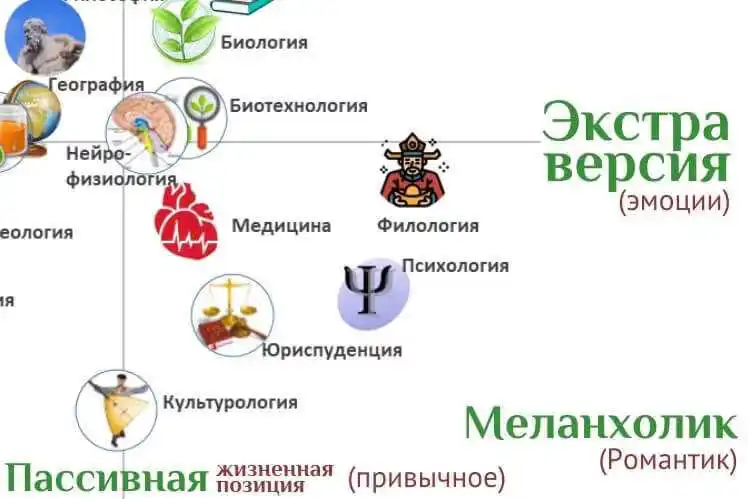
Philology (F 81%, 22-45) lets you study language, literature and culture in depth, improve your language skills and your understanding of other languages.
The melancholic is an Extravert in the Passive life position. The details:
? The melancholic temperament — a description
Psychology (F 79%, 31-45) helps you understand yourself and others better, manage your relationships and emotions better, develop your communication skills, understand your fears and weaknesses, think through a strategy for improving your life and cope with the problems life brings. In the end, a knowledge of psychology helps you become freer and more independent; it offers tools for developing your personality and unlocking your true potential.
Law (F 63%, 18-27, 36-45), as used to be thought, can offer rich career prospects. In the most general terms, knowing the Law lets you protect your interests and defend them in accordance with the law. Lawyers can use their knowledge to protect others.
Medicine (F 58%, 18-30). Quite apart from the many who choose medicine as a profession, an understanding of medical detail lets you make the right choices about looking after your health. Women may take an interest in the subject in order to secure professional and timely medical care for their families in any illness.
What do psychology and law have in common?
Both disciplines are built on the analysis of behaviour and motives. Both analyse what exactly leads a person to a particular behaviour or action, and how people understand and process information. Both use statistical methods to find the best solutions. Both use interviews, surveys and observation.
Clusters in an intermediate position
Careers for Extraverts. Between Melancholics (Romantics) and Sanguines (Romantics)
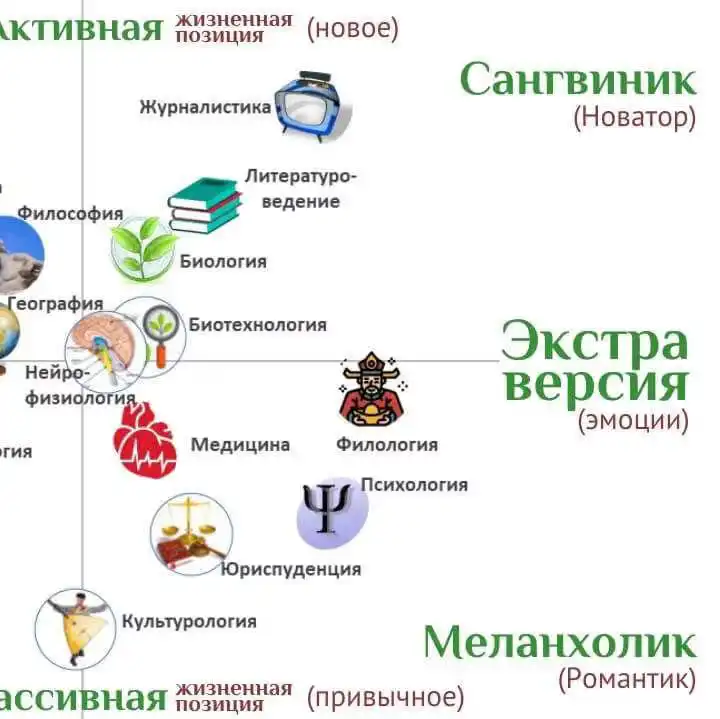
Biotechnology (F 66%, 18-30). This field develops new medicines and treatments that can be useful, for instance, in treating infertility or cancer.
This, in fact, is where we should have started:
? The extravert — in plain words
Studying neurophysiology (F 62%, 22-30, 36-45) lets you understand better how our brain works and how we process information. And therefore to understand psychological processes better too: the mechanisms of memory, attention and thinking, and how we make decisions. #Neurophysiology is used in psychology and psychiatry and shapes the development of new technologies and methods in neuroinformatics, medicine and bioengineering.
What do biology, biotechnology, neurophysiology and medicine have in common?
What unites all these disciplines is an interest in the human organism and how it functions. Biology studies the fundamental principles by which the organism works, biotechnology uses that knowledge to develop new products and technologies, neurophysiology investigates the human brain and nervous system, and medicine applies the knowledge gained to diagnosing and treating disease.
Careers for Introverts. Between the Choleric (Pragmatist) and the Phlegmatic (Conservative)
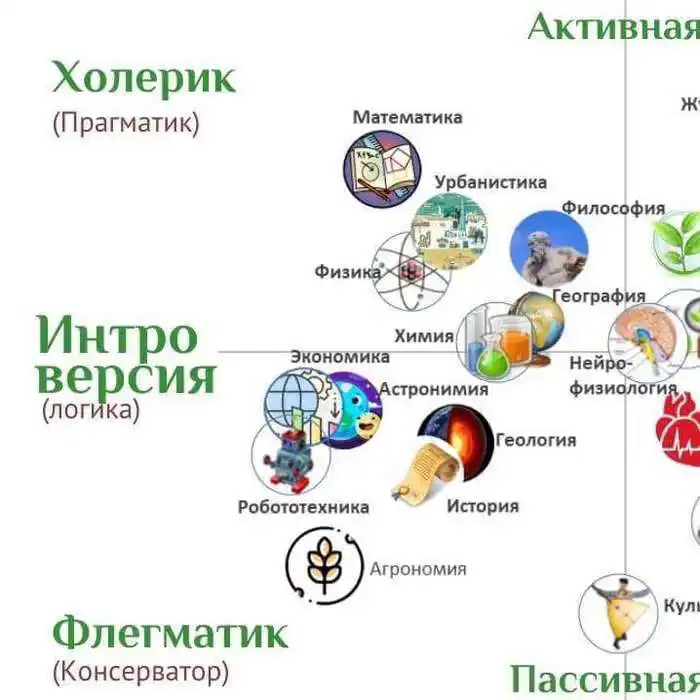
Geography (M 53%, 18-30). In the past there were real travellers and explorers who visited the remotest corners of the planet in order to study and explain the world. Today geography has amassed a colossal body of information about continents, islands, mountains, rivers and so on. As a science, broadly speaking, it gives an idea of how the way of life of the inhabitants of particular districts took shape, and an understanding of the corresponding differences between regions, countries and continents. For some of us geography allows us to enjoy the spirit of adventure that exploring new places inevitably carries. But strictly speaking, geographical science is far from romantic: it is a domain of exact knowledge and of a great deal of information.
Did you know that Introverts are searched for twice as often as Extraverts?
? The introvert — in plain words
In chemistry (F 55%, 18-27) there are many interesting applied problems that can be solved and put to practical use. Studying chemistry can be useful for creating new technologies, materials and medicines. The ability to analyse and interpret chemical processes can be very useful in solving many problems to do with the environment, science and engineering. #Chemistry, for instance, helps people use the Earth's resources more consciously and to do so safely for themselves and for those around them.
Careers for the Passive Life Position. Between the Melancholic (Romantic) and the Phlegmatic (Conservative)
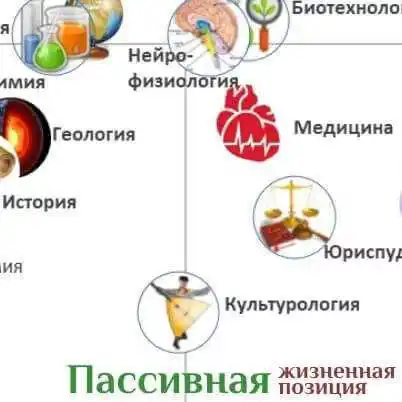
Cultural studies (F 53%, 31-46+) let you understand the historically formed conditions in society that act upon us. This discipline gives a rounded understanding of how different cultures are interconnected. Tracing various trends and the past history of cultural relations, people come across ancient traditions and practices that can be extremely useful to them. An understanding of cultural and historical values can serve as a starting point for a better understanding of life today. In theory, cultural studies are there so that we do not forget what kind of world we live in and can soberly forecast what our future may be.
What is the "Passive" life position? It has nothing to do with lying on the sofa! It is rather about the dominance of the Anima, the feminine principle, in a person's personality. The details: