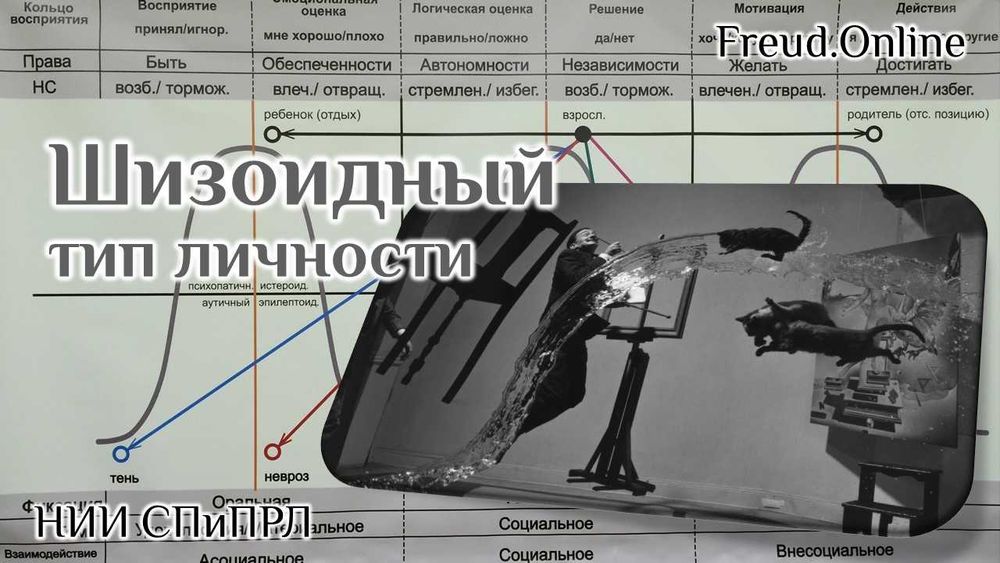
An inner world filled with ideas and symbols. There are many feelings and experiences (they come flooding in), yet most of them are never let out as emotions. Experiences are turned into elaborate structures of ideas and symbols, and only then are they shown to the world. An all-embracing, all-consuming wish (one that takes over the mind) to realise their own ideas-desires (overvalued ideas). These ideas often diverge from the real needs of the organism, of the body. Idealisation of what is wished for. Rigid territorial and personal boundaries, and a readiness to defend them. Self-removal from society, bordering on rejection of it (disgust) and arrogance. The stance “I am king”, “I am the master of my own life”, “I am the god who runs things”, “I am free”, “nobody tells me what to do”.

Disharmonious and Conflict-Prone Traits
- Defending their own territory and boundaries even when there is no need to (“don't push me — I know what to do and how”, “this is my house, clear the area” and so on)
- “Everything will be done my way” (in my house, on my territory, in my family) — while craving personal freedom, they deny it to those closest to them.
- Fencing themselves off from society (“to be honest, I don't need anyone”), shutting themselves up in their own world of ideas-desires.
- A different logic, often incomprehensible to others, combined with no wish to make themselves more comprehensible.
- Arrogance towards other people (“I am the cleverest”), snobbery.
- They dislike and refuse to help people just like that, out of kindness (only for the sake of an idea or a benefit).
- Over-idealisation of their ideas-desires — hence the difficulty of realising them (“that is no prince of mine, just some chubby fool”).
- “Cynicism, nihilism, sarcasm, orgasm” — the values of the schizoid.
Harmonious Traits
- Stable preferences (this is what I have chosen to eat, to do and so on).
- Respect for other people's boundaries.
- Cultivated refinement (respect for oneself and for the person one is talking to).
- An aristocratic bearing (a select circle, high standards).
- Masters of a large house and household, managers.
- Ambitious (to be the best, to stand out), vain.
- Clannishness (my clan, my family, my house).
- Clever, well-read, curious.
- A rich inner world of ideas and fantasies.
- Well-developed thinking (thoroughness, analysis and synthesis, induction and deduction).
- Respect for what is complex (complex tasks, structures, ideas and so on).
Fears, Sources of Displeasure
- Lack of freedom (of action, of thought, of ideas).
- Having other people's ideas and advice imposed on them (I know myself what to do and how), being coerced (as a form of unfreedom).
- Violation of their territory (my house, my family, my personality, my overvalued idea-desire).
- Failing to realise their main overvalued idea-desire.
- Stupidity, losing their mind, madness.
- Losing their self, their integrity, their boundaries.
- Having to depend on society.
- The flow, God, anyone else's influence on their life and their freedom.
Sources of Pleasure
- My home is my castle.
- Clan relationships (my house, my family, my kin).
- Books, films, theatre, ideas with a touch of symbolism.
- Complex problems and solving them, taking up an intellectual challenge.
- Debates about ideas, discussions, interesting arguments.
- “Good sex” (as the satisfaction of an animal instinct).
- Freedom from society.
- Realising their ideas-desires.
- The feeling of being “the very best” (the cleverest, for instance).
- I am the master of my own life, of my inner world, of my ideas. And so on.
Careers (Comfortable, Self-Actualizing)
- Analysts.
- Intelligence and counter-intelligence officers.
- Running a business of their own.
- Scholars of exotic disciplines of every kind.
- Philosophers.
- Science-fiction writers.
- Programmers.
- Physicists, mathematicians.
- Bank staff, economists, chief accountants, the field of taxation (solving complex problems).
- Theoretical scientists (a new vision, complex ideas that others do not understand).
- Directors, artists, inventors (of an unconventional kind).
Games – Roles – Manipulations
- Delusions of grandeur and omnipotence.
- Your rules and your ideas are limiting me (my freedom).
- “I have my doubts about your mental abilities” (“I am the cleverest, the rest are fools”).
- “You have trespassed on my territory, who gave you permission?!”
- “I know how to behave, I decide myself what to do and how to live. In my family and in my house everything will be my way, my children will grow up the way I want, and it is none of your business!”
Appearance
Rich colours, noticeable, often with no regard for what others think — whether it suits them or not, whether it is in fashion or not (the main thing is that I like it). Exclusivity.
Motor Activity
Confident, indifferent to the looks of others
Personality Development (Paths)
- Reining in the excessive force of their ideas-desires.
- Being on equal terms with people (I am the cleverest, but others are no worse — they too are interesting, clever and talented).
- Recognising that on my “territory”, in my family and at my work there are living people, and they are not obliged to carry out my desires-ideas perfectly; they have lives of their own.
- Recognising that life around them does not follow my plan or my idea (giving up the delusion of grandeur).
- Understanding that a person is free in any case.
- Recognising that my qualities can be described (for all my uniqueness).
- Softening their idealism (“my idea-desire can be realised in more ways than this one and need not follow the scheme exactly; deviations from the ideal plan are possible”)