They say you can never win a negotiation. You can only avoid losing it. And in difficult, seemingly hopeless situations there are patterns of behaviour that let you walk away without losing everything. As in the "I'll offer more».
Imagine a young man getting into a taxi and agreeing a fare of 50 euros with the driver. Then a girl jumps into the same taxi and starts up: she left her handbag on the bus, the bus is pulling away, there are 200 euros in the bag, let's go after it. Money or decency?
In general terms: a Seller has struck a deal with a Client. Then an Outbidder steps in and offers the Seller a larger sum. Of course, the Outbidder may simply be bluffing, and should not be trusted all the way. If the Outbidder turns out to have no money, everyone involved can end up with nothing.
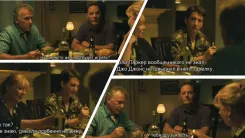
Or how do you get out of a situation like the one at the end of the film "Hostel 2"? The scene is far too brutal, so we had to censor it.

The situation is ambiguous and everyone involved stands to lose:
- The Seller holds the power and wants to maximise the gain, but has to choose between a bird in the bush (the Outbidder) and a bird in the hand (the Client).
- The Client has already struck the deal, cannot offer more and depends on the Seller keeping his word. His task is to hold on to what he has and not end up in the red.
- The Outbidder is trading in thin air. If it falls through, he may get it in the neck from both the Seller and the Client.
- The chances of success for the Outbidder and the Seller shrink with every passing minute.
To find a "clean" way out, let us recall a couple of rules of hard-nosed negotiation:
rules of hard-nosed negotiation
That is why it would be great to find a combinatorial solution in which
Since the Seller's chances of maximising the gain shrink with time, he can impose a time limit ("you have two minutes to negotiate"). For the Outbidder, one way out of the situation is to adapt to the Seller.
- Work out the criteria the Seller decides by. Does he care more about money or about principles? Build a profile of him, work out what he likes.
- The Outbidder talks not to the Client but to the Seller, in the language of the Seller's own criteria and values. For instance, if the Seller has a family, one can paint a family drama that will unfold unless the Outbidder gets his way. And the Outbidder speaks about the Client to the Seller in tones the Seller finds unpleasant.
Alternatively, the Outbidder makes the Client a FAST OFFER to buy his service back at a higher price and, at the same time, tells the Seller to close the deal. The tactic:
That is exactly how this strategy is played out in the film "Hostel 2"