Toxic people. People it makes sense to avoid. People you would rather not talk to. How do you spot them? What should put us on our guard about someone?
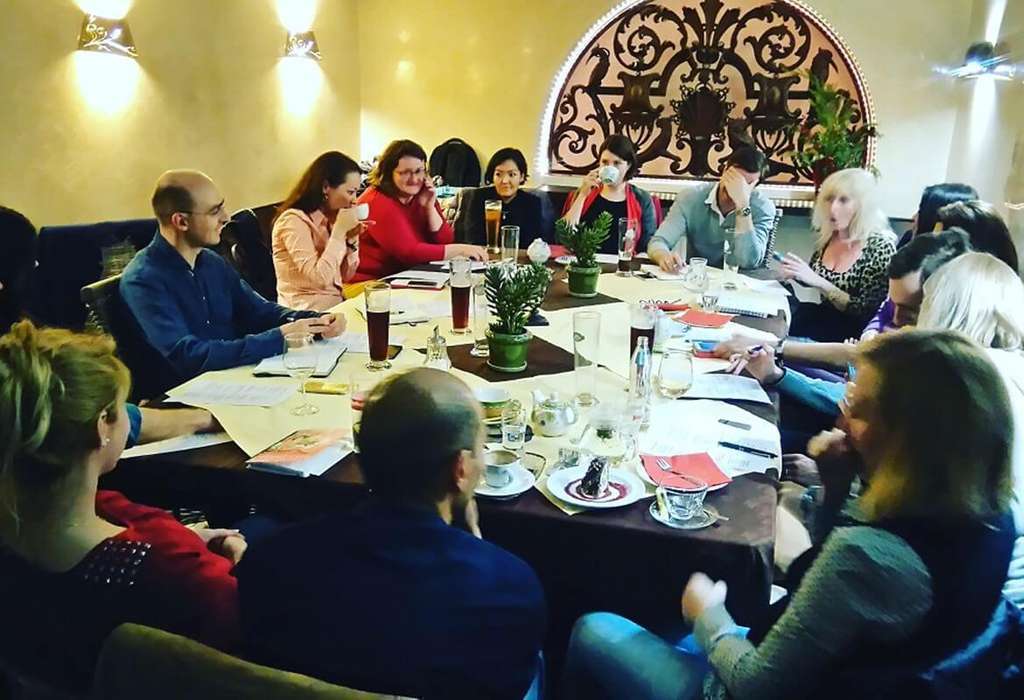
At one of the Freud's Legacy meetings a request came in: "how do you spot psychopaths and Arschlöcher?" That is, 'arseholes', or nasty pieces of work, in German. At first I did not take the 'order', thinking: "one man's swine is another man's hero". But the longer I thought about it, the more practical the question looked. Because there are people who want to choose their circle, to arrange their private life and to steer clear of trouble. And to do that, the 'trouble' has to be spotted. So at the next "Nothing Personal" meeting we drew up together a list of 'little signals' that point to problems in the psyche of the person in front of you. What came out was a list of "early warning signals".
- Bodily:Jitteriness in the bodyCannot be touched: the person will not tolerate other people touching themDoes a great deal of tango, yoga, fitness (group activities as a substitute for relationships)Dependent people with addictive behaviour (including gambling and collecting)Contempt (the corners of the mouth turned down) during "ordinary" conversationA lady or a gentleman with a toy dogA woman with long nails
- Out of keeping with their age:Still rebelling after 25A woman over 30 in the gymHas never been in a relationship at 35A woman of 35 without a childA man over 35 who competesTalks about spirituality at 20
- Problems with beliefsWhen "my partner should ..."When a man does not understand the word "No"When a person talks a lot about happinessAsks a lot of questions at the first meeting.An asymmetrical exchange of information
It came out just like in a bank: an early warning system for highly probable trouble)
How are risks assessed in a bank?
The well-being of banks depends on the honesty and the solvency of their clients. Before a bank gives a client a loan, it assesses their "creditworthiness". For that, experts develop a model for identifying risk factors. The client is checked against a whole set of quantitative and qualitative criteria; each criterion is given a certain number of "points"; the points are added up and converted into a simple scale of "reliability" (excellent, so-so, unreliable).
For instance, before it gives you a credit card, the bank will ask a lot of questions about you and rate you against its internal risk model:
- Under 28? Bad! Minus 20!
- Working in a bank? Excellent, that is reliable! Plus 30!
- Not married? Very bad! Minus 20!
- Earning about the same as everyone else? Nothing to be proud of! You are a zero!
- Own your flat? Well done! Plus 10.
As a result you have scored ZERO points. You work in a bank all right, and you bought a little flat on credit, but you are still young and there is no wife. So you are a zero, and we shall give you a middling loan.
Banks also keep a list of "early warning signals". These are patterns of client behaviour from which the bank concludes: "Careful! This client is starting to behave dishonestly! He will let me down before long! End the relationship immediately!"
When we start a relationship with someone (a personal one, a friendship, a business one), do we also assess the risks that come with that person? Do we decide how "reliable" they are and whether they should be given a credit of trust? Do we have an internal system for assessing the risks in our circle? Do we recognise in the behaviour of the person in front of us the warning signals that they are "unreliable" for us?
Why is it important to assess the risks a person carries?
When we discussed these questions at a "Nothing Personal" meeting, the most "humane" listeners objected: "I get on with everyone and I love everyone". Even N. I. Kozlov used to say that you can build a relationship with anyone if you want to. Let us not fool ourselves. There are always people we would rather not deal with. And not without reason...
When we deal with "toxic" people, we lose energy. We grow weaker physically and morally. Instead of gathering energy from contact and running off into the world to create, we invest our strength into keeping "toxic" connections going. That is, we get stuck in neurotic relationships. And if we are unlucky enough to run into a psychopath, then at best we crawl out of such a relationship with a fresh emotional wound, lowered self-esteem and a jangled psyche.
So at the "Nothing Personal" meetings we started asking people and collecting a list of "early warning signals". Which traits and which behaviour in the person in front of us should make a red light go on in our head? What is it useful to be wary of and to check?
Does this mean that as soon as we see one "danger signal" we should run for our lives? No! A person may be perfectly good company; nobody is perfect. The logic here is:
- one little signal — chance
- two little signals — coincidence. It happens to everyone! But it is already worth a check
- three little signals — a pattern
That is, with every extra marker the probability grows that this contact will end up hurting and upsetting us.
Signs of not matching your age
Every age has its own things that are wonderful, useful and needed at that time:
- At 20 it is useful and important to fight and rebel against adults, the regime and the established order
- At 25 it is useful to raise the beauty of the body to unheard-of heights
- At 30 it is useful to revel in wealth, cars, clothes and material goods
- At 35 it is useful to take an interest only in your own needs and to downshift
- At 40 it is useful to take up something creative
- At 50 it is very useful to become a spiritual person
And there is a great deal that comes at the wrong time for a given age. For example,
A brawler, an anarchist and a rebel after 25
Being a hot-blooded young man is fine in your youth. But physical youth ends quickly, whereas psychologically many people love to get stuck there. In that youth people love to fight, to offer their faces to police batons, to overthrow the ruling regime, to rail against their parents' outdated ways, to be anarchists. In short, to REBEL.
And so it turns out that a physiologically 40-year-old bloke is stuck at a psychological age of 20. And he rebels at protests and demonstrations, and rebels some more. In short, if you come across an anarchist and a "brawler" who is no longer young, think about what that might mean. And what do you want him for?
Female youth after 30
You know those dolls who at 35, 40, 50 dress like twenty-year-olds? Transformer women? Those are not women) And here is why.
The main life crisis for women is the "coming of maturity" crisis at 28. The breasts are not as firm as they were, cellulite has arrived, the weight no longer comes off by itself. Younger competition starts taking men from under your nose. And then a woman has to think about where femininity really lies. And she realises that the body is not the main thing. That beauty of the soul shines brighter than beauty of the body. And a woman appears. It is a different matter if, as she gets older, a woman still thinks that bodily beauty is the main thing. The beauty industry is only too happy to support such thoughts:

The point is not that you should do sport. The recommendations I know are 300 to 600 minutes of active movement a week. That is five to ten hours of activity a week. For a creative person, five hours a week is already a creative goal in itself! But compare the reasons why someone spends hours in the gym:
- To keep the body healthy and good-looking, or
- To take their mind off their thoughts, or
- To keep their breasts as firm as they were in their youth.
The last option is stuckness at the age of 28. Which is easy to check with a couple of leading questions. So if you come across a woman of 30 or older for whom bodily beauty is the most important thing, then you are done for, lads.
Has never been in a relationship at 35
If a man or a woman past 30 has not yet managed to break their heart a couple of times, then inside they are a teenager of about 20. This applies more to men. And most likely he is not capable of a relationship at all, avoids them, or gets thrown out after a couple of months. Why join the queue? And most likely, having had no relationships, he has never grown a sense of responsibility. This smells of problems at work too...
A woman of 35 without a child
Few women want no child at all. It is not very convincing, but it is possible. If a woman has not had a child by 35, then it is quite reasonable for me, as a man, to think that she will see me not as a man but as a sperm donor. Or as a tool for raising children with. But not as a man) Because the older a woman gets, the harder the genetic programme to produce offspring works inside her.
Plenty of men will be quite happy with that. So if you want to become a father quickly, look for a grown woman without a child)
A man over 35 who competes
There is a charming man in our circle who still intends to compete with other men for a woman. Or for a promotion. Or for "who is cooler".
Competing is useful and normal up to 30. Because men are essentially competing not with others but with their fathers. At 30 the lads reach the age at which their parents had them. As a rule they already have a wife, a house, a car, children. That is, everything their dad had when the lads were about five. And then a healthy person calms down and starts looking inwards.
So if a 40-year-old has started competing, you are looking at a man who has not achieved what his father had. And you will be his instrument in the contest. What for?
Talks about spirituality at 20
I have deliberately put this last so as not to alarm the aggressive defenders of spirituality. Personally I accept religiousness in women. And I know that men throw themselves into spiritual matters at around 50. Well, it is early for young people to take up religion at 20, early! At that age you make revolutions, offer your little face to police batons, then start a family, then earn money and buy flash cars, then.... At around 50 you get to God too...
Bodily signs
The body and the appearance can tell you a great deal. For example,
Jitteriness in the body
When a person cannot stand or sit still, when their leg is twitching... Strong, abrupt gesturing, legs and then arms shaking... Inner jitteriness speaks of jitteriness within. Which means you will get no peace... You can see jittering teenagers on the underground. You can see jittering journalists on television, as for instance here:

Contempt (the corners of the mouth turned down) in conversation
One of the easiest ways to spot trouble. When you are talking to someone, watch the corners of their mouth carefully. If they turn downwards as you talk, that person despises you. Any questions?
Cannot bear physical contact
You touch her and she is ticklish everywhere. Not in one spot — everywhere. What does that tell us? It points to a defensive reaction to a traumatic situation in childhood that has already moved to the level of the skin. A psychosomatic defensive reaction. Which means you will run into aggressive defence.
A love of tango, yoga and fitness
Tango is a wonderful dance. Very emotional. So emotional that it satisfies. And then no relationship is needed any more, and no sex. Only tango. And in yoga you can reach such a nirvana that men are no longer needed. As for people running off to the gym to iron out their complexes through their muscles, that is common wisdom by now.
Do not be alarmed: tango instils role models of behaviour and self-confidence, yoga calms you down, fitness levels out your emotional background and gives you energy. The only question is whether these people have healthy relationships (if they have any at all). Because tango, yoga and fitness can be a substitute for sex.
A person with a toy dog
There is nothing sweeter than a lonely lady or gentleman with a little dog. Because the presence of the opposite sex in a person's life makes the little dog unnecessary.
A woman with long nails
A normal bloke will not date a woman with long nails. What for? The sex will be mediocre, there is an obvious problem with her life goals and the way she allocates her personal time, and hygiene is even more of a mystery.
- What pleasures does a woman give a man? Well, you know that you can caress your partner with your hands, do you not? And that a man has places that respond very strongly? For that you need to take a firm hold of a cylinder three to six centimetres across, feel its tension and give yourself the chance to squeeze, release and move your fingers. How is a woman with long nails supposed to do that, if the nails dig into her own palm? She simply cannot! Hence the first conclusion: a woman with long nails does not give a man pleasure. If she does, it is clearly limited — that is, there are problems with intimacy.
- How long does it take to do a pedicure on long nails? Two to four hours of sitting with a straight back and outstretched arms? Could that time be spent on sport instead? How and on what does she allocate her time?
- What about hygiene? Long nails are handy for picking your nose. But you can no longer pick your teeth with them, can you? And how does she manage intimate hygiene with fingers that have blades planted on them? She does not, or everything down there is already cut to pieces by the nails? What about the bacteria under those long nails? Housework I shall not even mention.
Drug addiction, gambling, collecting
Drug and alcohol addiction do not simply disappear. They flow into other forms of dependence. There is a huge variety of addictive behaviour, and the most everyday of them is collecting. Stamps, for instance)
Dangerous beliefs
And finally, after observing the behaviour, all that remains is to listen to the person. And to hear the neurotic irrational beliefs with which you can make yourself unhappy without anyone else's help. For example,
"My partner should ..."
"A man should" — said Dima the PE teacher. A man should, thought the woman. Simply because he is a man, he owes me. Men can think the same way about women. This is a classic belief that leads not only to neurosis and to a childish level of relationship. It is a classic reason to get up and say goodbye.
A man does not understand the word "NO"
Remember the film "Sweet November"? As so often happens, the most romantic scenes in films are the most neurotic. In the film the heroine is dying of cancer. She asks the man to leave so that he remembers her while she is still well. Naturally, the man does not understand the word "NO": he comes back, tells her about his love and lays on pure romance for the dying woman. Look at the picture. What feelings do you see on the face of the woman made so happy by this romance?
From what position does a man act when he sincerely believes that a woman's "No" is an invitation meaning "maybe, come and win me over"?
- Perhaps from the position of a RAPIST, acting against another person's will?
- Or from the position of "YOU SILLY GIRL, you do not know what you want yourself"?
- Or from the position of "I KNOW BETTER THAN YOU what is right for you. You have no right to your own opinion"?
- Or from the CHILDISH position of a LITTLE PARTISAN? Mum said "No", and the child thinks: "No way, I know your no! I will try another way, maybe it will work?"
A woman talks a lot about happiness
When a person talks a lot about happiness, about happy and kind friends and about their own happy, harmonious life, that is a sign of a big hole in the soul filled with a layer of concrete. Happy people do not talk about happiness — for them it is as natural as breathing.
Female curiosity in a man
Asking a lot of questions is a good thing. It becomes suspicious when a man starts asking about the colour of your underwear, where you get your pedicure done, where you had your hair done. That is, about things men are not usually interested in. And it is a full siren when a man goes on questioning you after being asked to stop. That is already an open violation of a state border.
An asymmetrical exchange
Imagine a first meeting. You are asked a question — you answer. You are asked a second question — you answer. You ask a question back — and it is laughed off. Try this test a couple of times, and there is your exploitation, plain to see.
Yes, we use each other. Yes, we exploit each other. Any relationship is an exchange — of attention, favours, care, money. And it becomes a neurotic relationship when one gives and the other only takes. The most interesting thing is that you can notice this right at the start.