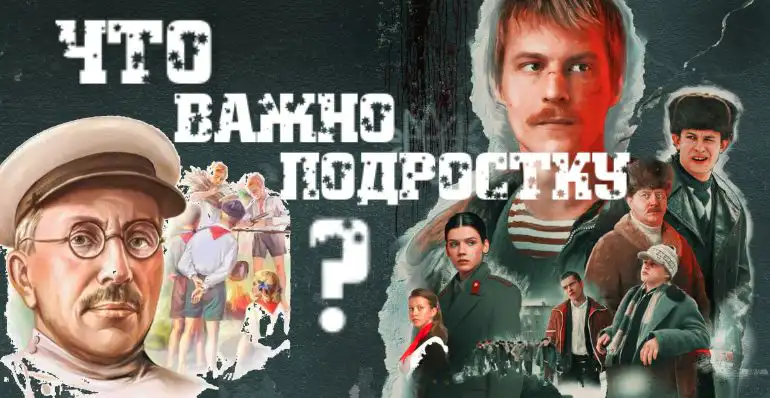
The series “Boy's Word” has become a popular meme that supposedly inspires teenagers to set up gangs of their own. The phenomenon has set off heated discussion among the Elders, many of whom see in it a romanticising of gangsterism. But let us try to look at the situation from another angle: what actually matters to a teenager, and what draws them to this series? “Boy's Word” is not merely entertainment, it is a mirror reflecting the inner experience and the aspirations of the young. In this article we will try to work out what lies behind this phenomenon and how we, the adults, can approach it with understanding and support.
This question is a particularly live one for the parents who come to me as a counsellor looking for understanding and for help for their children. And so, a frequent theme of parents' calls is: have a word with my 12-year-old. Either he sits at home with his games and will not talk to me, or he is depressed and hunting for diagnoses for himself on the internet, or he is already on drugs, or he is changing his gender, or he does not want to do any sport because he sees no sense in it. Let me, the counsellor, talk to him and make the child do what the parent wants.
And every time, with sadness, I have to say that I cannot help the teenager. Everything that works, everything that psychology and education have come up with for teenagers over the last century, is not supported by today's society (schools, child protection bodies, the system of upbringing). And that is not only my opinion. It is also the opinion of an Austrian teacher whom I run into at psychology seminars. But in this article I will at least tell you what a person needs at the age of adolescence, and what actually helps. Boy's word!
What matters to a teenager. From developmental psychology
What matters to a growing person at the age of 8-12? Peers, imitation, belonging, and… gangs.
Imitation is a very useful social skill; it is the ability to enter a group and join a collective. It is the understanding of which rules and which values are dominant in that collective, so as to become one of its own. If a child does not manage this skill and does not fit into the collective, he becomes the odd one out, and it is then hard for him to put together a circle of his own. That is when the child is overwhelmed by the experience of social loneliness.
What does it mean to enter a group and a community? The child starts up with: “I want the same jacket, the same phone, the same T-shirt”. And this is critical, because not having such things and such badges of belonging strikes you off the group automatically.
At 9 the groups begin to break up into smaller ones, and here the child has to learn to choose a group that he finds interesting. This is the ability to choose your own people.
At 10 the child learns to take his place in the group and builds the ability to show leadership skills. This is the time of mastering roles, of taking your place, of reaching your goals, of the skills of standing up for your boundaries and your own interests inside the group and with the help of the group. And school (or the yard) is here the crucible that a child passes through in order to be socialised. A child taught at home is deprived of this.

It is at school, too, that groups appear which certainly do not fall in with your interests and which may, what is more, be hostile to you. It is very important to learn to deal with them, to stand up to them. At school, at the age of 9-10, there used to appear bullies who would start shaking people down for money and knocking them about in the breaks; they band together in groups of several, and you have to be able to stand up to that crowd. This builds the skill of standing up for yourself, of coping with other groups, of learning to hold your ground and, when needed, of calling your friends in to help.
And then comes puberty, sexual identification, first love. But that is not about what parents ask for, and not about the series “Boy's Word”. I hope, though, that you have now heard what a teenager needs. Note that there is not a word in it about parents. At this age you are no longer needed. A group is needed. Then love is needed, unhappy love for preference. And after that the parents have to become “chushpans”, nobodies and losers, precisely so that the child can separate from them.
So how is a grown-up, even a counsellor, to help teenagers now, if by the very laws of developmental psychology he is already a “chushpan”? What has psychology come up with over its century?
The best there is in education
In 1988 UNESCO named four educators who had a significant influence on educational thinking worldwide in the 20th century: Anton Makarenko, Maria Montessori, John Dewey, Georg Kerschensteiner. Let me translate: this is the stuff that actually works in bringing up children.
Which of them worked with teenagers in particular?
Let us start with the one who is of least use for teenagers and works for the nursery, with Maria Montessori. An Italian doctor and educator, her methods also suit the first years of school. The style: do what you like, experiment, explore on your own in a safe setting, at your own pace.
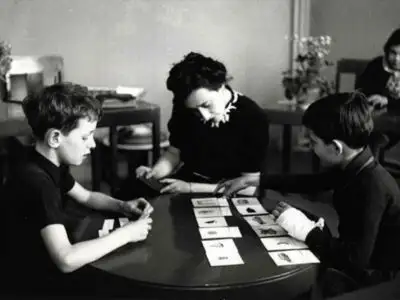
John Dewey, the American philosopher, psychologist and educator: with him the pupils are independent people who actively vote for and against their teachers and are forever setting up projects and experiments. That is, everything that in today's European system of education leaves teenagers bored, depressed and feeling that it is all pointless. In the USA it works, though, so the rumour goes.
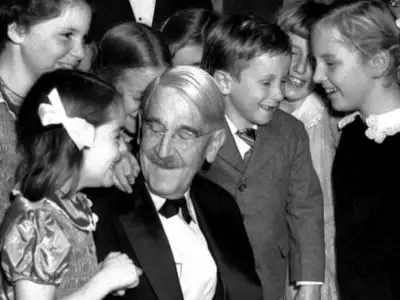
Georg Kerschensteiner, the German educator, trained children to be workers. You could say that it is thanks to him that we have vocational and technical colleges, or what in Austria is called a Berufsschule. Yes, this suits teenagers, because from the age of 14 they are already earning money. But at the age of the series “Boy's Word” it is still too early.
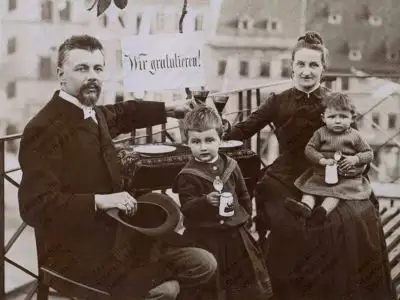
That leaves the only one who suits difficult teenagers — Anton Makarenko.
The only thing that works for teenagers
The method of Makarenko, the Soviet educator, is effective above all in the rehabilitation of young offenders, and it combines strict discipline, the development of social and vocational skills and collective responsibility with respect for the person. In practice the effectiveness of Makarenko's system rests on a children's version of dedovshchina, army-style hazing: the younger ones were brought up not by the teachers (who were the “authorities”) but by the Elders.
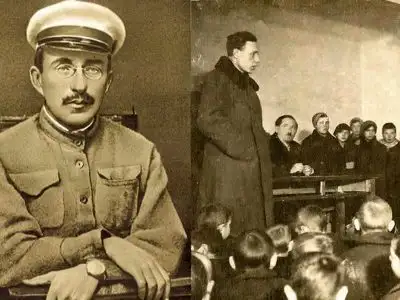
The Elders were mentors and leaders for the younger ones, helping them settle into the collective, teaching them and guiding them. The older pupils carried responsibility not only for their own behaviour but for the behaviour and the development of the younger ones. This system helped to create a strong spirit of community and solidarity among the pupils.
And what were the pupils busy with? Work! That is, with everything you saw in the series “Boy's Word”.
The drama of today's parents
And here we come to the drama of our own day. The European school has handed all the reins and the burden of upbringing over to the parents. That is, it is no longer the crucible a child passes through in order to be socialised.
For a child of 10-12 the parents are “chushpans”, from whom it is high time to start separating in the mind, in order to become an independent person. And that is a good thing, but it is completely useless for upbringing and socialisation.
The only thing that helps is a group, a gang, with authorities and Elders. Incidentally, in the USSR this arrangement worked in line with the child's needs. There was the Young Pioneer camp, and there were the Elders, the Pioneer leaders. Everyone was busy with work. And just try not fitting into the group there — you would not enjoy it. That is, everything in the finest style of Makarenko's method, and… of the series “Boy's Word”.
The only difference between the gang in the series and the troop at a Young Pioneer camp is who controls the Elders. In the USSR that was the state, the Komsomol, the “Authority”, which kept ideological control over the Elders. And the older ones would clout the younger ones round the head for smoking.
Once the Komsomol was gone, the Elders became the Afghan war veterans, the goblins, the criminals. That raises the crime rate, but for teenagers on the street it socialises them mentally (even if not in the sense of law and order).
And what do we do now?
So, what can a parent do if a problem with a teenager comes up? The least (and probably the most) you can do as a parent is to be nearby, but at a safe distance. And safe for the teenager, at that. Do not get too far into his affairs (because you will not be able to do anything about them anyway), do not push your way into being his friend (because you are a "chushpan"), just signal from time to time that you are close by and always ready to help.
If you are lucky, you will find your child a club, a group, an interest circle led by a master with real authority. That will be the answer. Or you can, of course, give me a call. Who knows, we might come up with something else together.