Behind every great man there is a great woman? I would say that behind every infantile Rescuer there are unhappy relatives. And nowhere is that easier to see than in the Mackenzie family in the series “Big Little Lies”.
Behind every energy vampire there are donors whose energy is being sucked out. Behind every grown-up stuck for ever in the state of the Child there are children, or a partner (a husband, a wife), doomed to be the eternal Adults, who are never allowed to be the Child. What does that look like?
The role of the Rescuer in the triangle
Meet Madeline! She will help anyone in town who has been slighted or pushed aside! She will defend the weak, put the insolent in their place; order in the little town of Monterey rests on her. And nobody asks her for help — she simply cannot bear injustice, chronically. She will stand up for the Victim of her own accord.
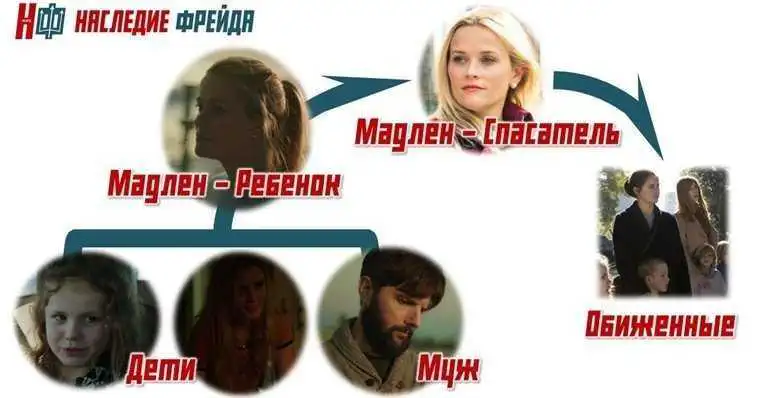
When Madeline is planning her rescue operations for the slighted and the pushed aside, she knows better than they do what they need, what is good for them, what is right. This is the classic role of the Rescuer in the Karpman drama triangle. To play it, Madeline takes the position of the Parent towards the Children around her (even if those “helpless” children are forty years old or more). But where does she get the energy for all of it? Meet the three donors.
Donor No. 1: the Little Professor
Donor No. 1 is Madeline's younger daughter, Chloe. She is six, and she is the Little Professor. She is the Adult inside the child: she comforts her mother, lectures her (“Calm down, woman!”, “Squabbling again, woman!”) and reads her mother's emotional state better than her mother does. Six-year-old Chloe gives her forty-year-old mother energy, support and mentoring.

Donor No. 2 is Madeline's elder daughter, Abigail. She is on the point of auctioning off her virginity for charity, in aid of the starving children of the Volga. She has very deep psychological skills: she can take her mother's behaviour apart like a psychoanalyst, defend her own boundaries against Madeline's neurotic attacks, and even walk up to her and ask her “how she is feeling”. After six-year-old Adult Chloe, she is the second Adult in the family.
Donor No. 3 is Madeline's suspiciously perfect husband, Ed. He is the perfect husband: he works from home, does the cooking, listens patiently to his wife lamenting how good her ex-husband was at oral sex, and comforts Madeline like a caring Parent. As the Adult in the family, he sees where the energy and the resources are going, and he can judge how dangerous his wife's rescue operations are. As the most grown-up of them all (Ed is somewhere in his forties), he is the only member of this neurotic circle who can see the danger and the harm his wife does to him, in spite of his feelings for her. And he says so openly.
Who is the adult here?
The most interesting thing to observe in the series is that in the Mackenzie family Madeline is the only Child. All the others — the two daughters and the husband — are Adults and Parents to her.
On both her children and her husband Madeline has imposed the injunction “Don't be a child”. This often happens with parents who feel threatened by their own children. Madeline is in effect telling them: “There is room for only one little one here. And that little one is me. All the same, I will put up with you as long as you behave like Parents and Adults towards me.” It shows in remarks like “You are too big to...” or “Big boys don't cry”.
In transactional analysis the Child is the source of energy, of resources, of boundless activity. But it needs a constant supply of strokes from the Parents.
So what do we get if we take the Mackenzie family apart from the point of view of transactional analysis? And if we assume that Energy, this Emotional Resource, is not inexhaustible, that it has to be replenished by somebody, and that it flows from one person to another?
What we get is that in the Mackenzie family the energy flows from the children and the husband towards the wife, and from her to outsiders. A funnel pointing outwards, as it were. And what is worst of all, neither the children nor the husband ever get back the energy they have given. An interesting form of respectable vampirism.
And so we arrive at a theory: behind every rescuer there are unhappy people close to them!