A MAGIC TALE is not so much about Baba Yaga and aliens as it is your most everyday story about everyday things — with a SUGGESTION built into it.
A story about a daisy, for instance, can carry any number of suggestions: about love, about health, about staying power, about Persil washing powder… It pays to choose a story in which the listener can see an analogy with their own question. The story can be long, or it can be two or three sentences.
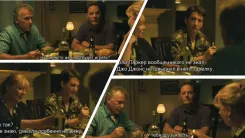
You can see an example of a properly told tale in a scene from the film “Chapaev”.
The Structure of a Magic Tale
A Magic Tale always follows a structure that contains
- characters and forces,
- the key — the solution,
- its symbolic use,
- a miracle, and
- a celebration for everyone and a stretch into the future.
Now let us take each point in turn
1) CHARACTERS AND FORCES
CHARACTERS are the elements of the story that have freedom of choice (Ivan the Fool, Koschei, an acquaintance.
FORCES are elements without freedom of choice (a swamp, a fence). A magic bulldozer can be either a Character or a Force, depending on the story.
Characters can be good or bad. The listener always identifies with a character — but you cannot possibly know which one. Perhaps with the villain. That is why Characters must never be killed off.
The story ends WELL for every character, even the bad ones. Forces, on the other hand, can be destroyed: the swamp drained, the fences taken down…
When you tell a tale, the problem has to be DRAMATISED. The hero tried this and that, and nothing worked. And then along came the MAGIC HELPER, who told the hero the solution (the KEY).
2) THE KEY
This is the symbol of the solution. A little golden key, a magic wand. It is the suggestion that a solution exists.
3) SYMBOLIC USE
Something has to be done with the Key. The golden key goes into the lock. The needle gets snapped. This is the symbolic use of a symbolic solution, and applying it changes the situation. The suggestion here is that solving something takes an act.
4) THE MIRACLE
After the Symbolic Use of the Key comes the miracle. Everyone, bad and good alike, ends up well off. Without fail! And right away, not in thirty years! This is the suggestion that the thing is worth it. The miracle should be described with enthusiasm, at length, with tears in your eyes and much waving of arms.
5) A CELEBRATION FOR EVERYONE and A STRETCH INTO THE FUTURE
after the miracle everybody rejoices and dances. What for? To show that the story was true. And they lived happily ever after and died on the same day, when a tram ran them over. This is the hint that the change is for good, that the dragon will not fly back and start it all over again. The miracle happens for ever!
An example
Listen to Timur Gagin selling this one phrase in the form of several Magic Tales!
To begin with, a simple algorithm will do. Say you want to advise a friend on how to get her man to do what she needs. Namely, to tell her man: “Yes, dear! Whatever you say, darling!” — and then he will do the thing she needs. Admittedly, few emancipated women today would agree to that: pride will not let them) So we spin a yarn.
We start with “I know this woman”. That is the opening of the yarn, with a positive character.
- “And everything was going badly for her! Her man would not listen to her, would not fix the sockets, would not take out the rubbish. She had had all she could take of him and was about to leave.” Here a negative character has been introduced, and the drama conveyed as long suffering and fruitless effort.
- “So she came to me and told me the whole story. And I said to her: try a little cunning! Tell him ‘Yes, dear! Whatever you say, darling!’” Enter the Magician (that is, me))), handing over the Key (that is, the verbal formula)
- “And the very next time she came out with that phrase! Yes, dear! Whatever you say, darling!” That is the symbolic use.
- “Next morning her man not only fixed the sockets, he did the whole cleaning!” A Miracle has taken place!
- “And they have lived happy and content ever since.” There is your never-ending celebration!
Recipes for a magic tale
So, for a tale to be truly “magic”, on top of the five components it must also keep to the rules:
- The tale must be dramatic. All is nearly lost, and then…
- Characters must not die. Even the villains change their tune and live happily at the end
- There must be a miracle! The solution comes not through hard grind but at once, through the magic little key
- The solution comes for good, with no “until next time”
Go on, spin a yarn!