They had both had a fairly wild youth and both had had time to grow disappointed with life. It was probably that very weariness and disappointment that brought them to us. They did not know where to look, or whom to look for, and were not sure why. You could say that neither of them was in good shape — certainly not in their best shape.
Background: The stories are published from the feedback we received and with our clients’ consent. The names have been deliberately changed. At the end you will find a counsellor’s commentary analysing the relationship.
Skip to the counsellor’s commentaryDina, who in her normal state is quite the lively, energetic sort, came to us in a state of complete turmoil. On the one hand she had grown disappointed with men as such; on the other, she badly wanted to find a proper family at last and start living the way one is supposed to. She said straight away, though, that she had only the vaguest idea of what that “supposed to” actually looks like: her parents divorced when she was seven. Before the divorce her father did his best to spend as little time at home as possible, lied about his salary so as not to hand anything over for the family's needs, and on the whole was not particularly ready for a child. After the divorce her mother never missed a chance to tell Dina how badly her father had behaved, how irresponsibly, and so on down the list. Dina could not see why men like that were needed at all, and so at the faintest sign that her boyfriend resembled her father she shied away and, for good measure, blew up every bridge behind her. In time she realised that she was either looking for men who resembled her father, or looking for her father's traits in those men — but that in any case things could not go on like that. She reached these conclusions on her own, with no outside help, but she had no idea what to do about it. And so a friend's advice to find a match through counsellors brought her to us.
Lyova was not in the best shape either. He had just come home from Bristol, where for several years he had been obsessed with the dream of becoming a real Englishman. Alas, his partners let him down, and the harsh local reality had little sympathy for “losers”: rather than wait for total collapse, he packed his things and came back home, where life was both simpler and cheaper. Busy looking for a job, which for some reason had to be in the entirely new field of project quality control (Lyova was just finishing a course in the subject), he decided it was time to cast a line on the personal front as well, and see where it took him.
He, too, had not the faintest idea what a normal family life looks like: his mother had suffered from bipolar disorder until her death, and his father drank. On top of that came constant moves and hospital stays, during which Lyova looked after both the home and his mother. The day after his mother died, his father put his belongings out in front of the entrance and expressed the wish never to hear of such a son again. To be honest, Lyova had nothing against breaking off contact with his father for good — he had just not expected it to happen so quickly and so meanly. All the same, he soon found himself somewhere to live, got back on his feet and went off to change jobs and girlfriends with no particular aim in view.
What kind of perfection he was after in life is anybody's guess, but whatever he kept finding never matched his idea of the beautiful. And, like the grasshopper in the fable, at some point he began to worry that winter was coming. Or rather, that it was time to settle down and put his life in order. And then one day, wandering through humour and entertainment groups on social media, he came across a mention of us in the comments. It was fate — and if it was fate, why not give it a try.
They were lucky that neither of them had inflated expectations. Our clients often do not even try to talk to each other, to find out why we consider them compatible, to give each other a chance. Dina admits that in her usual state she would have told Lyova to get lost — so far was he from her idea of a “suitable bloke” and from the sort of men she used to pick for herself in order to run away from them later. Lyova, for his part, was an experimenter, but rarely took the initiative himself. So in the end they started talking more out of boredom than for the reason they had come to us. Light conversation, easy jokes, chatting about whatever came up. It went perfectly well, and they decided to meet and take a look at each other.
At the very least, they oblige you to carry on. This is not light, easy flirting, not the carefree teasing of strangers at neighbouring tables who can walk away at any moment. Dina saw such a meeting differently, as if the two of them had already stated what they wanted and, given even the slightest attraction, were obliged to try and see what came next. To her, a meeting like this tied her hands, causing an illogical but very real discomfort. Lyova, too, could not quite see why anything had to start so abruptly. He preferred events to unfold in their own course, at their own pace and without any compulsion. He was already regretting that in a rush of emotion he had agreed to this whole escapade, but he was not ready to drop everything and cancel either. And so, almost against their own will, the two of them met.
The venue chosen was a “games” café of sorts. It belonged to people from some African country, went in for extremely modest decor, and offered a stack of card sets and backgammon boards. On the other hand it had vegan dishes and produce supposedly straight from African farms, bypassing the wicked multinationals. Dina had her doubts, but kept quiet, since she had never taken an interest in the subject and had never checked. Lyova, on the other hand, immediately proclaimed himself both a vegan on principle and a fighter for justice (a passive one, who merely visited cafés like this and bought produce like this). Dina once again suppressed the urge to say that she did not need any of it, and carried on with the polite conversation. Just as well, probably, because in conversation Lyova turned out to be very clever, well read and with a good sense of humour. He felt safe and calm to be with, for all his hang-ups and quirks. She almost managed to forget how obliging these deliberate internet introductions are. At the very least, Lyova, unlike all the other men Dina had met this way, showed not the slightest impatience to jump into bed and make wicked use of her. That won her over.
When they had finished and Lyova had gallantly put Dina on the bus home, Dina did something of her own accord that she had never done before: she texted after him to thank him for the lovely time she had enjoyed so much. She had been strangely touched by the way he turned round, lonely and forlorn under the drizzle, and set off towards his own bus. One thing she knew for certain: beside him she felt safe, and that was worth a great deal. In other respects he was quite a character. Clever, gallant, calm — a prince, really — and yet somehow… shop-soiled. As if he had been left too long on a back shelf, noticed by nobody but the dust and the spiders, gone flat and crumpled and so heartbreakingly lonely and lost that you wanted to take him down, hug him, dust him off and make a fuss of him.
![Миссис Даутфайр [русский трейлер]](https://storage.yandexcloud.net/medusa-irkeda/Missis_Dautfajr_russkij_trejler_368232180b.webp)
Lyova was charmed by Dina, but he knew what such charm is worth. Firstly, he himself was far from being in the best shape; secondly, people reveal themselves gradually, and a first-rate harridan may yet emerge from under a charming exterior. You just have to wait and watch, and sooner or later everything falls into place and becomes clear. Of course, a good sense of humour is a sign of intelligence, her decisiveness and her ability to size up a situation in a flash were mesmerising, and her brightness and originality won him over. And then there was her strange cheek, when she suddenly announced that she was like a mild drug: the longer he spent with her, the more enchanted he would be and the more unthinkable it would be to part.
The thank-you text was a kind of last straw, and completely unexpected — women usually wait for the man to write first. It seemed to shout: “yes, you are wanted, yes, act, because nobody but you…” And Lyova decided to invite her out again. And then again, and again. She was a puzzle of sorts, emotional and unpredictable, and above all she had been absolutely right: the longer they spent together, the more delighted he was with her, the more enchanted he became.
Dina, too, was enjoying the warmth and reliability of being near Lyova, but gradually she began to wonder why there was no next step. For two months now they had been going round different cafés and games clubs, parks and gardens, and taking short day trips out of town; Lyova gladly indulged her every whim and hauled her things out of his seemingly bottomless stores — yet Dina had never once been to his home. What amazed her most was that even when he fell ill and she brought him food, vegan bread and vegan raspberry jelly (vegan meaning without gelatine), Lyova, with a thoroughly frightened look in his eyes, took the bags through a slightly opened door, making sure that Dina did not — heaven forbid — catch sight of what was inside. She learned the reason much later; at the time she simply turned round and went home, frankly unable to work out what had just happened.
She did not get inside Lyova's flat until New Year. They celebrated it at a board games club, membership of which Dina had been given as a birthday present. Lyova had been a regular there for years. It was odd, in the age of smartphones and unlimited internet, to see so many strange, nerdy-looking grown-ups gathering to play some abstruse game such as Terra Mystica, the rules of which alone took Lyova two hours to explain — but it was something new and even rather sweet. By one in the morning of the new year Dina's brain had been thoroughly blown and drained by battling experienced players at that very game. Almost like a zombie she followed Lyova to his home, since it was within walking distance of the club, lay down on the little sofa she was offered in the front room, tried to spin Lyova a line about how even now they had better sleep separately, and passed out.
The morning of the first of January began for Dina closer to lunchtime, with a survey of an unbelievably cluttered flat, a cat whose fur was matted beyond any comb, and a mortally offended Lyova who had spent the night heaven knows where.
“How could you even think I would try anything!” he protested. “We are friends!”
“That is not why we met,” Dina remarked.
“So what! I am not like all those creeps! We have been talking for so long! Did you really take me for a pervert!!!”
Dina had to apologise, explain herself and calm Lyova down, while at the same time working out how to take a relationship like this further and… while at the same time taking in the flat and the cat. Lyova had certainly been right to be afraid of showing her the place. Generally spacious and conveniently laid out, it was buried under the most varied junk, from plastic fruit trays to shop receipts, free newspapers and catalogues. Among the mountains of rubbish you could make out a desk with a dusty, haphazardly assembled and plugged-in computer, a rail for shirts that do not need ironing, heaps of dirty clothes that were not urgently needed, and so on. In the next room, among the mountains of junk, stood out a host of dusty musical instruments and boxes of more important papers. The window sills were piled with little boxes of coins from various countries and eras, including the Soviet Union, as well as of a number of national currencies “killed off” by the euro. The kitchen was no better: an overflowing sink, piles of bags in every corner and on every worktop… And to crown it all came the admission that Lyova never had hot water at all: something to do with the pipes.
Outwardly she kept her composure. Inside, an inner dialogue was racing feverishly, torn between advice to run and never come back and caustic remarks about who else would want Dina anyway. Handsome princes are entitled to beautiful ladies — slim, feminine, sweetly giggling and batting their long lashes, in extremely expensive underwear, with quality manicures, fresh from the hairdresser… Nothing like Dina, in short. Women like Dina should be glad of shop-soiled princes like this, with chaos in the house. Because her age is past its sell-by date, and so are her looks, and anyway she is a long way from being a beautiful lady. Well, she had grown disappointed in fairy tales like that, in impulses like that, and you simply have to accept it as a fact. Especially bearing in mind that she had recently moved back in with her mother for financial reasons… She was hardly likely to get anything better, so she had to make the best of what she had. And Dina resolved that sooner or later she would put Lyova's flat in order.
Lyova was genuinely afraid that Dina would take fright and run. His living conditions were truly spartan, and he was afraid even to start cleaning. It was easier to save up for a proper renovation and then do everything in one go. Better still if workmen did it, because the moment he started digging into the piles, clouds of many years' dust flew round the whole flat, got into his sensitive nose, reached his lungs and brought on incredible attacks of breathlessness. There was nothing he had not tried: sweeping in a surgical mask, spraying water from a bottle…
They had agreed in advance that Dina would stay the night after the New Year gathering, and he had even tried to tidy at least the room where she was to sleep. Alas, a proper clean would have required at least finding somewhere to move all the rubbish to. While he wandered round the flat in search of that somewhere, he remembered that he needed to check his email, and then went off to look at social media, where he got drawn into a scientific argument and spent the rest of the day searching for scientific papers that might shed light on the point at issue, since he was not entirely sure of it himself. By the time he came to his senses and realised it was nearly time to leave, it was too late to clean. He did grab a mop to at least wash the dust from between the mountains of rubbish, but after a couple of strokes he finally understood that it was all useless and, above all, pointless: he would never manage to get the place perfectly tidy, so it was easier to let everything take its course, and if Dina took fright, lost her temper and ran, then that was fate. Dina did not run, and that was fate too.
Somehow things picked up from there and grew a great deal more serious and more pleasant. Lyova fell more and more in love (that damned prediction of Dina's!) and tried to do everything in his power for her, from digging out board games when she was bored, and bicycles when she fancied a ride, and any other bit of junk she might need, right through to cooking for her.
He did get a little nervous, of course, when Dina announced that she could not live with such a filthy kitchen and such an overflowing sink — but then, with a couple of easy movements, Dina somehow managed to sweep all the rubbish from the worktops into four bin bags, rake out the rubbish from underneath them without raising any dust (his sensitive nose, at any rate, noticed nothing) and heroically wash up his entire stock of crockery in ice-cold water. Lyova even tried to help: he brought the mop and started spreading the dust around the floor, until Dina silently took the mop off him and — behold — the floor was transformed within minutes. The woman is a witch, plain and simple!
Alas, Dina then asked a far more dangerous question: why not move in together. In truth Dina had simply fallen out with her family yet again and decided yet again that she had to move out. So she rang her boyfriend on the spot and suggested that, rather than coming over the way she did now, she might move in with him.
“Are you mad!” Lyova protested. “How do you picture that? The place is a tip!”
“We will tidy it. It can be done!”
“And the renovation has not been done…”
“There you are, that will be the motivation to do it!”
“And have you forgotten there is no hot water? Or fridge, or washing machine. How do you picture washing in cold water every day, and then washing your hair as well?”
“Listen, then sort these problems out! I have had enough! It takes me a whole hour just to get to you — you have no idea how tiring that is!”
In truth, Dina's resolve wobbled noticeably at that line of argument. But what offended her most was the protest itself, when Lyova dug his heels in and seemed ready to do anything at all so long as she did not move in. And even if his reasons sounded logical — why on earth should she toughen herself up like that every day — what offended her was rather the fact that he was doing nothing to change the situation. She got angry, she boiled over and… she acted. Dina did not like complaining at all. You cannot make soup out of complaints. So if something is not to your liking, you simply have to get up and do something to change it. To put it in terms of the old joke about the man who promised to hammer in a nail — the man will do it, and there is no need to nag him about it for six months — Dina certainly would not have nagged for six months. She might have waited a week or two, purely out of respect for the man, and then hammered the nail in herself; and possibly, in her younger, bolder years, she would have given up on the man too. Now that same disappointment with the world, and the thought that she was not likely to get anything better, kept her from giving up on him. But she had no intention of doing nothing either.
It was a beautiful spring day; Lyova had opened the window and was waiting for Dina to arrive. Nothing foreshadowed disaster until she came in and handed him two bags of cleaning products, bin bags, sponges, gloves and the rest.
“What is all this for?” Lyova sensed trouble in his gut.
“For you!” When a woman speaks in that tone, she is capable of absolutely anything, from murder to dyeing her hair every colour of the rainbow.
“I have got some…” Lyova smiled uncertainly and instinctively tried to block Dina's way.
“You will run out soon!” Dina promised grimly, ignoring him and marching further into the flat.
“What… what are you going to do?”
“I am going to get this place in order.”
“Look, I will do it myself, and there is the renovation as well, remember? It is just that my life is in such a mess at the moment…”
“Right then. Have you heard that to put your life in order you have to put your flat in order? Well, we are going to put it in order right now!”
“But there is so much work here…”
“It can be done, and a journey of a thousand miles begins with a single step…”
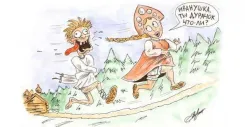
Lyova protested; he tried waving his arms, fussing about, objecting, all but crying. But Dina had simply gone mad. All the newspapers, receipts, paper, catalogues and other junk from the first room filled the first three fifty-litre bags, which were solemnly handed to Lyova to carry out to the bins. The dirty clothes went into another bag, the shoes into a third. Lyova was working himself into genuine hysterics. He could not save the plastic fruit trays he had meant to use for topographical models, nor a stack of old equipment. He pleaded that he had used the flat as a storeroom for years, tried spraying Dina and everything she was sorting through with his water bottle, clutched at his head, at his heart, at the surgical mask against the dust and at his head again. He stood up, sat down, ran round in circles and groaned, gasping and coughing from the dust, while Dina was entirely unmoved. His world was collapsing, irrevocably and beyond recall, and he did not know whether to rejoice or to weep. By the time the natural disaster named Dina reached the video cassettes, Lyova had already resigned himself and picked up and carried out the box of cassettes himself, without even sorting through what was inside, ignoring Dina's own protests.
On the first day they cleared two rooms and the kitchen. The second room was harder, since that was where Lyova actually lived. There the natural disaster took pity and sternly ordered Lyova to sort through the piles himself, or else she would move in there too. Meanwhile she cleared out the second room. On the fourth day they started on the living room, and got bogged down there for a full three days.
Dina was running out of steam. Instead of a holiday she had ended up with work she would never have agreed to before. What kept her going was the thought that she was working for her own future. At the same time it seemed to her that as she sorted out the mess in Lyova's flat she was sorting out the mess in her own head, and her own life was becoming clearer and easier to understand.
Lyova gazed in astonishment at his transformed flat. Dina had left too quickly for him to take any of it in. That is how a hurricane vanishes in an instant, leaving behind a ringing silence under the bluest of skies. And through that silence wandered a thoroughly lost Lyova and a thoroughly bewildered cat, shaved over a third of its body (Dina had tried to rid it of its matted fur too, but gave up when she realised that in cutting the fur she was cutting the cat's skin). His cough echoed through the emptied rooms, the walls gaped with scratches and cracks, and the furniture caught the eye with its complete lack of coordination. Even sitting at the computer was not what it had been.
Lyova looked glumly at the cracks in the walls, then went to a builders' merchant, bought everything he needed and filled them in — his time on a renovation crew had not been wasted after all. The flat began to seem even more alien and strange. So Lyova sat down at the computer again and looked up where he might send his CV.
Despite the temptation to tell the whole thing to go to hell, Dina stayed with Lyova. No, it was not all plain sailing. Lyova was superb at getting worked up in order to show off his cleverness, because he had studied something somewhere once and everyone else, Dina included, was wrong. Dina was superb at exploding about how she carried everything on her own shoulders, did everything, and if it were not for her… But for some reason neither of them could explain, they stayed together every time. Dina found it the most puzzling of all, since in her view Lyova regularly did everything, absolutely everything, wrong. Then again, she knew she was no picnic herself, and given how she sometimes drove him to white heat, she could not understand why he had not told her to get lost. Empirical science never did establish what Lyova was thinking at such moments, since we never managed to wheedle a definite answer out of him even with Dina's and my combined efforts. But Lyova, giving himself terrific airs about advising a very large mobile phone manufacturer, certainly did not look dissatisfied.
Counsellor’s commentary
Dina is the schizoid personality type. The basis of her personality type is the ideational, symbolic content of her inner world. There are far too many experiences and feelings, yet most of them never come out, are never let out as emotions. They are transformed into intricate ideational and symbolic structures, and only then made public. On top of that, Dina is characterised by an all-embracing, all-encompassing desire to realise her overvalued ideas, which often diverge from the real needs of the organism and the body, and by difficulty in expressing her own wishes. It is easier to say what she does not want, or why the thing she does want is necessary and indispensable.
The rigidity of her territorial and personal boundaries, the way she defends them, and a self-removal from society that borders on rejection of it and on haughtiness. She always emphasises her freedom and independence and her control over her own life. Schizoid women are often too self-sufficient, too independent, to settle into a relationship, and frequently only people like Lyova are able to take their antics more or less calmly.
Lyova is the frustration personality type. The basis of his personality is an inner prohibition on any quick, sudden, unconsidered start and on finishing, on achieving; he will keep putting the brakes on. Why start cleaning if it is a lost cause anyway, if there is still the renovation to come, and so on. He has a need for unhurriedness, for thinking through all his actions, since it is better not to do something important than to do it, better not to say something than to say it; and he has an aversion to formality, pomp and excessive strictness and seriousness. He does not trust logic, he learns through personal experience, and he has difficulty accepting the negative results of his actions and responsibility for his decisions. He is inclined to let deadlines slip and to fulfil agreements and arrangements late, or not at all.
Frustration men love humour, appreciate sarcasm and can join in a bit of sparring — or at least make grateful listeners. Lyova is inclined to savour life slowly, with a certain unhurried ease. And he develops a “lazy intrigue”, because Dina is quick and does not immediately notice that she has already been caught. That is how he charms her.
Schizoid women often experience a major inner conflict: “how on earth can anyone fall in love with this?” And between them there arises a feeling of closeness, a sense of contact, warmth, reliability, mutual understanding. She is charmed by how much he knows, how much he reasons things through, how he lives among his thoughts — a philosopher.
Schizoid women have a particular feature: their contact with their own fathers and with the father figure is very poor, and the need for a good father figure is there. As a rule, schizoid women transfer that need entirely onto the frustration man. And he, from his side, allows it to be projected onto him, yet does not see her as a little girl. And that wins her over.
He is hooked by her beauty, her intelligence, her ability to stir him up. She is active, she will not let him lie on the sofa, and he will be in demand. Both of them have difficulties with the body. Their meetings take place on the territory of the mind. It is intellect that hooks and excites them. She is hooked by a well-put question from him.
She is the one who takes the initiative. She delights and fascinates him. She is bright and strong. She has a wealth of feelings and experiences and events. She is someone you want to study. And he is potentially a good resource: clever, interesting, and if you work on him he will be splendid. She actively takes possession of him. Time and again he does not even realise he is already in a relationship. Every so often he discovers that his things have been moved, or that his territory has been settled, and that of the five shelves in his favourite cupboard only one is left to him. Attempts to rebel meet with completely illogical answers that leave no room for argument: “but don't you like it?” She cannot forgive him for doing nothing. He becomes more socially active and better adapted.