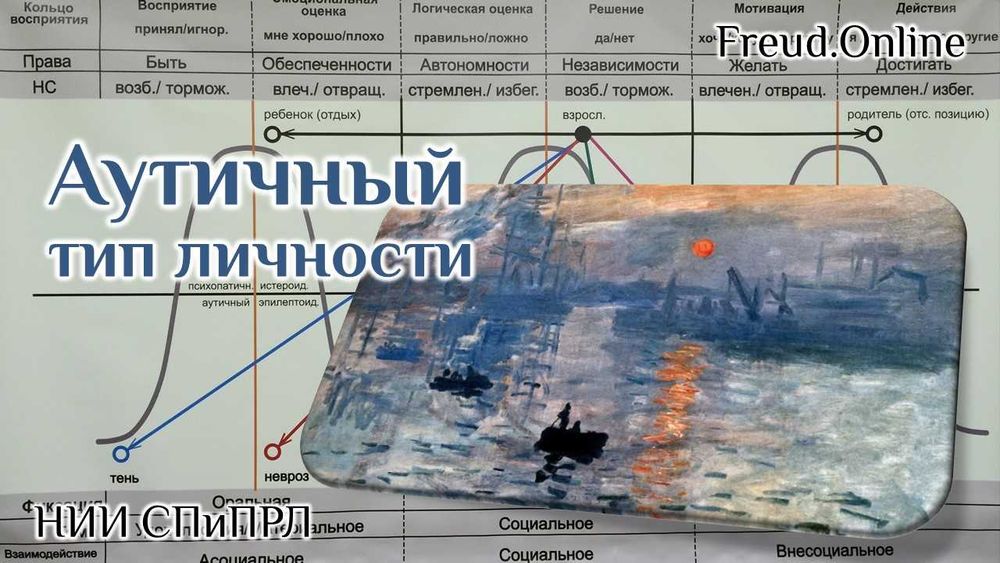
An underdeveloped, blurred sense of one's own presence in this world and of one's own boundaries (inner and outer). Difficulty defending one's territory; difficulty separating oneself, standing out, showing oneself against the background of other people and of the surroundings. Hypersensitivity, a heightened receptiveness to bodily sensations coming from the senses. The world consists of a stream of different bodily sensations. An obsessive need to single things out, to mark out clear gestalts (“good forms”), to complete them, to dot every i.

Disharmonious and Conflict-Prone Traits
- Dropping out of the world, withdrawing from social life, not showing themselves, being unremarkable
- Confluence, no line drawn between themselves and others, symbiosis (“everyone thinks, feels, sees and senses the way I do”).
- Excessive attention to trifles, a broken hierarchy of priorities (the big picture and the small detail are given equal weight).
- Demanding “quiet” for the senses (“stop shouting”, “turn off the light”, “don't touch me”).
- Insistently proving their right to satisfy their bodily needs freely (sensations are sacred).
- An obsessive need to shape their surroundings into a gestalt — including other people's surroundings (“nice and tidy”, “in unison”, “a finished picture”).
- A search for pleasant sensations (impatience).
- They easily pick up the mood of the person they are with, but find it hard to switch back to their own.
Harmonious Traits
- Sensitivity and receptiveness to outer sensory signals and to signals from the body.
- Care for other people's everyday needs.
- Freedom from stereotypes of perception. A new, fresh, unclouded view.
- Sincerity. Realism. Pragmatism.
- Precision. Reliability. Diligence. Neatness.
- Command of the finest nuances. A good memory for small things and details.
- An ability to see the gestalt, the completed structure, to feel the slightest deviation, falseness, break in unison or resonance. An interest in the parts of the whole.
- An ability to stay in the background, to work behind the curtain.
- They are content with little (in social terms).
Fears, Sources of Displeasure
- Broken agreements, broken promises, broken trust.
- Not being free to satisfy physical needs; getting no pleasure from life (in the form of sensations).
- Physical pain (waiting for it is worse than the fact of it), the pain threshold of the senses being exceeded (too bright, too loud, too strong and so on), bodily discomfort.
- Injustice, unfair punishment, slander.
- Missing or forgetting an important detail, a small thing — and therefore losing control of the situation; sudden, unplanned changes in the situation.
- Pointless fuss and hurry.
- Life itself — being, showing themselves, being noticeable and vivid.
- Looking intrusive, pushy or clingy, disturbing others by their presence, by their very existence in the world.
Sources of Pleasure
- A variety of pleasant sensations, bodily pleasures (food, a bath, tantra, dance, massage and so on).
- Having their need for a variety of sensations met.
- Equality of men and women, of races, ages, professions and so on.
- Being on top of every small detail.
- Good gestalts, completeness (it sounds right, it looks finished, every i is dotted).
- Thoughtfulness, convenience, an ergonomic space with nothing superfluous in it.
- Sincerity with those around them, depth in close relationships, the chance to trust another as they trust themselves, symbiosis.
- Playing an important, meaningful part while remaining outwardly invisible and unshown.
Careers (Comfortable, Self-Actualizing)
- Those who serve, in every form
- Any behind-the-scenes role (keeping processes running). Office managers. Facility managers.
- Anything to do with clients' physical comfort (massage, tea houses, catering and so on)
- Energy healing (Reiki and the like)
- Mediums (picking up subtle vibrations).
- Designers (whole, finished, convenient forms).
- Masterly command of the body and its sensations (singers, dancers, mime artists and so on).
Games – Roles – Manipulations
- “I don't trust you, you have lost my trust.”
- “There is no place for me here, this is not my home.”
- “Life is meaningless if I cannot meet all my needs.”
- “Everything will fall apart without me. I am irreplaceable.”
- “Stop shouting!” (“you are too loud, too smelly, too bright, too rude and so on”).
- “I have a good memory for facts! I remember everything exactly. It was nothing like that. Why are you making things up?!”
Appearance
A finished look; a muted, unremarkable style that draws no attention and is, above all, comfortable for the body
Motor Activity
Soft-footed, unobtrusive (filling the gaps between people in an attempt to slip past them unnoticed), modest
Personality Development (Paths)
- Developing trust in themselves and in people, and especially bodily trust (through sensations).
- Letting go, relaxing, allowing what is to be.
- Developing a sense of their own boundaries and their own territory, and the ability to mark it out, put it into words, protect it and stand up for it.
- Giving up excessive responsibility (hyper-responsibility — “this is my job, my task, and that one is already somebody else's”).
- Developing the ability to express themselves (including on the emotional level), to mark their presence in this world, not to be embarrassed about being there and being noticed.