Long, long ago, in stern patriarchal times, when women went about in long skirts, people rode to their business on horseback or in carriages and all food was organic because you had to grow it yourself, life was harder. There were no single-mother benefits, no maternity payments, no pension savings, no decent medicine and none of the many other pleasant features of modern life. People had to survive, and together that was far easier than apart. To provide at least some sort of social guarantee, the institution of marriage was created and fairly strictly regulated, and spouses were as a rule chosen by the parents, who took into account their own experience, the reputation and property of the families and other useful factors. Love was a rarity and belonged rather to fairy tales and novels.
Background: The stories are published from the feedback we received and with our clients’ consent. The names have been deliberately changed. At the end you will find a counsellor’s commentary analysing the relationship.
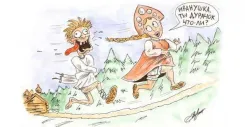
Skip to the counsellor’s commentaryThink about it yourself: how can a prince fall in love with a princess he has saved from a dragon, a sorcerer or a curse if he has never even seen her before? And the princess? Her family had already said goodbye to her in their minds, her reputation was thoroughly ruined by that same sorcerer or dragon — who knows what she got up to in captivity — and here comes a thug of no obvious intellect who has managed to fell an actual dragon with a couple of bits of ironmongery and is ready to save her honour. Hardly the moment for love, sweets and flowers. It is only logical!
And what about now? Utter chaos in the search for, and the expectation of, some sort of feelings, emotions, butterflies in the stomach... Then sex, as if nothing in the world mattered more. And theatrical, noisy break-ups with accusations that it was all only for the sex, that there was no love, and that women are bitches and men are swine anyway. And all the while everybody is looking for their perfect prince or princess. Otherwise why do they keep making films about how an ordinary girl married a prince and how hard it was for her to learn court etiquette, and how in the end a mad, blind love conquered every obstacle.

Rita simply could not see how it was possible to be incapable of learning a set of given rules. Now, mixing paints and putting them on canvas — that is understandable, there are no general rules there. Writing poetry, likewise; there are rules, of course, they even teach them at school, but sooner or later you have to go beyond them. No, Rita had never planned to marry a prince, and she did not much believe in the “great and pure” either — she believed in what a person can achieve on their own: building up contacts, reaching a certain standing in society, earning a reputation. And it was precisely those goals, the ones she really could influence, that Rita did everything in her power to reach. As for love... Respect and mutual understanding were decidedly more important, and given a reasonable man all of that could be sorted out. In the meantime she could do what depended on her alone: reach the social standard and the level at which she would be able to meet men who suited her. With a degree in economics and a job as an estate agent — a prestigious one, preferably — all that was left to her was to keep to the appropriate rules of etiquette.
Rita kept to it, choosing good clothes and shoes with care and making sure that both her make-up and her hair were in perfect order. She watched her speech and was fanatical about making sure that nobody could accuse her of not keeping her word. And yet the contacts were built up, as they say, by unstinting toil, even in an industry as “high-status” as property. But Rita did not give up, allowing herself coffee in luxury coffee houses and dinners in very respectable restaurants over something to read. That was how she reminded herself what she was trying so hard for.
Turning a page of her magazine thoughtfully, Rita stretched and... quite accidentally knocked the tray out of the hand of a waiter passing by. A latte, served in a beautiful branded cup, splashed no less beautifully over the young man sitting at the next table.
— “Oh, God!” Rita blurted out, realising a moment too late that this probably sounded rather too theatrical. But the moment the young man turned round, Rita could not hold back a second “Oh, God!”
The young man really was divine. Regular features, two or three grey strands proudly and worthily setting off his temples, a bold, open gaze; a suit that hardly looked expensive sat on him not merely perfectly but as though he had been made to measure for it, and his charisma... It seemed that this was how a man who owned the whole world ought to carry himself. A little Olympian godling who had condescended to taste the coffee in one of the best coffee houses in their city. And Rita had tipped a latte over him!
The godling, however, reacted with truly Olympian calm, even with humour. Rita did not notice how she was drawn into the conversation, and before long they were talking as though they had known each other for years. Pyotr taught economics at a large university and was a visiting lecturer at several private universities and academies besides. He travelled to conferences in different countries with the greatest of pleasure and spoke fluent English and German. He seemed to be at home only to change his clothes and sleep.
The first conversation was followed by a first date, and the first by a second and by all the rest. It was a beautiful and very well-considered courtship. They went to places Rita had never known, although she had thought she knew the city well. What amazed her most was that everybody recognised Pyotr and greeted him with delight. Whatever shop or café they walked into, this ordinary lecturer was recognised; people smiled at him, exchanged news or jokes. What Rita had been struggling at fruitlessly for years came to him without any particular effort. And what a pleasure it was when he introduced her:
— “And this is Rita, my girlfriend. A first-class estate agent, by the way, if anybody ever needs one.”
And people would immediately remember that yes, the great-uncle of the second cousin of their brother’s wife had needed something exactly like that quite recently, and the other agent had turned out to be a rare crook, so at the first opportunity and in general it would be Rita and nobody else. Advertising like that would have taken her years to earn, and it seemed to cost him nothing at all.

It was probably not the kind of love you get in women’s novels, where the hormones go off the scale and you think of nothing but your feelings. Rita had never understood that sort of thing either. But that he was the best man of all those she had gone out with she was certain; that was shown by a whole set of markers she had worked out for herself over years of experience: the absence of neuroses, his reputation, the kind of friends he had, their reaction to her, the way he behaved with his parents and a number of others. She had always striven to have only the very best, and he was exactly that. So yes, you could say that she had come to love him, but in her own way, calmly and dependably.
She analysed the situation fairly quickly and knew precisely what she could give in this relationship and which part of it Pyotr needed. She had to be that girl from high society, the best, the cleverest and the most beautiful — but not one who eclipsed her man. Setting him off, rather. Enriching the figure he cut.
Perhaps it was slightly overdone, but it worked. Wherever they went, they were the finest couple, the most stylish and the most dazzling. They were the model and the ideal of how it ought to be done. Always together, always helping each other, always of one mind and loudly praising each other in front of friends. And they did not have to dissemble in the slightest. They both sincerely did everything they could to keep both the image and the reputation of their family intact, understanding perfectly well that any Potemkin village will sooner or later be blown away by the wind or washed away by the rain. Their own union had to be not merely good-looking but genuinely good.
Not everybody believed them. Many of his friends joked about when their honeymoon would finally be over, when they would finally fall out, when they would start telling each other off. Rita and Pyotr merely smiled and went on being the ideal, dwellers on high who stood above all earthly disagreements.
— “But what about love?” marvelled Rita’s sister Oksana.
— “And what is love?” Rita would ask mockingly.
— “Well, love!!!” Oksana would flutter her eyelashes. “When feelings and emotions sweep over you — and here you are like a robot, except that now, on top of property, you have family duties to perform as well!”
— “I don’t mind it.”
— “Nobody minds it, and then one day they pick up an enormous butcher’s knife or a chainsaw...”
— “...And chase their overly curious sisters round and round the mulberry bush.”
— “Well, you know...” Oksana would sigh, offended. “I, for one, dream of real love, the kind that knocks you off your feet and lifts you into the skies! Not the sort you have, a marriage of convenience!”
At first that “marriage of convenience” stung Rita. But then, on mature reflection, it was precisely that kind of shared calculation that turned out to be the only right option. Rita knew exactly what held them together, and that something was far stronger and far more reliable than Oksana’s “love that knocks you off your feet”. Of course, nothing in the modern world could guarantee a union in the style of “till death do us part”. Only the absence of divorce as an institution could guarantee that. But a logical, realistic view of life, of marriage and of relationships is already a very good start.
Counsellor’s commentary
Rita is the manic personality type. These are introverts with an active life position who are guided by logic. She has her own fixed beliefs and principles, together with the notion of herself as the sole bearer of the truth. At the same time there is the notion that the idea stands above the person, and service to that idea. In order to find that truth of their own, manic types will go into a subject quite deeply and study a great deal, but their conclusions and results will nonetheless be largely “black and white”. One of Rita’s fundamental Ideas is reaching a certain social status, and her activity is built around that idea.
Pyotr is the narcissistic personality type, an active extravert. The basis of his personality is the drive to be the best and to arouse admiration in those around him. He will always strive not to be like everybody else, to stand out, sometimes even to behave provocatively, playing to the gallery. People of this type need “admirers”, but even with a crowd gathered around them they will feel lonely, separate from it, better than it. For people of the narcissistic personality type it matters that everything should be beautiful, but this beauty is expressed in everything coming together beautifully: their image and their role, their reputation, their affairs, their adventures and hobbies. You could say that Pyotr had been developing the skills of being liked and of finding a way to people since childhood, managing to be the life and soul of almost any gathering. What many find difficult is his natural state — sizing people up, finding a way to them, selling both himself and his skills.
Rita and Pyotr are both active personality types. That means that in order to coexist peacefully they have to find compromises every day and “decide” who is going to be the passive one today. At the same time it is important to both of them to realise themselves in society; in couples like this it is normal for both to contribute something to the family budget. And of the three “pillars” of a relationship — closeness, sex and partnership — their relationship is built precisely on closeness, on understanding and feeling each other.
By and large, a manic woman herself wants to be like the narcissistic ones, and periodically tries to live up to the female dress code. Most manic women strive to obtain the very best. They do it through the social standard. It matters to narcissistic types as well, and that is where they meet. She has a sense that he will bring her out into society, a sense that he belongs to the bohemians. She lacks company of that kind, and he is able to provide it. For her part, with manic persistence and thoroughness she will support his image and his reputation, will accept the game and add depth to it.